

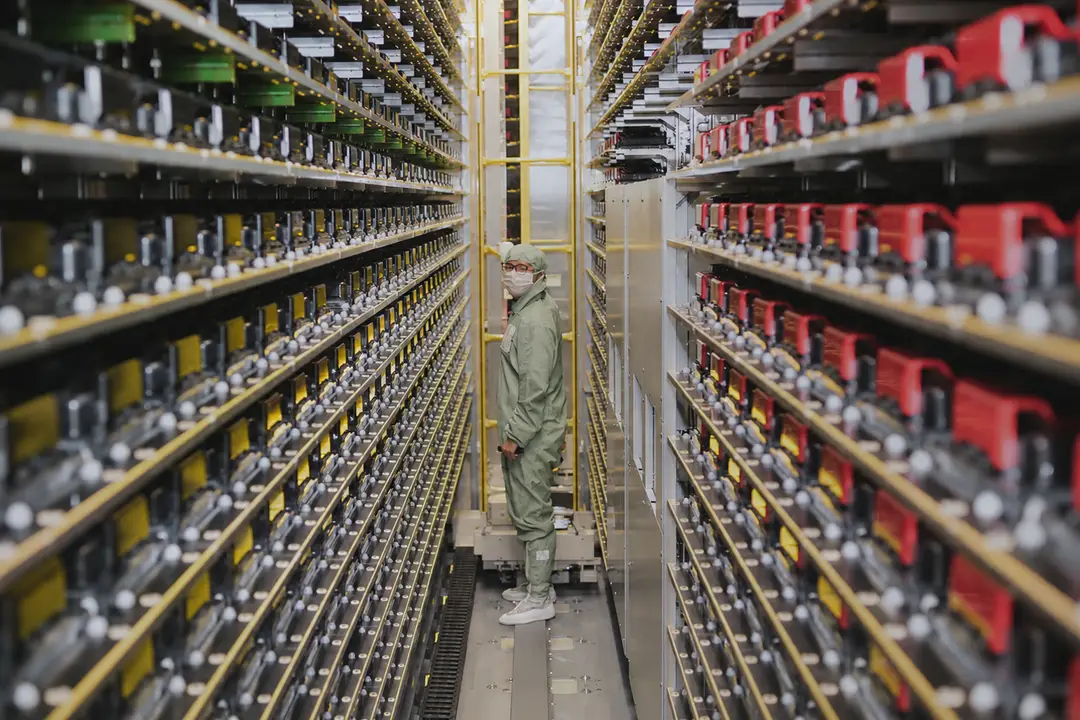
China’s largest contract chipmaker, which is narrowing the gap with Samsung on a global level, benefited from AI and domestic substitution despite weak smartphone markets.
By Da Cheung
China’s largest contract chipmaker is proving that a semiconductor company does not need a monopoly on cutting-edge AI processors to cash in on the global AI boom.
Semiconductor Manufacturing International Corp. (SMIC) (0981.HK) (688981.SH) reported record third-quarter revenue of $3.19 billion on Nov. 12, a 6.1% quarter-on-quarter increase, topping both market expectations and the company’s own guidance. The jump was driven by record shipments which exceeded 3.03 million 8-inch equivalent wafers — the standard silicon discs on which chips are etched — pushing factory utilization to near-full capacity at 97.3%.
In the capital-intensive chip manufacturing business, where expensive machinery depreciates on the books whether it is in operation or sitting idle, running factories at full tilt dramatically lowers the cost per chip. That high utilization helped lift SMIC’s gross margin by 4.6 percentage points from the second quarter to 29.9%, the highest since late 2022.
Net profit attributable to shareholders under IFRS fell 10.6% quarter on quarter to $428.4 million partly reflecting lower fair-value gains on equity investments. On a year-on-year basis it rose 123.4%. Separately, net profit excluding non-recurring gains and losses, calculated under Chinese accounting standards, net profit jumped 107.3% from a year earlier to 2.64 billion yuan (approximately $396 million).
However, company management and independent analysts disagree on how much pricing power really contributed to the quarter’s performance. SMIC Co-CEO Zhao Haijun said in an earnings briefing that blended wafer average selling prices rose 1.8% sequentially due to previously negotiated price adjustments and a shift toward higher-value products. By contrast, research firm Dolphin Research calculated that the blended average price per wafer rose just 0.4% to $1,052, arguing that lower unit production costs accounted for 4.3 percentage points of the 4.6-point gross margin expansion, while pricing contributed less than 0.3 percentage points.
AI spillover offsets a smartphone slump
Behind SMIC’s fully utilized production lines lies a structural shift in global semiconductor supply chains. As industry leaders TSMC and Samsung Electronics dedicate their newest capacity to ultra-advanced AI processors under 7 nanometers, production capacity for older, mature chipmaking technologies has been squeezed.
Yet AI data centers require more than just primary graphics processing units. They also rely heavily on supporting components — such as power management chips, specialty memory, and controllers — that are built using mature manufacturing processes. Those orders are spilling over to foundries like SMIC. Zhao told investors that customer demand for these supporting chips for AI infrastructure grew faster than expected in the third quarter.
This spillover, combined with Beijing’s push to replace foreign technology with domestic alternatives, helped SMIC weather a sluggish consumer market. Third-quarter wafer revenue from computers and tablets, as well as industrial and automotive clients, each jumped 26% from the second quarter. Meanwhile, revenue from smartphone and consumer electronics fell 8% and 1% respectively from the previous three months.
That pullback reflects broader weakness in China’s handset market. According to data from Omdia, mainland China smartphone shipments fell 12% year-on-year in the third quarter to 59.3 million units — the lowest third-quarter total since 2013 — with Huaweiand Apple being the only top-five brands to post growth.
At the same time, SMIC is becoming increasingly reliant on its home market. Chinese customers accounted for 90.8% of total revenue in the third quarter, up from 86.2% a year earlier, while the U.S.’ share shrank to 7.8%.
Closing the global gap under tech constraints
The influx of domestic and mature-node orders has propelled SMIC closer than ever to the global foundry industry’s top tier. According to second-quarter 2026 revenue data from TrendForce, SMIC ranks as the world’s third-largest contract chipmaker with a 5.4% market share. That puts it ahead of second-tier rivals United Microelectronics Corp. (UMC) at 3.9% and GlobalFoundries at 3.2%, and just half a percentage point behind second-place Samsung at 5.9%. TSMC remains dominant with 72.5%.
Unlike UMC and GlobalFoundries, SMIC is still attempting to push into advanced chipmaking despite being unable to obtain ASML’s extreme ultraviolet (EUV) lithography systems because of export restrictions imposed by the Netherlands amid U.S.-led efforts to limit China’s access to the most advanced chipmaking technology. According to Dolphin Research, SMIC relies primarily on older deep ultraviolet (DUV) equipment and “multi-patterning” — a technique that etches a circuit pattern in multiple overlapping steps — to advance its internal N+1, N+2, and N+3 manufacturing processes.
Third-party teardowns cited by the research firm suggest that SMIC’s N+3 process achieves a transistor density near 115 million transistors per square millimeter, and its next-generation N+4 node is expected to approach the density of TSMC’s 5-nanometer technology. However, relying exclusively on DUV multi-patterning requires more complex photomasks, driving up manufacturing costs and making it harder to ramp up production yields — the percentage of working chips per wafer.
Looking to the fourth quarter, which is traditionally a slow season for the chip industry, SMIC expects revenue to grow another 4% to 6% sequentially, putting full-year 2026 revenue on track to surpass $12 billion, up nearly 30% on 2025, according to the company.
Still, profitability faces near-term headwinds. SMIC guided fourth-quarter gross margins down to a range of 26% to 28%. According to the company, the projected dip stems from rising raw material and depreciation costs, alongside the resumption of research and development test runs that were scaled back in the third quarter to meet urgent customer orders.
Capacity expansion may also face bottlenecks. SMIC’s third-quarter capital expenditure dropped to 7.42 billion yuan from 12.57 billion yuan in the second quarter. While Zhao noted that this year’s expansion plans remain on track, he warned that tight global equipment supply chains, longer delivery lead times and uncertainty over some equipment deliveries could disrupt capital expenditure execution in 2027.
Feature photo: SMIC lab by SMIC, edited by The Insight Asia.
Sources