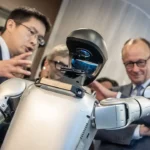


The chairman of TSMC has criticised what he described as a focus on visually impressive but impractical robotics, arguing that real value lies in systems built around sensors, data and computing reliability.
Speaking at the 25th anniversary celebration of Asia University on March 21, when he was awarded an honorary doctorate, C.C. Wei said companies in mainland China were producing robots that dance around, but lack practical usefulness, describing them as “good to watch, but not useful”.
Wei said truly useful robots require a vast array of sensors and data to allow their “brain” to function effectively and provide services. “Currently, 95% of the world’s robot brains are manufactured by TSMC because the reliability of a robot cannot be overlooked,” he said.
He also disclosed that TSMC is pushing forward with an “Everything AI” strategy and has entered the 2-nanometre process stage, with the aim of increasing AI computing power by around 100 times over the next 20 years.
Where a robot’s value really lies
His remarks suggest that many current robot demonstrations remain at the performance level and lack real-world usability. He emphasized that a robot’s value lies not in the movements themselves, but in the coordinated capabilities of sensors, data and processing.
His comments also highlight a core contradiction in the robotics industry: while computing power has advanced rapidly, system efficiency and practical usability have severely lagged behind.
Current robot systems remain structured around a “heavy brain, light system” model, relying heavily on centralised computing and external commands which leads to delays in response and low coordination efficiency.
In industrial scenarios, such an architecture makes it difficult for robots to adapt to high-frequency, real-time and multi-task environments, often requiring frequent human intervention which limits large-scale deployment.
To compensate for this shortcoming, the industry has generally pursued the path of stacking computing power, using larger models and higher levels of processing to improve prediction. However, this approach places excessive emphasis on computing resources while neglecting communication links and control architecture, the commentary said.
Laboratory success vs real-world failure
Industry estimates suggest that in complex collaborative tasks, a significant portion of computing power is consumed not by decision-making itself, but by latency correction and status synchronisation. This causes resource waste and increased system complexity, ultimately leading to structural problems in which robots perform well in laboratory settings and demonstrations, but face difficulties in real-world production environments.
A potential solution to this involves making comparisons with the human nervous system. Rather than relying solely on the brain, human intelligence operates through coordinated layers including central processing, transmission pathways and peripheral systems.
In this structure, high-speed neural transmission enables real-time feedback, while local neural circuits handle lower-level tasks, allowing higher-level cognition to focus on key decisions. This significantly reduces dependence on the brain’s central computing power while ensuring the system’s real-time responsiveness and reliability.
The implication is that if information transmission in robot systems can achieve sufficiently low latency and high reliability, the need for centralised computing power could be significantly reduced.
Based on this approach, Chinese companies including ZTE have begun to restructure embodied intelligence systems into three layers — a central “neural hub”, nerve pathways and nerve endings — optimizing communication links and distributed processing capabilities to achieve pathway speed-up and computing load reduction.
This shift from a computing power-driven to a system-driven approach, is seen as a potential path for moving robotics from demonstrations to industrial-grade applications