
The company’s latest AI accelerator strengthens an existing full-stack strategy as Chinese technology companies seek to reduce reliance on Nvidia.
Alibaba (9988.HK) (BABA.US) has unveiled a new AI accelerator that it says is three times as powerful as its predecessor, as China’s technology companies intensify efforts to build alternatives to Nvidia’s AI computing infrastructure.
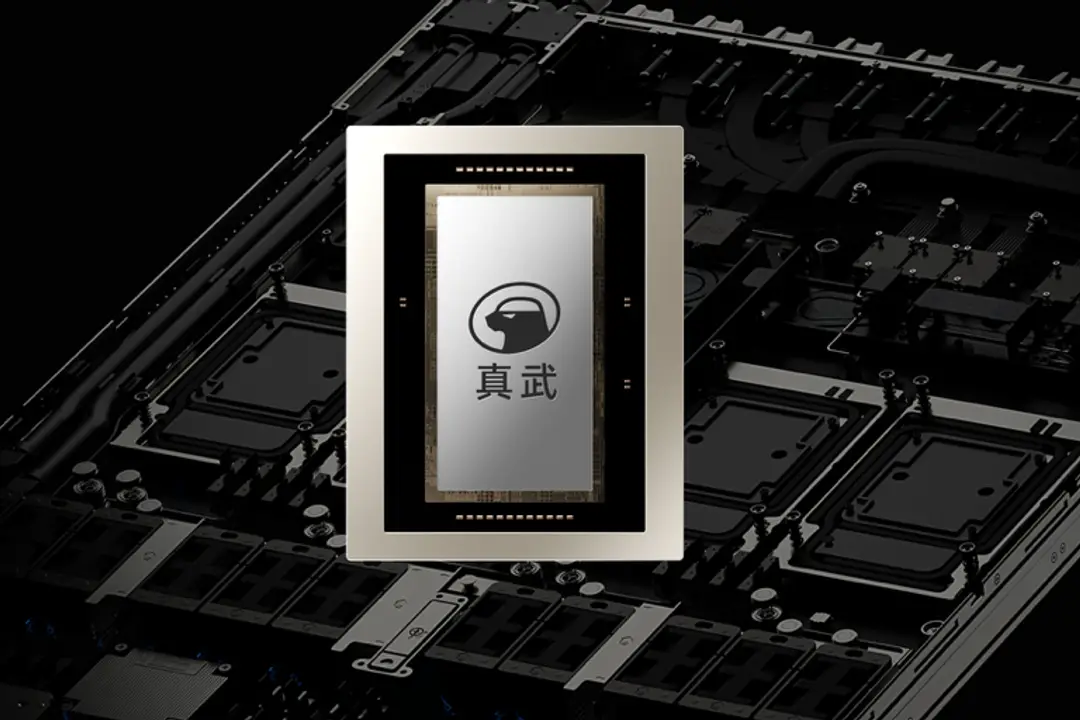
T-Head, the group’s semiconductor subsidiary, launched the Zhenwu V900 at the company’s annual Apsara conference in Hangzhou on Sept. 22. Alibaba says the chip is designed for both AI training and inference, has 216 gigabytes of memory and 1,200 gigabytes per second of inter-chip bandwidth. It is scheduled to enter mass production in the first quarter of 2027.
Alibaba describes the V900 as China’s most powerful domestically developed AI chip, although that ranking has not been independently verified. The chip is designed to handle the training and inference of models with trillions of parameters. The company’s claim that it delivers three times the performance of the previous-generation Zhenwu M890 has also not been independently benchmarked.
Building beyond the chip
The significance of the announcement lies less in the headline performance claim than in how Alibaba is positioning the chip within a broader computing system.
Alibaba has been developing a vertically integrated AI infrastructure strategy for years. Its Zhenwu accelerators are being developed alongside Yitian server CPUs, ICN interconnect chips, Panmai networking chips and Zhenyue storage controllers, while Alibaba Cloud provides the data-center and cloud infrastructure and the Qwen family provides the company’s own AI models.
The V900 therefore does not suddenly make Alibaba a vertically integrated AI infrastructure company. Instead, it is the latest and more powerful component in a strategy that was already taking shape.
The company began scaling that approach with the M890, introduced in May. Alibaba said then that more than 560,000 Zhenwu chips had been shipped to more than 400 customers across more than 20 industries. It also introduced a server system combining 128 M890 accelerators with its own networking technology.
Alibaba said in August that its own chips were already being deployed at scale in its data centers and that replacing commercially purchased chips with proprietary silicon could eventually improve margins. Its AI cloud and computing revenue rose 45% year on year to 48.44 billion yuan in the June quarter.
That gives the chip strategy a commercial rationale as well as a technological one: Alibaba wants to use its own hardware to power the cloud and AI services it sells to customers.
Why interconnect matters
Perhaps the more consequential part of the announcement isn’t the chip itself but how it connects. For trillion-parameter models, raw chip speed is only part of the equation: thousands of chips must also work together efficiently.
T-Head says the V900 addresses this through its ICN Switch interconnect chip. When linked together into what the company calls a “supernode,” the V900s gain native memory semantics and unified memory addressing, allowing more than 1,000 chips to operate as a single logical “superchip.” The result, according to T-Head, is high-throughput, low-latency, high-concurrency computing suitable for the largest models.
Packing the V900 alongside the ICN Switch, Panmai smart network cards, and Zhenyue SSD controllers coordinates compute, storage, and networking at the system level rather than stitched together after the fact. Through Alibaba Cloud’s redesigned intelligent computing network architecture, the company claims a single cluster can scale to 500,000 cards, although that figure should be treated as a stated scalability capability rather than evidence Alibaba has deployed a 500,000-accelerator system.
The underlying strategy is nevertheless significant. Rather than attempting simply to produce a Chinese equivalent of an Nvidia accelerator, Alibaba is developing the surrounding components as well and optimizing them for use together.
That resembles the broader strategy that has made Nvidia’s position difficult to replicate: high-performance accelerators are only one part of a computing platform that also depends on interconnects, networking, software and systems engineering.
China’s Nvidia problem
The announcement comes as U.S. export restrictions continue to limit Chinese access to the most advanced AI chips from Nvidia, increasing the incentive for Chinese companies to develop domestic alternatives. Huawei is pursuing its own accelerator and interconnect systems, while Alibaba, Cambricon (688256.SH) and other Chinese companies are also developing AI hardware.
The result is not necessarily a single Chinese rival to Nvidia, but an increasingly broad domestic ecosystem in which companies are trying to control more of the technology required to build and operate large AI systems.
Alibaba has substantial commercial reasons to pursue that goal. The company has committed to investing 380 billion yuan ($56.7 billion) in AI and cloud infrastructure over three years and has said its AI computing investments could be recovered within three years at current margins.
It is also expanding its ambitions at the model and infrastructure levels. At the Apsara conference, Alibaba said it was developing a new Qwen model with 5 trillion to 10 trillion parameters and aims to increase Alibaba Cloud’s global data-center capacity to more than 20 gigawatts by 2032.
The V900 is therefore best understood as one part of a much larger bet: that Alibaba can use proprietary silicon, infrastructure, cloud services and AI models to build a self-reinforcing computing business with less reliance on foreign hardware.
It is significant as a signal — of China’s self-sufficiency ambitions, of Alibaba’s vertical integration strategy, and of how seriously the company is treating the AI infrastructure race. But the real test comes in 2027, when the chips are supposed to ship and independent eyes can judge whether the promises hold up. Until then, it’s a compelling story told by the company that stands to benefit most from it being believed.
Source:
IC Smart
Additional reporting by The Insight Asia