

By Da Cheung
Chinese companies developing brain-computer interface (BCI) systems are witnessing a surge in fundraising this year, in what industry insiders are calling a watershed moment for a technology that promises to seamlessly connect human minds to external machines.
In the first three months of 2026, some 80 Chinese BCI companies raised a total of around 3.8 billion yuan ($560 million) across 17 deals — more than double the 1.45 billion yuan raised in all of 2025, according to an April report from Beijing’s Fourth Wave Technology Think Tank.
A BCI is a system that translates neural signals into commands capable of controlling external software or hardware — such as a computer, a robotic limb, or a wheelchair. Long relegated to science fiction and laboratory experiments, the industry is witnessing unprecedented momentum, driven by government support.
A national venture capital fund launched in December 2025 and funded by treasury bonds listed BCI as one of seven key investment areas alongside artificial intelligence and quantum technology. The technology was, for the first time, included in this year’s government work report to lawmakers, highlighting it as a strategic industry to be supported.
Pioneering products and global momentum
The year’s catalytic event occurred in mid-March, when China’s National Medical Products Administration approved the commercial use of the world’s first implantable BCI medical device. Developed by Shanghai-based Neuracle Technology, also known as Borui Kang Medical Technology, the device is designed to restore hand-movement capabilities in individuals suffering from severe spinal cord injuries.
Rather than penetrating the brain tissue directly, the device uses electrodes placed outside the protective membrane to decode signals and trigger a pneumatic glove, restoring the patient’s ability to grasp objects, according to the company. Neuracle says it has already launched clinical training at top-tier Chinese hospitals to pave the way for widespread medical application.
Globally, the competition to commercialize BCI devices is accelerating. In late May, Elon Musk’s Neuralink revealed its next-generation surgical robot. While Neuracle’s device aims to restore movement to the patient’s own hand via a less invasive implant, Neuralink focuses on using thought to control robotic arms or computers. The company says its new model features a smaller implant arm equipped with advanced sensors and moves along five axes, allowing it to insert flexible threads directly into brain tissue. Swiss neurotechnology firm Neurosoft Bioelectronics recently raised $7.5 million to advance its BCI implants toward human deployment and commercialization in the U.S. market, aiming to build a neural data foundation model of the human cortex.
Although traditional BCIs are based on electrodes, new technological pathways are gaining traction. The most prominent is ultrasound BCI, a non-invasive technique that monitors blood flow changes associated with brain activity, and can also utilize sound waves to modulate targeted neural circuits. In January U.S. startup Merge Labs secured a $250 million investment from OpenAI, indicating intensified competition with Neuralink and signaling a major bet on non-invasive ultrasound BCI over surgical implants.
The same month, ultrasound-based non-invasive BCI developer Gestala Technology was formally launched. Within two months, the Chengdu-based company had raised 150 million yuan in an angel round financing, a record for the largest angel round in China’s BCI sector.
Beyond healthcare: embodied AI and global expansion
As clinical medical devices make steady progress, BCI companies are simultaneously pushing the boundaries of consumer technology and robotics — often described as embodied AI, where artificial intelligence interacts with the physical world through robotic bodies.
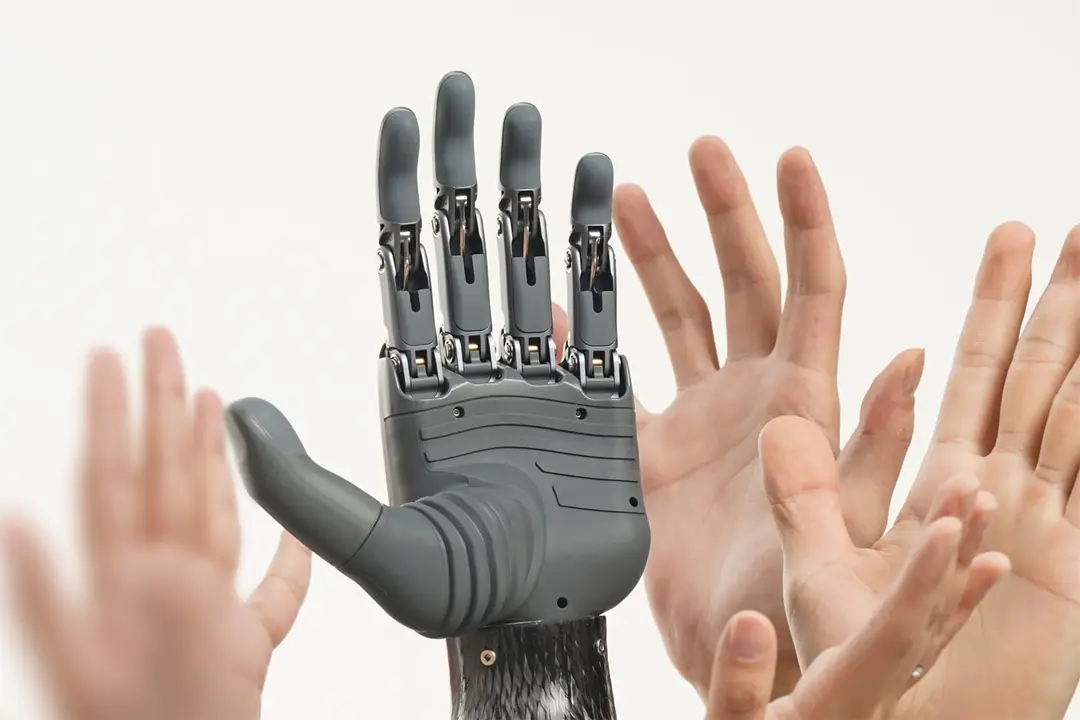
Hangzhou-based BrainCo, a non-invasive BCI company that gained global recognition for its neural-controlled prosthetic hands for amputees, has significantly broadened its ambition. It recently introduced the Revo 3, a robotic bionic hand boasting 21 degrees of freedom — enough to replicate most natural hand movements with impressive precision — an impressive grip strength of 70 Newtons, and advanced tactile feedback. Instead of limiting its technology to human prosthetics, BrainCo says it is extending its advanced bionic hands to humanoid robots. Founder Han Bicheng was quoted by Kechuang Daily as saying that BCI is ultimately about reshaping the relationship between humans and machines, with the goal of creating a “super assistant” that intimately understands human intent and emotions.
Chinese BCI technology is actively pushing into international markets. Earlier this month, Shanghai-based OYMotion Technologies announced a strategic partnership with Thailand’s telecom giant True Corporation to develop customized neural rehabilitation solutions. Leveraging 5G networks and AI, the partnership aims to conduct clinical trials in top Thai hospitals and bring smart, localized stroke recovery and prosthetic technologies to Thailand, with plans to scale across Southeast Asia.
A boom built on hype or reality?
While funding is skyrocketing industry analysts are advising caution. The current wave of capital is highly concentrated on a few top players and many heavily funded startups are trading on distant possibilities rather than near-term commercial viability.
Restoring vision to the blind, often referred to as the Mount Everest of the BCI industry, perfectly illustrates the tension between immense promise and grueling timelines. In late 2025, Chinese startup Mindtrix achieved what it claims is a global-first functional interactive validation of visual reconstruction for complex shapes and colors. However, the company projects that an actual product will not hit the market until 2030. Hangzhou-headquartered Nanochap Electronics spent seven years simply completing the technical type testing for its cortical implant of a visual reconstruction product. Because the field had no prior standards, the team had to build evaluation metrics from scratch.
Despite these sobering realities, some analysts are touting 2026 as the year China’s BCI industry steps out of the lab and into the crucible of clinical and market validation. With firm policy backing, an agile manufacturing base, and unparalleled capital inflows, brain-computer interface is no longer a science fiction fantasy — though its path to becoming a ubiquitous commercial reality will be a long and winding road.
Feature photo: Bionic hand from BrainCo
Sources: