

By Da Cheung
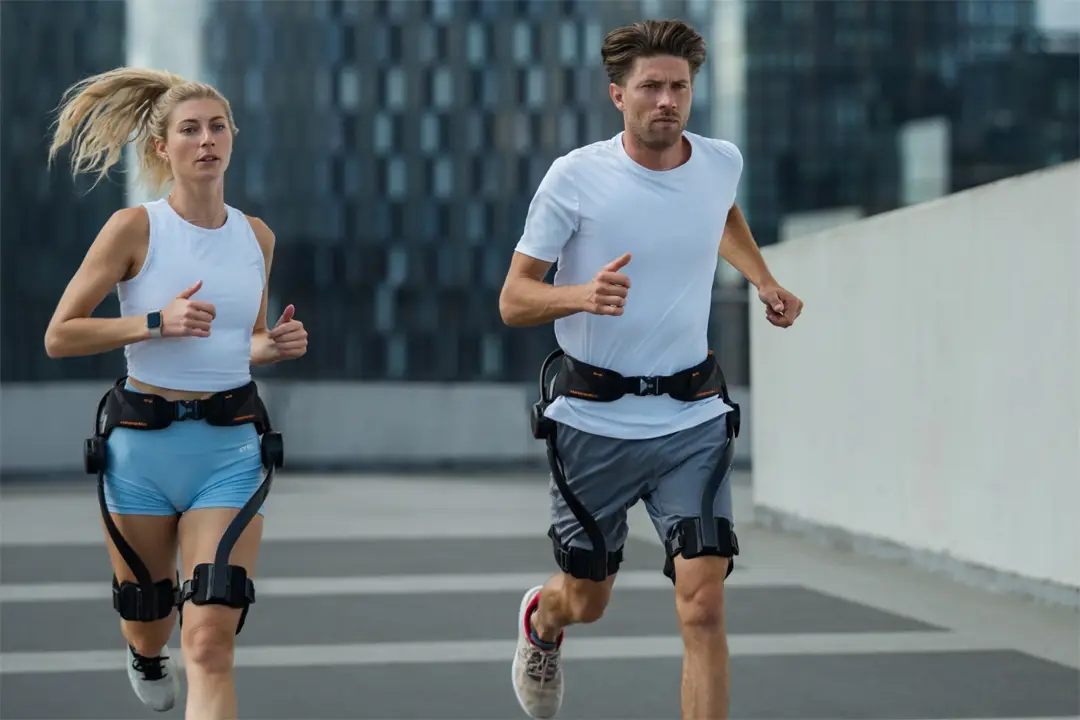
Exoskeletons — once clunky medical devices restricted to rehabilitation centers or science fiction staples — are steadily becoming everyday gear for outdoor adventure and urban commuting. Yesterday, wearable robotics startup Hypershell unveiled its new X series of consumer exoskeletons.
Earlier this week, the Shanghai-based company announced the completion of a $50 million B+ funding round led by Chinese tech giants Ant Group and Meituan (through its VC arm Dragon Ball), with participation from Belgium-based PE firm Sofina and Singapore-based Granite Asia. This brings its total Series B funding to $120 million. With global sales already hitting tens of thousands across more than 70 countries, the company currently claims the top spot globally in the consumer exoskeleton market, transforming a niche concept into a rapidly commercializing tech sector.

AI as an external cerebellum
How did a once prohibitively expensive medical tool become accessible to hikers, cyclers and workers? According to the company, the breakthrough came from replacing heavy traditional machinery with intelligent software, reducing manufacturing complexity while boosting adaptability.
Hypershell uses an algorithm named HyperIntuition, creating what the company refers to as an “end-to-end” AI control system. In the context of modern robotics, an end-to-end AI framework means a system takes raw data — such as terrain shifts, foot speed, or human balance — and maps it directly to a physical action without relying on manually coded intermediate steps. This enables the machine to predict the user’s intent and synchronize instinctively with their gait.
In an interview with Late Post, founder Sun Kuan said the product design philosophy strictly limited manual controls to push engineers to maximize the software’s capability. Instead of relying on numerous buttons or complex mode settings, the system uses only a single power button. It relies almost entirely on AI to recognize the wearer’s pace, stride, and fatigue levels, effectively acting as an “external cerebellum” — the part of the brain that helps coordinate movement and balance.
From hiking trails to disaster zones
When the company first launched, it faced deep skepticism from venture capitalists who questioned the mainstream need for exoskeletons. To bypass the clinical stigma associated with medical devices, the startup actively pursued hardcore outdoor enthusiasts first, fostering a “cool” image before expanding its target demographic. Priced competitively for a consumer electronics market, the new X series ranges from 6,999 yuan (around $970) for a lightweight commuter model to 13,999 yuan for the high-end flagship model.
The hardware itself is designed for endurance. The flagship model features 3D-printed titanium alloy and carbon fiber components, a maximum output of 1,000W, and up to a 30-kilometer range per battery. This rugged construction has allowed the product to find varied and sometimes extreme real-world applications. Professional mountaineers are now using the product to assist their expeditions in the treacherous environment of Mount Everest.
At the same time, the exoskeletons have proven highly applicable to emergency response and daily labor. During a residential fire in Hong Kong at the end of 2025, firefighters relied on Hypershell’s exoskeletons to repeatedly climb 30 stories while carrying rescue materials weighing up to 90 kilograms. Similarly, a Walmart employee, who walks up to 70,000 steps daily while pushing heavy carts, uses the device to mitigate physical exhaustion.
The competitive landscape is expanding as well, with rivals including Chengtian Weiye Technology (300689.SZ), a company traditionally focused on medical robotics, and wearable brand Skip, a spinoff from Alphabet’s Google X moonshot lab that’s backed by outdoor gear brand Arc’teryx. Meanwhile, other international industry players, such as South Korea’s WIRobotics, are exploring humanoid robotics like the ALLEX, approaching the human physical labor gap from a completely different angle.
Augmenting humanity in the robotics age
While many high-profile tech companies race to build autonomous humanoid machines designed to replace human labor, Hypershell focuses on extending the limits of the human body. Sun Kuan — who built complex 3D printers from scratch during his college years — has said that his overarching goal is to amplify human potential rather than sideline it.
“During the long isolation of the pandemic, I increasingly felt that human happiness largely stems from connecting with the real world,” Sun told Late Post. “A product that can enhance human mobility and expand people’s worlds holds great value.”
Despite its recent fundraising, Hypershell’s path has been far from easy. According to China Entrepreneur Magazine, the team faced near-bankruptcy with only around 200,000 yuan left in the bank before an initial crowdfunding round on Kickstarter generated $1.23 million in 2023.
While the company has cracked the initial consumer market, it acknowledges that mainstream adoption requires further refinements. The flagship device still weighs nearly 2 kilograms, requiring a carrying case during travel, and AI optimization for different body types remains an ongoing engineering challenge. Nevertheless, as investment pours in and the technology matures, wearable mechanical enhancement could soon transition from extreme outdoor gear to a normal part of our everyday wardrobe.
Sources