

By Da Cheung
The sky is buzzing with new flying machines, but the next big leap in aviation might not involve spinning blades at all, but a return to nature.
Last week, Eagle Sight Dynamics (ESD), a Shenzhen-based robotics startup, announced it had completed a Pre-A funding round, raising tens of millions of yuan (several million USD). According to Robotics Foresight, this capital injection marks the company’s third successful funding round since its establishment in March 2025. Founded by a core team of Gen Z doctoral students from Shanghai Jiao Tong University, the startup focuses on embodied-intelligence biomimetic flapping-wing robots — essentially, AI-driven robotic birds capable of operating autonomously in real-world environments.This recent investment signals that a technology long confined to laboratory experiments might finally be entering a phase of commercialization.
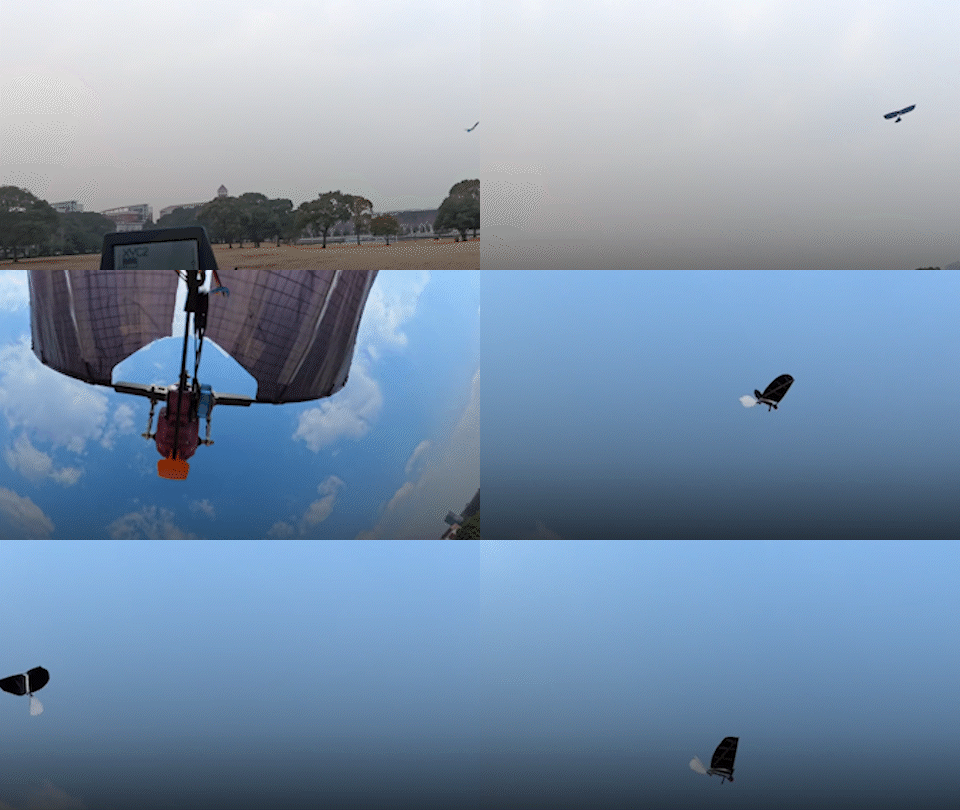
Footage from ESD of their flapping-wing drone
The centuries-old quest for natural flight
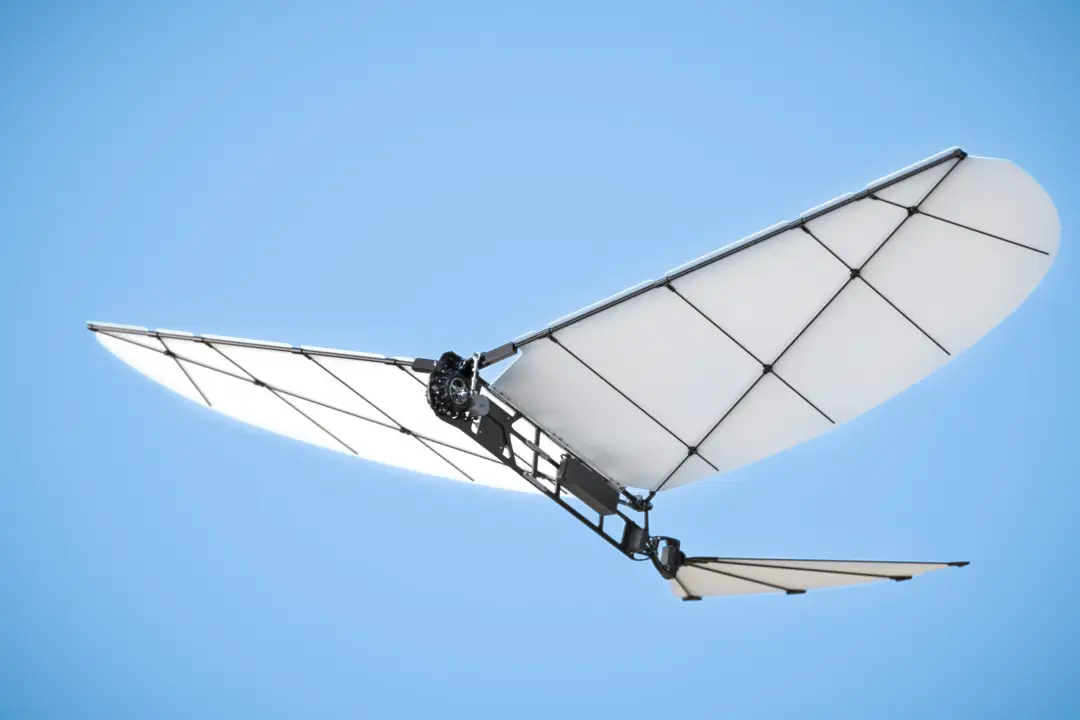
To understand the significance of this shift, one must look at the history of the “ornithopter.” An ornithopter is an aircraft designed to fly by flapping its wings to generate both lift and thrust, mimicking the flight mechanics of birds, bats, or insects, rather than relying on fixed wings or rotary propellers.
Humanity’s fascination with this concept is ancient. Italian polymath Leonardo da Vinci wrote Codex on the Flight of Birds in 1505, outlining systematic research on avian flight, and had even sketched human-powered ornithopters years prior. However, replicating nature proved immensely difficult. It was not until 2010 that the University of Toronto achieved one of the first successful sustained human-powered ornithopter flights, named the “Snowbird,” which flew a modest 145 meters. By 2013, Germany’s Festo introduced the SmartBird, a radio-controlled robotic seagull that represented the pinnacle of biomimetic flight at the time.
The enduring allure of ornithopters lies in their unparalleled potential for energy efficiency. Take the blackpoll warbler for example, a bird native to the Americas that weighs about 20 grams. During its 2,500-kilometer migration across the Atlantic Ocean, it consumes roughly half of its body weight in fat. For engineers, that kind of efficiency — a bird flying thousands of kilometers on just grams of fuel — remains an almost unimaginable benchmark and a powerful inspiration for pursuing flapping-wing technology.
Why flap instead of spin?
Beyond the theoretical limits of energy consumption, flapping-wing drones offer immediate, practical advantages over traditional multi-rotor drones.
A primary benefit is safety. According to Flapper Drones, a company operating in the same industry, lightweight flapping-wing drones are safer because in close-contact environments because they lack exposed high-speed rotors — their wings flap back and forth, gently bouncing off objects without causing damage upon impact. Furthermore, they address one of the biggest complaints about drones: noise. Rather than the annoying, high-pitched buzz associated with conventional drones, flapping wings generally produce less intrusive noise than multi-rotor drones.
This natural profile also makes them ideal for ecological and scientific observation. Because they look and sound like real birds, they can seamlessly blend into the environment. Last month, the Chinese Journal of Engineering highlighted ornithopter research by scientists at the University of Science and Technology Beijing, including eagle-, pigeon-, butterfly- and beetle-inspired designs. According to the journal, one eagle-inspired prototype achieved a maximum continuous flight time of 256 minutes during testing.
Historically, the engineering complexity of ornithopters has kept developers at bay. The technical difficulty of flapping-wing flight is significantly higher than that of traditional rotary-wing technology. When a wing flaps, it must simultaneously generate both lift and thrust. The resulting aerodynamic forces are highly coupled, and the complex, turbulent airflows are incredibly difficult to control using traditional mathematical models.
Moving from novelty to commercial reality
Despite these advantages, practical applications of ornithopters remain somewhat limited. For instance, Canada’s Aerium Analytics has deployed biomimetic drones designed like peregrine falcons to scare smaller birds away from fruit orchards in Australia, as well as from airports and mining sites, according to a recent report by the Australia Broadcasting Company . Aerium Analytics president Jordan Cicoria noted that the technology has been in operation for 10 years in the mining and aviation industries.
Eagle Sight Dynamics hopes to bridge this gap between novelty and widespread commercial use. The company plans to launch a consumer-grade ornithopter named Dante in the second quarter. Aimed at tech geeks and educators, the product lacks traditional rotors entirely, relying solely on biomimetic flapping for highly maneuverable flight. On the company’s website, Dante is priced at around 3,000 yuan ($400), which is quite affordable for such a niche product in the market. The company says an industrial-grade product, designed for urban inspection and ecological monitoring, is scheduled to start flying in June.
To overcome the aerodynamic challenges of flapping flight, ESD is also developing Vortrix. The company describes this as an AI-driven fluid-control simulation engine designed to train flight controllers for different biomimetic designs, from pterosaurs to butterflies, allowing them to adapt to turbulent airflows.
The revenue of the global robotics industry will reach $25 trillion by 2050, with aircraft and drones accounting for $4.7 trillion of that pie according to investment bank Morgan Stanley’s Robot on Earth report published in December 2025. As the low-altitude economy expands into urban environments, the demand for safer, quieter, and more natural flying machines will only grow. The flapping-wing era may have just found its updraft.
Sources
- 上海交大00后博士团队做仿生扑翼机器人,刚融了数千万元
- 陆奇押注的上交大00后,造飞行机器人,融资数千万
- 扑翼飞行有戏吗?
- 解码扑翼无人机“驭风”飞行
- Peregrine falcon drone could save Australian fruit and almond orchards from hungry birds