
By Brent Li
China’s ambition to fill its skies with passenger drones is facing a reality check. EHang Holdings Ltd. (EH.US), the frontrunner in the emerging low-altitude economy sector has seen its shares plummet as the timeline for actual commercial passenger flights keeps getting pushed out.
On Tuesday, the company reported a first-quarter net loss of 126 million yuan ($17.3 million), a significant expansion from the 78.4 million yuan loss recorded a year earlier. Revenue slipped to 25.7 million yuan as the company delivered only four of its electric vertical take-off and landing (eVTOL) aircraft. For the uninitiated, eVTOLs are battery-powered aircraft that hover, take off, and land vertically. They are similar to helicopters but are designed to be quieter, heavily automated, and cheaper to operate.
Investors reacted harshly: EHang’s shares tumbled 23.3% after the financial update, extending the stock’s year-to-date decline to around 50%.
The waiting game for passenger flights
The biggest question hanging over EHang is when regular people will actually be able to buy a ticket to fly.
In March, the company set high expectations, announcing that it would launch the world’s first commercial eVTOL passenger flights in the cities of Guangzhou and Hefei. However, that milestone has yet to materialize.
The company says it is working closely with the Civil Aviation Administration of China (CAAC) to address additional operational and safety requirements before it can launch public ticketed services.

Despite strong backing from local governments, the delay in commercial operations suggests underlying complexities. There are two primary possibilities for the holdup. First, the company’s internal engineering teams may still have reservations about the absolute safety of manned commercial operations, even as its investor relations and marketing departments orchestrate stunts to boost public confidence. When popular YouTube creator IShowSpeed rode an EHang eVTOL during a visit to Shenzhen last year, he was told that due to safety concerns, the aircraft would only take off, rotate, and land straight away. His footage remains one of the very few publicly available videos showcasing an EHang eVTOL carrying a human passenger.
Second, the final timeline rests entirely with aviation regulators rather than the company. The CAAC is known for its uncompromising safety protocols — for context, it strictly bans passengers from carrying lighters on commercial flights and only permitted the use of mobile phones in the air in 2018. Until the CAAC is completely satisfied, EHang’s core passenger business will remain grounded. Still, founder and CEO Hu Huazhi publicly embraces the oversight. “Some people worry that more regulations will restrict industry development, but I think exactly the opposite; it is a positive factor,” he said during an earnings call. His remarks underscore the deferential stance the company must maintain toward China’s powerful aviation authorities.
High-level political backing
Despite these operational delays, the low-altitude economy remains a highly prioritized sector in China, benefiting from deep political and commercial enthusiasm.
A flurry of corporate fundraising and flight testing is also driven by ambitious new regulatory blueprints from Beijing. China’s latest Five-Year Plan explicitly outlines the promotion of the low-altitude economy. It emphasizes refined airspace management, dedicated new infrastructure like landing pads and communication networks, and the expansion of low-altitude consumption — shifting aviation from a pure commercial utility to a regular consumer experience. By 2025, the domestic low-altitude market was already worth an estimated 1.5 trillion yuan, driven by an influx of capital from startups and established tech corporations.
This top-down mandate was on full display in mid-May when the top political leaders of two major provinces — Jiangxi’s party secretary and Guangdong’s governor — jointly visited EHang’s headquarters. It is rare in China for the top leaders of two different provinces to simultaneously inspect a single private company.
Such high-profile visits send important signals. They show that EHang maintains excellent government relations, which is an essential prerequisite for long-term, stable development for private enterprises in China. The presence of top officials sends a clear message to the public and investors that the state is fully committed to nurturing the low-altitude industry. For local municipalities, supporting EHang helps project an image of fostering high-tech growth, while potentially securing future tax revenues and boosting local employment.
Seeking alternative revenue streams
While waiting for passenger flight approvals, EHang is leaning heavily on its non-passenger operations to generate cash.
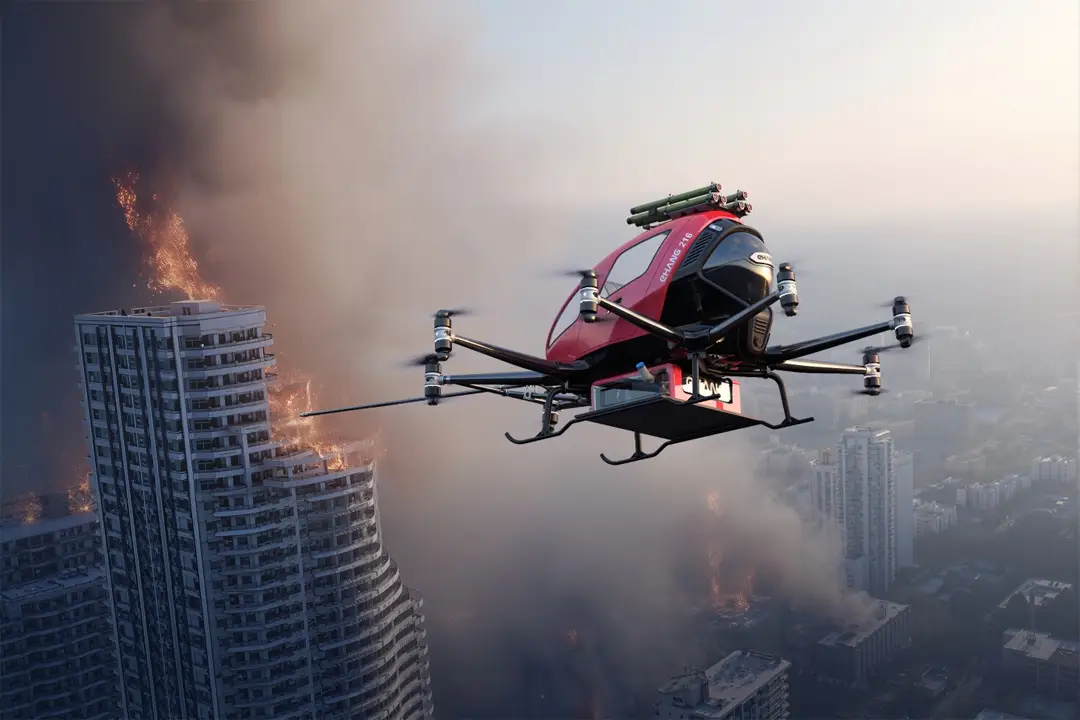
During the first quarter, aerial media operations — essentially using fleets of drones for synchronized light shows — accounted for about 40% of the company’s total revenue. During the recent Spring Festival holiday, EHang set a Guinness World Record in Hefei by launching 22,580 drones simultaneously. According to the company, EHang is also actively developing eVTOL models for firefighting and logistics, which it considers critical secondary growth curves.
Despite the bleak first-quarter earnings, management maintained its full-year revenue guidance of 600 million yuan. The company assured investors that government procurement budgets and project approvals are typically finalized in the second half of the year.
Still, the clock is ticking. Unless EHang can clear the final regulatory hurdles for passenger flights, generating sustainable, driving large-scale consumer revenue will remain an uphill battle.
Sources List