
A fatal crash involving a conventional light aircraft has prompted fresh safety concerns that could slow regulatory momentum for China’s emerging low-altitude aviation sector
By Hu Minghe
A fatal light aircraft crash in Beijing has cast a shadow over China’s drive to develop a low-altitude aviation industry, highlighting the regulatory and safety challenges facing the sector even though the accident had no connection to electric vertical takeoff and landing (eVTOL) aircraft or their manufacturers.
The June 26 incident involved a two-seat light sport aircraft that struck Citic Tower, tallest skyscraper in the city’s central business district, killing the pilot and injuring 13 people on the ground.
Although the aircraft was not an eVTOL and didn’t involve EHang Holdings (EH.US) or any other developers of these aerial vehicles, the crash has raised broader questions about how quickly China can expand low-altitude aviation while ensuring airspace management and operational safety, issues that affect the industry’s regulatory environment regardless of the aircraft involved.
China has spent the past several years promoting the low altitude economy as a new growth engine, envisioning electric aircraft carrying passengers above congested city streets and connecting tourist destinations, transport hubs and business districts without the need for conventional runways.
The Beijing crash came as policymakers were encouraging investment across the sector and local governments were rolling out ambitious development plans. It underscores the challenges China still faces in coordinating airspace management, flight approvals and emergency response as it develops a modern low-altitude aviation network.
Commercialization still a challenge
Those issues are particularly important for EHang because it has progressed further toward commercial operations than any domestic rival, even though its aircraft were entirely unrelated to the Beijing crash.
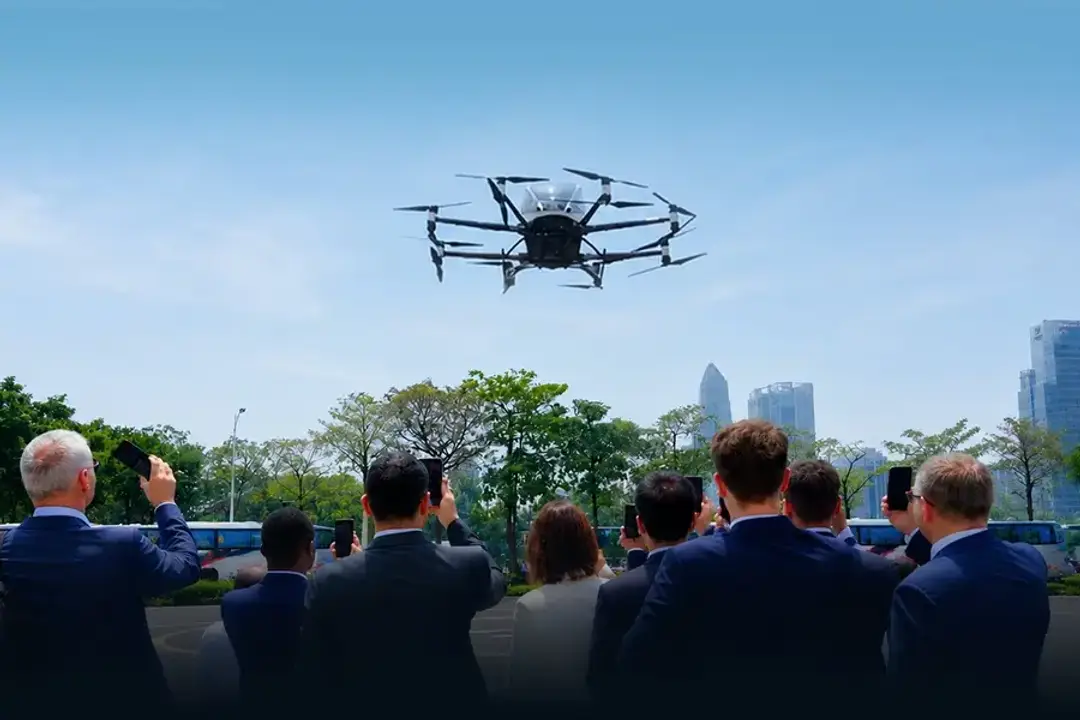
The Guangzhou-based company’s pilotless two-seat EH216-S has received a type certificate, production certificate and standard airworthiness certificate from the Civil Aviation Administration of China (CAAC). Flight operators working with EHang have also obtained China’s first air operator certificates for human-carrying eVTOL services.
Those approvals have made EHang China’s most advanced listed eVTOL company from a regulatory standpoint. But they also mean investors are increasingly focused on whether the company can translate certification into sustainable commercial operations.
Its latest financial results illustrate that challenge.
EHang delivered just four EH216-series aircraft in the first quarter, down from 11 a year earlier and 61 in the previous quarter. Revenue fell to 25.7 million yuan ($3.7 million), while its net loss widened to 126.4 million yuan. Drone light shows, rather than its passenger eVTOL business, generated about 40% of quarterly revenue.
The company said it continues to work with the CAAC and operating partners to satisfy additional operational and safety requirements before launching ticketed passenger services. A Goldman Sachs summary carried by Sina Finance said approval for remote-pilot training also remains among the steps before commercial passenger operations can begin.
While Beijing has repeatedly identified the low altitude economy as a strategic industry, substantial infrastructure still needs to be built, including vertiports, charging facilities and air traffic management systems. The CAAC has forecast the market could reach 3.5 trillion yuan by 2035.
The EH216-S has a range of about 30 kilometers, making it better suited to sightseeing routes and short flights between designated locations than widespread urban commuting. Many of the company’s deliveries have so far gone to local government-backed entities and state-linked tourism and transportation operators, rather than reflecting broad consumer demand.
Investment implications
The Beijing crash has nevertheless prompted some analysts to reassess the pace of industry development.
BofA Securities downgraded EHang to “underperform” and cut its price target to $5.40, citing the possibility of tighter regulation and a slower commercialization timetable. It also lowered its forecast for China’s eVTOL sales in 2030 to about 2,900 units from 3,500. EHang shares closed at $5.59 on July 10, down about 58% this year.
Investment in the sector has been strong this year. Chinese media reported that financing for the low altitude economy exceeded 20 billion yuan in the first half of 2026, with eVTOL developers accounting for a significant share. Much of the funding has come from state-backed investment funds, local government financing platforms and strategic investors.
Competitors continue to expand. Volant Aerotech recently raised 1 billion yuan and is preparing for a Hong Kong IPO. XPeng AeroHT, the flying-car subsidiary of EV maker Peng (9868.HK), has reportedly filed confidentially for a Hong Kong listing, while AeroFugia, backed by Geely, is seeking a listing on Shanghai’s STAR Market.
The companies are pursuing different strategies. EHang is focusing on certified pilotless aircraft for short-range passenger services, while rivals are developing larger piloted aircraft or leveraging automotive manufacturing capabilities.
EHang is looking at international expansion and has given demonstration flights in Switzerland and Mexico and undergone regulatory trials in Hong Kong. The company is developing the longer-range VT35, has formed a joint venture with Chang’an Auto to tap automotive supply chains, and has diversified into smart unmanned boats.
The Beijing crash is unlikely to derail China’s ambitions for the low altitude economy. But it may reinforce policymakers’ focus on airspace management, operational oversight and public safety before regulators approve wider commercial operations.
For EHang, the key challenge remains unchanged: converting its regulatory lead into a commercially viable business as China’s low altitude aviation market gradually takes shape.
Source:
Bamboo Works