

By Wei Xianghui
China’s fast-emerging low-altitude economy is on the cusp of producing its first listed company, as Aerofugia, a Geely-backed developer of electric vertical take-off and landing (eVTOL) aircraft, accelerates toward an initial public offering just weeks after securing a major funding round.
In early April, the company filed for IPO tutoring with regulators in Sichuan province, taking a key step toward a planned listing on Shanghai’s STAR Market. The move comes less than two months after Aerofugia closed a nearly 1 billion yuan ($140mn) financing round — the largest single investment in China’s low-altitude economy sector so far this year.
The speed of the transition from fundraising to IPO preparation underscores the intensity of capital flowing into the sector, even as its underlying technologies and commercial applications remain some distance from maturity.
Three-dimensional mobility strategy
Aerofugia has now completed five rounds of market-based financing. Its most recent round was led by CSC Financial, with participation from a mix of private equity firms and state-backed investors. Existing shareholders also increased their stakes. The company’s investor base has evolved into a hybrid structure combining state capital, industrial partners, and financial investors — a configuration designed to provide both long-term funding stability and access to technical and industrial resources.
Geely, the automotive group controlled by billionaire Li Shufu, plays a central role. Through multiple affiliated entities, it holds roughly 45.7% of Aerofugia, maintaining clear control and positioning the company within its broader mobility ecosystem.
That ecosystem reflects ambitions that extend well beyond aircraft manufacturing. Geely has spent years building out a “three-dimensional mobility” strategy. Its early move came in 2017 with the acquisition of Terrafugia, a US-based flying car company. Since then, it has invested in Germany’s Volocopter and established Aerofugia in 2020 as a core platform for low-altitude aircraft development.
Aerofugia’s governance overhaul ahead of the IPO highlights its shift from a start-up to a more industrialised platform. In late March, the company converted into a joint-stock entity, doubling its registered capital to 360 million yuan. At the same time, Xu Zhihao, chief executive of Geely Technology Group, took over as chairman as part of a management reshuffle.
The promise versus the reality
The shakeup signals tighter integration with Geely’s industrial strategy. Xu brings experience in overseeing multiple advanced manufacturing and technology businesses, including new materials and semiconductors.
Meanwhile, Aerofugia founder Guo Liang remains chief executive and chief scientist, anchoring the company’s technical direction. A graduate of Nanjing University of Aeronautics and Astronautics, Guo previously worked on major unmanned aerial vehicle projects at a state research institute before founding a drone company in 2015 that was later absorbed into Geely’s ecosystem.
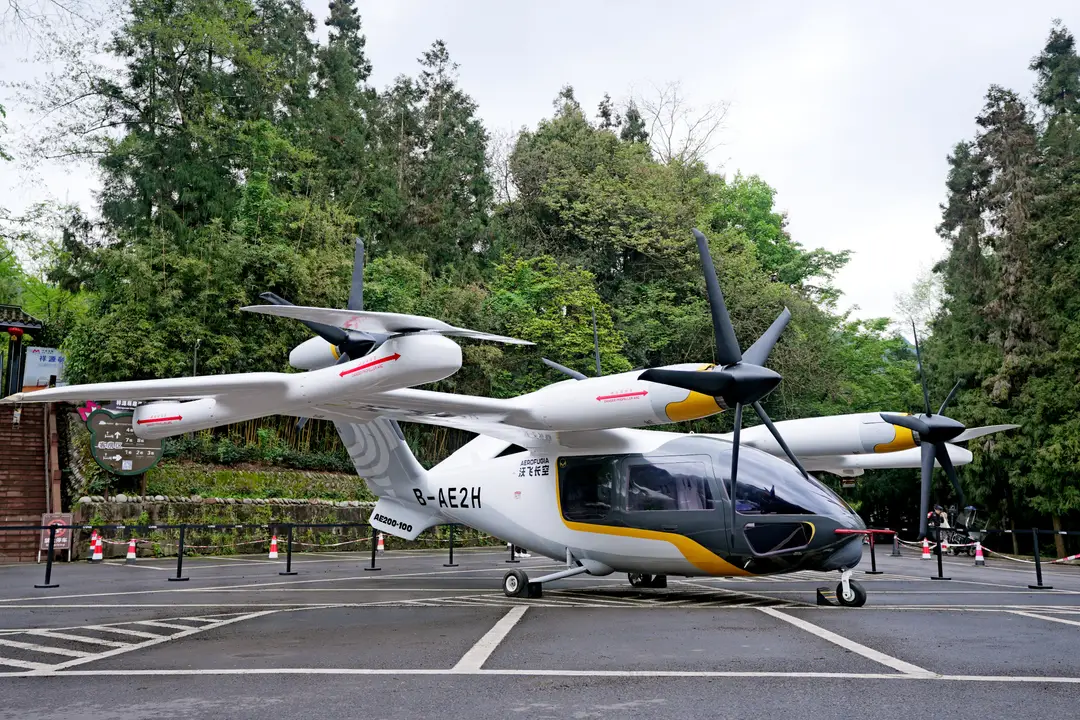
Despite strong investor interest, Aerofugia’s flagship aircraft — the AE200 — has yet to receive airworthiness certification and is not in mass production. The six-seat tilt-rotor eVTOL completed its first full-scale transition flight test in 2024, and the company expects certification by 2026. Its Chengdu production base is also still under construction, with operations scheduled to begin in the second half of the year.
This gap between capital enthusiasm and industrial readiness is emblematic of China’s broader low-altitude economy. According to an official industry report, the country has largely completed its top-level regulatory framework and is expected to enter a phase of “substantive operations” around 2026. However, significant challenges remain, particularly in balancing safety oversight with the need for rapid scale-up.
Regulators reopen the IPO door
Regulatory developments have nonetheless provided a crucial boost. In 2025, China’s securities regulator revived a listing pathway for pre-profit technology companies on the STAR Market and explicitly extended eligibility to low-altitude economy businesses. The move is widely seen as tailored to eVTOL developers, which require heavy upfront investment and long certification timelines.
Industry participants expect capital to become increasingly concentrated among companies that demonstrate tangible progress in core technologies and regulatory approvals. In this context, Aerofugia’s relatively clear certification roadmap may strengthen its position.
The company is also pushing ahead with early-stage commercialisation efforts. It is working with airlines, tourism operators and mobility platforms — including Geely-backed ride-hailing services—to explore practical use cases. These range from scenic flights linking tourist destinations to rapid airport transfers in major cities and emergency medical transport enabled by vertical take-off capabilities.
Yet the broader question facing the sector remains unresolved: who will secure the next critical “licence to operate” in a heavily regulated airspace environment?
If Aerofugia’s IPO proceeds as planned, it may claim the title of the STAR Market’s first low-altitude economy stock. But its success — and that of its peers — will ultimately depend less on capital-market milestones than on whether the industry can translate technological promise into safe, scalable operations.
Source:
Dongsi Shitiao Capital