

Hangzhou-based company is betting that lighter, simpler aircraft can bring personal flying to consumers, backed by dual-redundant flight control and full insurance.
The Green Goblin’s flying glider from the Spider-Man movie may no longer look quite so far-fetched.
With minimal training, you can step onto a platform, take hold of a control stick and take off. No movie magic.
That is the proposition behind Coolfly (Zhejiang) Aircraft Technology, a Hangzhou-based aircraft technology company that has launched two single-person electric vertical takeoff and landing (eVTOL) aircraft: the seated Dream and the standing Urban, alongside its in-house NA80 flight-control system.
The company has already put its technology on public display. At the 2026 CCTV Spring Festival Gala in Harbin, two of its aircraft carried performers in temperatures below minus 30°C, flying alongside lights, fireworks and ground performances.
Since then, Coolfly says its products have begun to gain traction overseas, with almost 100 units attracting paid deposits as consumer products.
The emergence of aircraft, flight controls, orders, distribution channels and insurance points to a nascent commercial market for personal manned flight — one of the more speculative corners of China’s fast-growing low-altitude economy.
A flying platform, not a conventional aircraft
Coolfly’s two aircraft take very different approaches. Dream – with familiar seating – is the near‑term path to entertainment flying, low‑altitude tourism, outdoor exploration, yachts and gated sites. Urban, while also available for leisure flying, represents the longer‑term vision: lighter, smaller, more portable – a genuine personal transport device.
The Dream resembles a more conventional aircraft. The pilot sits in the center of a multirotor platform and uses a control stick to direct movement and altitude. The Dream Pro can carry up to 120 kilograms, reach a top speed of 100 kilometers per hour and fly for up to 40 minutes with a 70-kilogram pilot.
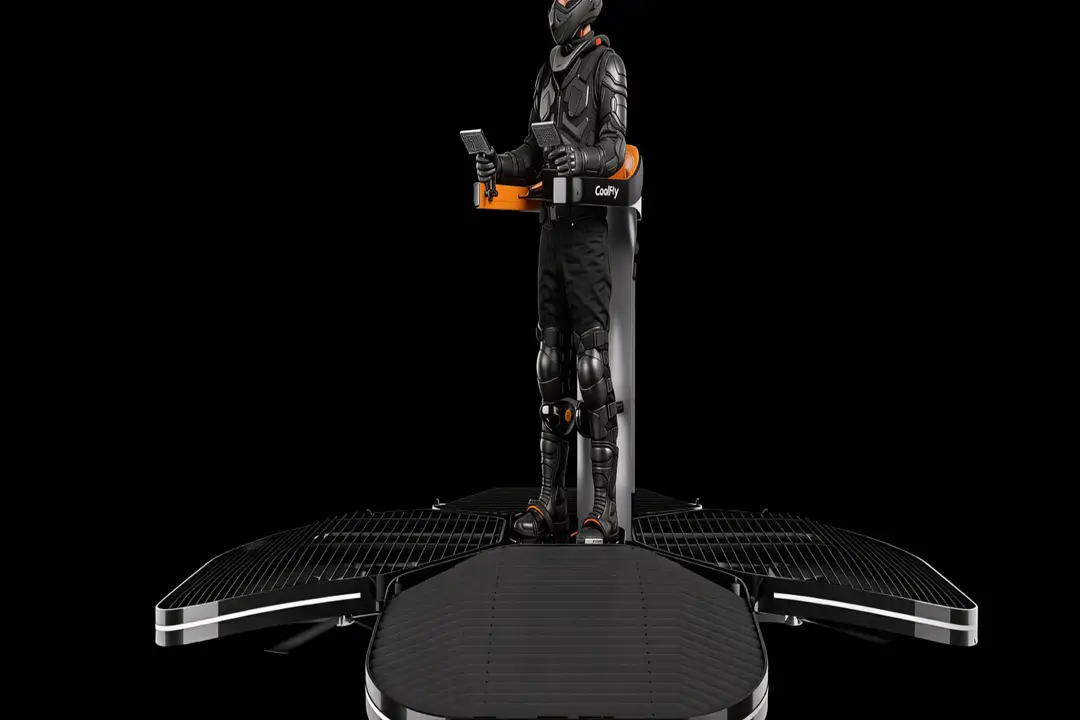
The Urban abandons the conventional aircraft look altogether. It has no wings, no cockpit, and no seat. Its black body is essentially a flat platform surrounded by multiple protected rotor units. The pilot stands in the middle, helmeted and padded, and controls the aircraft from a stick mounted at the front.
With a 70-kilogram pilot, the Urban is currently achieves about 11 minutes of flight time.
The standing configuration may look simpler, but it creates a more complicated control problem. A seated pilot is largely fixed in position by the seat and restraints. A standing pilot can continually shift the aircraft’s center of gravity simply by moving their body.
Coolfly’s flight-control system therefore has to account not only for the aircraft’s movement and the pilot’s commands, but also for changes in the pilot’s position and external disturbances such as wind.
The company is developing center-of-gravity sensing that can detect changes in the combined position of the person and aircraft and adjust thrust accordingly. The resulting controls are intended to feel more like operating a self-balancing vehicle than piloting a conventional aircraft.
Safety has to be built into the aircraft
Both the Urban and Dream use Coolfly’s NA80 flight-control system, which has a dual-redundancy architecture. Two independent flight-control units operate simultaneously, with each incorporating three aviation-grade inertial measurement units. The system cross-checks sensor data and can detect failures and switch control to the second unit within milliseconds, the company says.
The redundancy extends to the aircraft themselves. The Dream ST and Dream Pro use four-axis, eight-rotor configurations, allowing the system to redistribute thrust if some propulsion units fail. The Dream Pro also has redundancy in key power-supply components.
Coolfly says it designed its aircraft as manned systems from the outset, rather than assembling existing drone components. It has also applied high standards to areas including environmental durability, electromagnetic compatibility, vibration and impact resistance, component selection and manufacturing quality.
The company’s safety approach has three layers. The first is structural redundancy designed to prevent a single failure from causing a loss of control. The second is active safety: the aircraft monitors pilot inputs, attitude, sensors, battery levels and its surroundings, and can intervene when operations approach predefined limits. The third is passive protection, including enclosed rotor systems, airbags, protective suits and, on some models, whole-aircraft parachutes.
The insurance package Coolfly announced alongside its products is another important step toward commercialization. The company has worked with People’s Insurance Company of China and China Pacific Insurance to establish what it describes as the industry’s first integrated insurance package covering the aircraft, occupants and third parties.
The package includes third-party liability coverage of up to 2 million yuan ($300,000) per accident, occupant liability coverage of up to 3 million yuan in total, and protection against damage to the aircraft.
For an emerging product, insurance matters for more than simply covering accidents. It signals that risks surrounding the aircraft, its users and potential third parties can at least begin to be defined, assessed and priced — an important step in turning an experimental technology into a commercial product.
From drones to personal flight
Coolfly was founded in late 2022 by a team with backgrounds in drones and aerospace technology.
CEO Li Wei began working on drones and aviation technology in 2013 and obtained a light-sport fixed-wing aircraft pilot certificate the following year. He subsequently worked on drone, aviation technology, and emergency-equipment ventures.
His experience gave him a view of the gap between consumer drones and manned aviation. Modern drones can automatically hover, compensate for wind, plan routes and return when their batteries run low. A consumer can operate one with a remote control. But manned aircraft remain far less accessible, requiring specialist equipment, airports and training.
Coolfly’s proposition is that some of the automation developed for drones can be extended to manned flight, allowing the aircraft itself to handle more of the complexity.
The company’s co-founder, Wang Zhisheng, an academician of the European Academy of Engineering, has worked on UAV applications, electromechanical simulation, industrial robotics and integrated control systems. The company also has Chinese Academy of Sciences academician Wu Hongxin as a technical adviser.
That background helps explain why Coolfly has opted for in-house development rather than simply buying an existing drone flight-control system. A person moving around on a standing aircraft introduces changes in weight distribution and control requirements that conventional multirotor systems do not necessarily have to accommodate.
The company’s full-stack approach means developing the aircraft structure, propulsion, flight controls, human-machine interaction and safety systems together. Coolfly argues that this will allow it to continue reducing weight and size while preserving safety margins.
A market begins to take shape
Personal aircraft still face substantial regulatory and infrastructure constraints. In markets such as the U.S., certain ultralight aircraft that meet the conditions of FAA Part 103 can operate under a simplified regulatory framework, without the airworthiness certification and traditional pilot licensing required for conventional aircraft.
For now, Coolfly expects its products to focus on entertainment, tourism, outdoor exploration, yachts and enclosed sites rather than urban commuting.
That puts personal aircraft on a different commercial path from the larger eVTOLs being developed by companies such as Joby, Archer, and China’s EHang Holdings (EH.US). Those aircraft are designed to provide transportation as a service, with professional operators managing the aircraft, routes and infrastructure. In China, EHang’s EH216-S has already obtained the relevant certifications and begun offering paid passenger flights at approved operating sites.
Personal aircraft instead put the vehicle directly in the hands of an individual or a site operator.
There are signs that consumers will pay for that proposition. Jetson’s ONE, another standing-free personal aircraft, is officially priced at $148,000, with production capacity for the next two years sold out, while companies including Pivotal and LIFT are developing reservation, training, delivery and experience programs.
That does not mean personal flying is about to become mainstream. But it suggests there are eager users prepared to lead the way.
As the wider low-altitude economy develops, Coolfly is betting that commercialization can begin with a smaller group of consumers willing to pay to experience something that, until recently, belonged almost entirely to science fiction.
Source:
QbitAI