

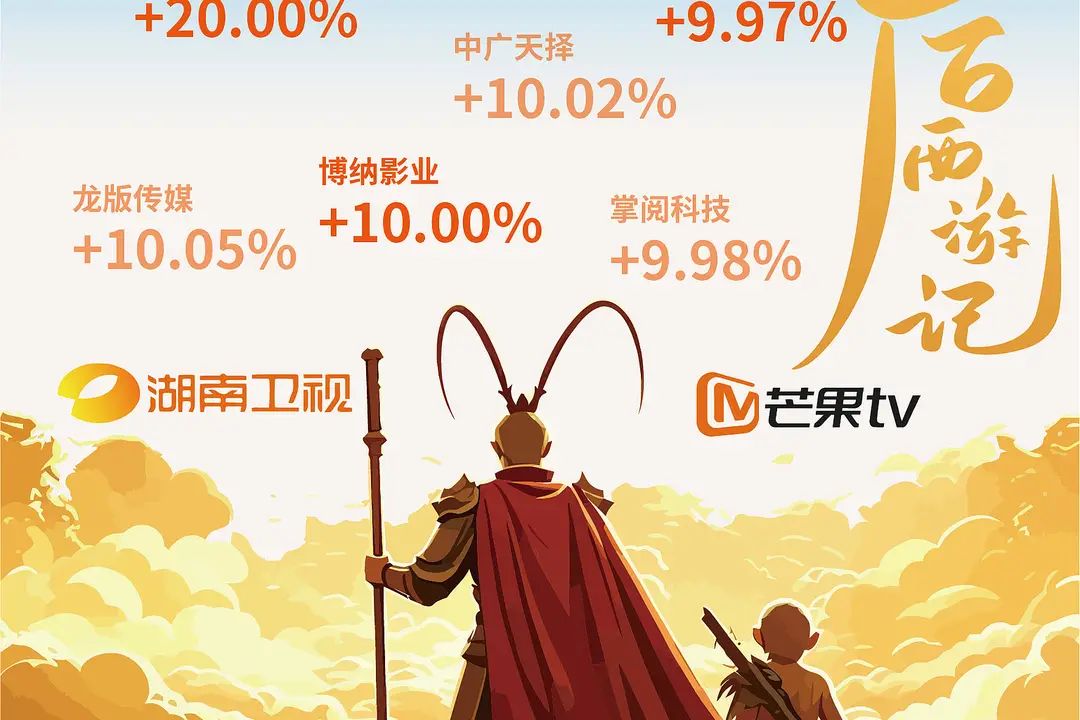
China’s first AI generated content long-form series without human actors sparks rally in media stocks as analysts see cost and efficiency revolution ahead .
By Li Yiwen
China’s A-share short-drama and gaming stocks rallied on Aug. 31 after The Sequel to Journey to the West, an AI-generated television series, began airing, with Mango Excellent Media (300413,SZ), its producer and broadcaster, surging by its daily limit.
Mango Excellent Media surged 20% to hit its upper trading limit, while Rongxin Education and Culture (301231,SZ), Decai Group (605287.SH), IReader Technology (603533.SH), H&R Century Union (000892.SZ), Bona Film Group 001330.SZ) and TVZone Media (603721.SH) jumped by their daily limit. COL Group (300364.SZ), Beijing Jetsen Technology (300182.SZ), Hicon Network Technology (301262.SZ), and several other stocks also rose.
The market reaction came as The Sequel to Journey to the West, a mythology-themed seasonal drama produced by Mango’s AI generated content (AIGC) Innovation Content Center and commissioned from Beijing-based Bojing Culture, went online on streaming platform Mango TV on Aug. 31. The first season, titled “Flower Fruit Mountain,” also began airing at 8 p.m. on Hunan Satellite TV’s prime-time drama slot, with a simultaneous debut on the “Good Dramas” big-screen on-demand section.
According to Hunan Satellite TV, the series is the first AIGC long-form drama to be broadcast on a Chinese satellite television channel. Its visuals and character performances were generated using AIGC, with no human actors involved.
Commercial potential and copyright concerns
The drama is also the first television series in China to be produced, reviewed and broadcast simultaneously since the release of the National Radio and Television Administration’s “21 measures” governing the development of television and online audiovisual content. The production team said the approach can shorten the time between content creation and broadcast while allowing the storyline and other details to be adjusted dynamically based on regulatory reviews and audience feedback.
Chinese entertainment companies are increasingly exploring the commercial potential of generative AI, while also facing growing scrutiny over copyright and content compliance.
Mango Excellent Media addressed those concerns on Aug. 31 in response to investor questions on the Shenzhen Stock Exchange’s interactive platform. The company said that, as a licensed long-form video platform operator, it attaches great importance to compliance in AI-generated content. It has dedicated content-review and copyright-management teams and has established management mechanisms specifically for AIGC content to mitigate related risks.
Mango TV has also launched a dedicated AIGC channel featuring AI-generated comic dramas, photorealistic dramas and animation. The company said it strictly follows regulatory requirements on labeling AI-generated content.
Reshaping the film and TV industry
The growing use of AI is reshaping the film and television industry across production processes, cost structures and business models, prompting several major Chinese brokerages to assess how the technology could transform the sector.
Zhongtai Securities said AI-generated short dramas have already demonstrated the commercial potential of AI in film and television and that the technology is likely to spread across the broader industry.
It expects content supply to become increasingly segmented into standardized productions, specialized long-tail content and creative breakout hits. At the same time, content creation is likely to become more decentralized, with the industry’s focus shifting from production itself toward managing intellectual property assets.
Investment could also move away from making large bets on individual productions toward lower-cost portfolios of projects that function more like options, Zhongtai said. As audience attention becomes increasingly scarce, distribution platforms with strong data, algorithms, creator ecosystems and IP-discovery capabilities could become the central hubs — and major profit centers — of the industry.
China International Capital Corp. said AI directly addresses two major pain points in film and television: the cost of trial and error and the cost of communication between different parts of a production.
Massive cost savings
AI-based scene-concept and dynamic-previsualization tools, for example, could cut the preparation time for the visual design of historical dramas from several months to several weeks. Pre-production visualization could also reduce extensive reshoots and rework on set.
Production accounts for roughly 70% to 80% of industry costs, giving AI substantial room to reduce expenses, CICC said. Virtual production bases could cut set-construction costs by as much as 85%, while the cost of original modeling for digital actors could fall by 80%. AI could also shorten special-effects production cycles by as much as 40%, with further efficiency gains possible in promotional materials and overseas localization.
In the long term, CICC expects AI to improve the industry’s investment returns through three main channels: increasing the probability that content succeeds, reducing production costs and accelerating the turnover of capital. This could ultimately reshape how value is distributed across the film and television industry.
CITIC Securities similarly said advances in large AI models are driving changes in both production processes and entertainment products. After years of debate in overseas markets over whether AI could replace human creators, major companies such as Netflix have increasingly embraced the technology. Chinese industry leaders are likewise building AI capabilities through in-house development and partnerships, using the technology to improve production efficiency while developing new products such as AIGC micro-dramas and AI-generated comic series.
Source:
21st Century Business Herald