

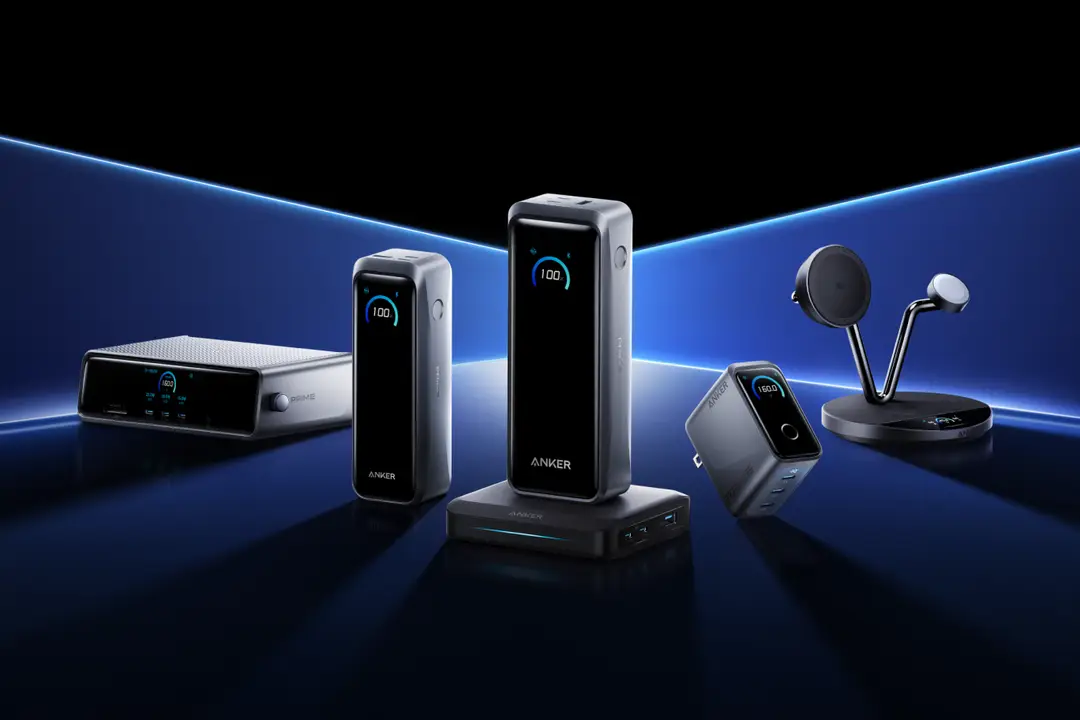
The charging giant is expanding into energy storage, smart home products and UV printing as it seeks to become a broader consumer electronics platform.
By Wang Sichuan
Anker Innovations (300866.SZ), a manufacturer of consumer electronics such as power banks, reported first-half results recently — revenue rose 29% year on year to 16.6 billion yuan ($2.48 billion), while adjusted net profit jumped 49.65% to 1.44 billion yuan.
But the numbers tell only part of the story.
In April 2025, Anker’s eufyMake brand launched the E1 UV printer on Kickstarter. It raised more than $1 million within a minute and ultimately brought in $46.76 million, a platform record across all product categories. The printer went on sale in China in March for 13,999 yuan.
The result highlights how far Anker has moved beyond its origins in charging accessories. Charging accounted for 53.8% of revenue in the first half, but the other 46.2% came from energy storage, smart security, smart audio-visual products and newer categories such as UV printing.
The “power-bank company” label is becoming outdated.
Charging is no longer tied to smartphones
Anker’s charging business is often viewed as an extension of the smartphone cycle. Yet over the past five years it has grown at an average annual rate of about 22%, around 7 percentage points above market expectations. Even as smartphone shipments declined in 2025, Anker’s charging revenue grew more than 12%.
Charging demand increasingly comes from the growing number of connected devices consumers own, including watches, earbuds, cameras and laptops. Global consumers owned an average of 3.6 mobile electronic devices in 2023.
Replacement demand also has a logic of its own. Power banks can theoretically last more than five years, but their actual replacement cycle is about 1.5 years, largely because people lose them.
Higher prices are another growth driver. The average price of Anker chargers rose from 79.5 yuan in 2020 to 125.6 yuan in 2025. Sales of its higher-end 7-series products increased from 3% of charging revenue to 16%, with a long-term target of 30%-40%.
Energy storage is the bigger growth bet
Charging provides a stable base, but energy storage is becoming a more important source of growth. Its appeal varies by market, with policy changes often creating the demand and product design determining who can capture it.
In the U.S., ageing power infrastructure and frequent outages are supporting demand for home backup systems. California’s NEM 3.0 policy has also sharply reduced compensation for excess solar power fed into the grid, encouraging households to store more electricity for their own use.
Anker’s SOLIX E10 addresses another obstacle: installation. Traditional home-storage systems can take weeks to install. The E10, with its modular design, allows consumers to stack the batteries themselves, leaving a licensed electrician to handle the final grid connection. Anker says installation can take as little as 2.5-6.5 hours.
Germany offers a different opportunity through balcony storage. Plug-and-play systems avoid much of the cost and complexity of conventional home storage. Anker says its Solarbank products have captured 55% of Germany’s balcony-storage market.
In the Netherlands, the planned end of net metering in 2027 is expected to encourage households with existing solar installations to store more of their own electricity. Anker’s Solarbank Max AC can connect to the household AC system without replacing the existing solar inverter.
Across the three markets, the strategy is similar: policy changes create demand, while simpler product formats allow Anker to capture it.
UV printing introduces uncertainty
UV printing is a bigger gamble. The technology has traditionally been aimed at industrial users, with machines costing hundreds of thousands of yuan. Anker developed its own print-head control board, cutting the cost from about 4,000 yuan to 400 yuan and reducing the machine to roughly one-tenth the size of industrial equipment.
The E1’s Kickstarter performance shows that demand exists, but does not establish whether mainstream consumers will repeatedly buy consumables or whether Anker can support the products at scale.
Benchmarking against Chinese 3D printer maker Bambu Lab — 10 billion yuan in revenue in four years at 30% net margin — a neutral forecast puts Anker’s UV printing revenue at 7.8 billion yuan by 2030, contingent on building a consumables ecosystem and service network before competitors like Bambu Lab and xTool scale up.
Expansion brings risks
Energy storage remains highly dependent on policy. Australia’s household battery subsidy fell from about A$372 per kWh when the scheme began in July 2025 to A$251.60 per kWh in May 2026. Competition from EcoFlow and Zendure could also reduce Anker’s share of Germany’s balcony-storage market.
UV printing faces the more fundamental question of whether early adopters can translate into a mass market. Crowdfunding backers are mostly geeks and early adopters, with a gap to mass-market scale. Anker previously tried 3D printing with AnkerMake before adjusting course amid competition. Going from zero to one is easy; one to ten is hard.
There is also an organisational risk. Anker once operated nearly 30 product teams before concentrating on three core brands: Anker, eufy and soundcore. Its expansion into energy storage and UV printing risks spreading resources too thinly.
Anker’s broader ambition became clearer at IFA in Berlin this month, when it announced plans to bring Anker, eufy, soundcore, SOLIX and eufyMake under the single Anker brand.
It also unveiled Anker MindBase, a local AI hub intended to connect charging, security, cleaning and energy-storage products into a more integrated smart-home ecosystem.
The strategy is therefore shifting from building successful individual products to using a common brand and technology platform across categories.
Huachuang Securities has compared the model with Procter & Gamble, which uses organisational capabilities and brand equity to compete across multiple consumer categories.
Anker’s addressable global categories have a combined market size of about 11.4 trillion yuan, while its 2025 revenue was 30.5 billion yuan, giving it a share of just 2.7%.
Its challenge now is to turn that relatively small global footprint into sustained share gains across multiple categories while managing the policy, competitive and organisational risks of expansion.
Anker is no longer just selling power banks. The question is whether it can build a consumer electronics platform capable of supporting its ambitions.
Source:
Decode New Sight