
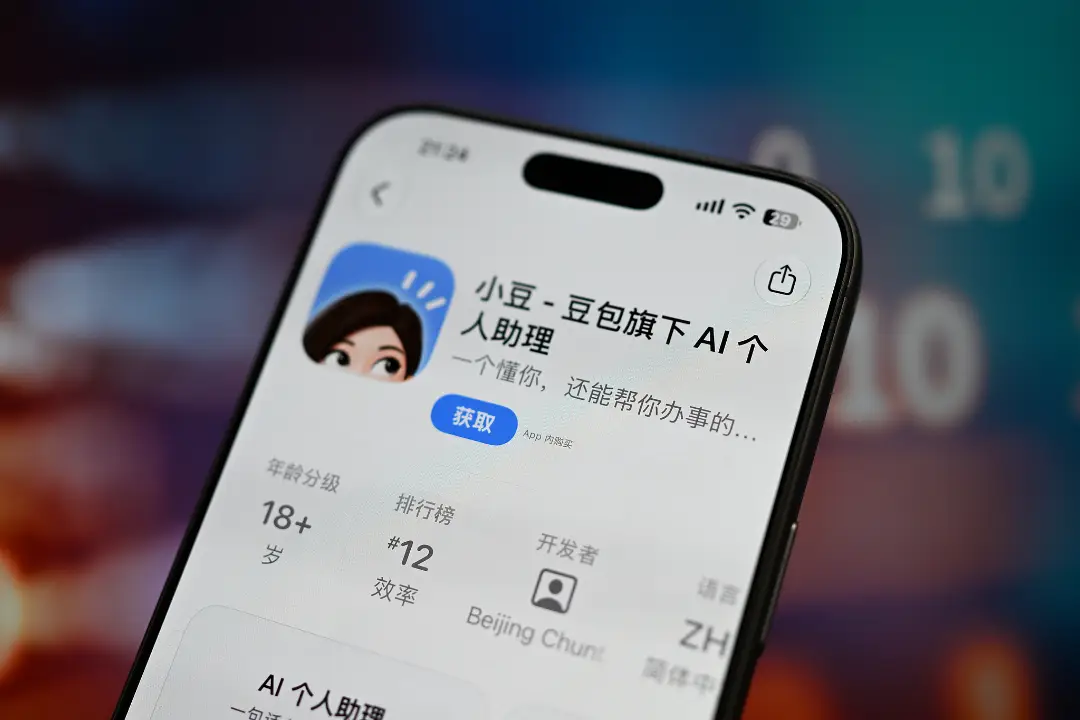
The new personal assistant Xiaodou can draw on Doubao’s user memories and connect to more than 40 apps, but its reasoning capabilities remain a work in progress.
By Fan Yating
ByteDance is betting that its existing app ecosystem can give it an advantage in the race to build useful personal AI agents. Its new assistant, Xiaodou, combines the capabilities of its Doubao chatbot with access to services including Feishu, Douyin and Amap, allowing it to handle tasks across work and everyday life.
Launched into beta on Nov. 24, Xiaodou is ByteDance’s latest addition to its expanding Doubao product family. The assistant supports connections to more than 40 applications, including music streaming service Soda Music, ride-hailing platform Amap, office collaboration tool DingTalk, financial platform Tonghuashun and Baidu Netdisk.
It recommends users initially connect four services: Douyin, health data, Feishu and location services. The selection reflects an ambition to cover entertainment, work and personal management through a single assistant.
The distinction between Xiaodou and a conventional chatbot is that it is designed not just to provide information but to act on users’ behalf.
Feishu integration offers a significant advantage
One of Xiaodou’s strongest features is its integration with Feishu, ByteDance’s workplace collaboration platform. It can retrieve documents and meeting notes, identify outstanding tasks and help users communicate with colleagues.
In one test, the assistant was asked to send a draft article to an editor and prepare an accompanying message. After the user confirmed the request, Xiaodou completed the task almost immediately.
The same instruction was given to Doubao Work, the assistant embedded within Feishu. It took 1 minute and 38 seconds to complete the task, with much of the delay attributed to document retrieval. Xiaodou also produced a more natural-sounding message, according to the reviewer.
More strikingly, Xiaodou independently retrieved the user’s weekly meeting document from the previous day and identified follow-up tasks without being prompted. It also detected a new assignment in the message stream and proactively alerted the user.
Such capabilities illustrate the potential value of personal agents: rather than waiting for instructions, they can monitor relevant information and anticipate what needs attention.
From chatbot to personal assistant
Xiaodou also draws on long-term memories accumulated through users’ interactions with Doubao. This could help it overcome one of the biggest obstacles facing personal AI assistants: the time and effort required to build an accurate picture of an individual user.
Many overseas agents rely on access to email and calendar services to assemble personal information. In China, however, user data is spread across numerous platforms, including messaging, e-commerce, short-video and food-delivery apps.
By tapping into ByteDance’s existing ecosystem, Xiaodou can start with a substantial amount of user context already available. In testing, it recalled previous conversations about medication restrictions and pillow preferences, as well as accessing authorised health data such as sleep and step counts.
Its integration with Douyin also allows it to draw on browsing history, saved content and account activity to recommend videos or suggest topics for content creation.
In a test involving winter clothing recommendations, Doubao offered general purchasing advice, while Xiaodou asked about the user’s gender, budget and intended use. After learning that the user commuted by bicycle, it prioritised windproof and warm clothing and offered to recommend complementary equipment.
However, the assistant could not continuously monitor the prices of recommended products and alert the user when discounts became available, highlighting the limits of its current capabilities.
Xiaodou also demonstrated its ability to coordinate travel arrangements through Amap. Given only a vague request to plan a trip from Beijing to a robotics event in Ma’anshan, it identified the venue, compared transport options and recommended taking a high-speed train via a transfer rather than flying. It also suggested hotels near the event venue. Ticket purchases could be completed within Xiaodou’s app without switching to another service.
Reasoning remains the bigger challenge
Despite its extensive integrations, Xiaodou is not immune to a problem affecting personal AI agents more broadly: the gap between producing an impressive-looking plan and reliably executing the reasoning behind it.
In another travel-planning test, the assistant was given hotel and scheduling information for a trip to Shanghai. Its proposed itinerary contained a basic timing error, allowing just four minutes between leaving the hotel and the scheduled departure of a train.
The mistake illustrates a fundamental limitation. Connecting applications and retrieving information can make an agent appear highly capable, but complex tasks still require sound reasoning and the ability to check whether recommendations are practical.
Xiaodou’s interface also has room for improvement. Its relatively low information density makes it less convenient to review multiple tasks, appointments and cross-application updates at a glance.
ByteDance is offering Xiaodou through the same subscription structure as Doubao, with three paid tiers priced at 68 yuan ($10.2), 200 yuan and 599 yuan a month. Annual subscriptions cost 688 yuan, 2,048 yuan and 6,088 yuan respectively.
The company’s existing ecosystem gives Xiaodou a potentially powerful head start. Its access to Doubao’s memories, Feishu’s workplace tools and services such as Douyin and Amap brings it closer to the idea of an assistant that can manage both professional and personal tasks.
But ecosystem integration alone will not determine whether personal agents fulfil their promise. Xiaodou’s early performance suggests ByteDance has made substantial progress in connecting services. The harder challenge will be making the underlying AI intelligent and reliable enough to handle increasingly complex tasks.
Source:
Si-Planet