
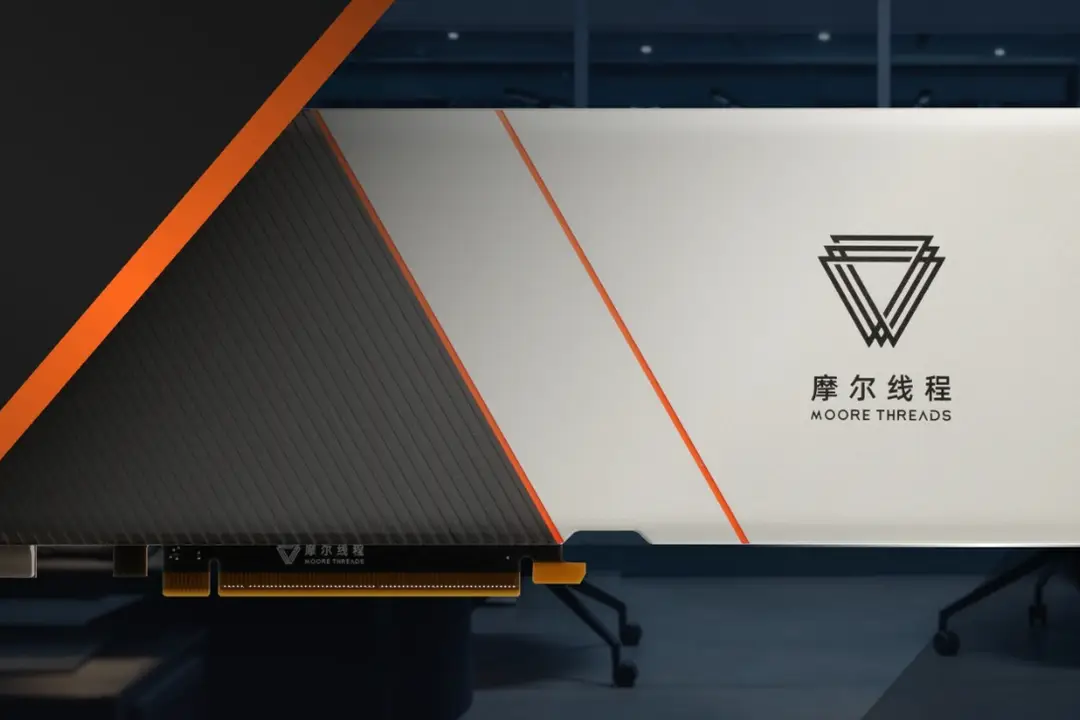
Chinese AI chipmaker Moore Threads (688795.SH), reported a sharp surge in revenue and its first quarterly profit, positioning itself as a fast-rising domestic alternative to Nvidia as demand for AI computing power accelerates in China’s cloud market.
In its 2025 annual report and first-quarter 2026 results, released on April 26, the Beijing-based group said revenue soared 243.4% to 1.51 billion yuan ($208 million) in 2025, underscoring strong demand for domestic AI computing power, particularly in cloud-based applications.
Gross profit for the year jumped 218.4% to 990 million yuan. Although the growth rate lagged slightly behind revenue expansion, the absolute value suggests that economies of scale are beginning to take hold. The company’s gross margin stood at 65.6%, reflecting the high value-added nature of AI chips and computing infrastructure.
Losses, however, remained significant, though markedly reduced. Net loss attributable to shareholders, excluding non-recurring items, narrowed 56.7% to 650 million yuan in 2025. The improvement suggests a steady march toward profitability as the company moves beyond an earlier phase characterised by heavy investment and sustained losses.
First quarter milestones
Total assets at the end of 2025 were 117% higher than a year earlier at 15.34 billion yuan, indicating a doubling of asset scale alongside continued business expansion.
The momentum carried into 2026. In the first quarter, Moore Threads reported revenue increased 155.4% to 740 million yuan, bringing quarterly revenue close to its full-year 2024 level.
More notably, the company achieved net profit attributable to shareholders of 29.4 million yuan for the quarter — its first single-quarter profit and marking a key inflection point from persistent losses towards break-even and beyond. On an underlying basis, losses excluding non-recurring items narrowed to 54.3 million yuan, a 60% improvement year on year. The data suggests that core operations are steadily strengthening, with profitability in the main business continuing to improve.
A breakdown of 2025 revenue highlights the company’s strategic positioning. All of Moore Threads’ income was derived from the integrated circuit sector, with 97% coming from cloud-based products. Meanwhile, 99.87% of revenue was generated within China, indicating that the company’s rapid growth has been driven almost entirely by domestic demand for AI cloud computing capacity.
The results reflect a broader trend in China’s technology sector, where demand for locally developed AI infrastructure has surged amid geopolitical tensions and restrictions on advanced semiconductor imports.
Moore Threads has continued to invest heavily in research and development, with total R&D expenditure reaching 1.31 billion yuan, equivalent to 86.7% of annual revenue.
Full-stack product and ecosystem strategy
The workforce remains lean and technical: out of 1,274 employees, 1,009 are R&D personnel, accounting for nearly 80% of the total headcount, underscoring the company’s identity as a technology-driven enterprise. Its intellectual property portfolio has also expanded rapidly: by the end of 2025, Moore Threads had filed 2,014 patent applications, including 1,743 invention patents, and had been granted 806 patents, of which 590 were invention patents.
The group has also moved to build out a full-stack product and ecosystem strategy. It now offers a portfolio spanning cloud, edge and end-user applications, including flagship GPU cards, large-scale computing clusters and AI PC products. These are designed to address the three core markets of training, inference and terminal deployment.
At the same time, its developer ecosystem is expanding quickly. As of April 2026, the company said it had attracted more than 450,000 developers, partnered with over 200 universities and built an independent software vendor alliance exceeding 1,500 members.
Moore Threads has also worked to ensure compatibility with leading large language models from Chinese technology groups, including DeepSeek, Z.ai (formerly known as Zhipu AI), MiniMax, Kimi and Alibaba Group. Early-stage integration with such systems has helped improve product compatibility and industry recognition.
Taken together, the latest results suggest that Moore Threads is transitioning from a capital-intensive growth phase to one defined by operational leverage and improving margins — though its long-term trajectory will depend on sustaining technological competitiveness in an increasingly crowded AI chip market.
Source:
5G and 6G