

By Da Cheung
For decades diamonds have been marketed as a symbol of eternal romance, but an oversupply of lab-grown alternatives has steadily stripped the gemstone of its scarcity. As manufacturing techniques matured, retail prices plummeted to as low as 4,000 yuan ($550) for a one-carat ring — a tenth of the price of a natural equivalent. The cost breakdown of custom lab-grown rings reveals that the precious metal settings are now significantly more expensive than the stones themselves, according to a report in the 21st Century Business Herald. This price collapse, while good news for consumers, sent shockwaves through the global jewelry market, forcing industry giants like De Beers to slash prices of natural diamonds.
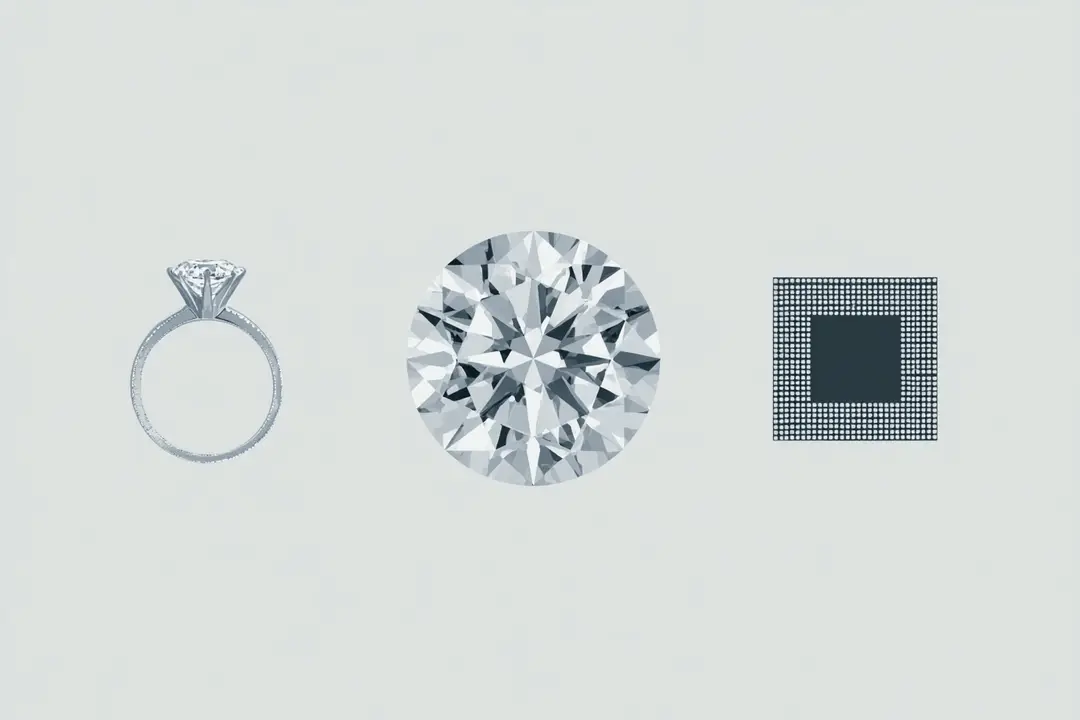
But while the consumer market for lab-grown diamonds has lost its luster, Chinese producers have found a lifeline in an unexpected sector: artificial intelligence. Since the beginning of 2026, the shares of China-listed lab-grown diamond stocks have staged a massive rally. The sector’s main index surged over 71% in the first five months of 2026, driven not by eager brides, but by the voracious cooling demands of high-performance AI chips.
The ultimate heat sink
Modern AI processors generate an immense amount of heat, turning thermal management into a severe bottleneck for computing power. With the growth in power consumption, traditional materials were reaching their physical limits. Enter the diamond. In industrial terms, the gemstone boasts unparalleled thermal conductivity — approximately five times that of copper and 10 times that of silicon. Furthermore, diamond material remains physically and chemically stable under extreme temperatures and does not react with common semiconductor materials like silicon or gallium nitride.
The industry’s watershed moment arrived in February 2026 when Nvidia announced that its next-generation AI chip would adopt a new “diamond composite material and liquid cooling” solution. A diamond-copper composite embeds synthetic diamond particles into a metal matrix, an engineering technique designed to maximize heat transfer while maintaining a structure suitable for electronic hardware. Industry testing indicates that outfitting Nvidia’s high-end Rubin and Feynman chips with diamond heat sinks can drop chip temperatures by 60 degrees Celsius and lower energy consumption by 40%.
Chaoying Diamond, a supplier of diamond technology application materials, said its CEO Zhu Yanhui met with Nvidia CEO Jensen Huang in January during his visit to China. The company, which is reportedly preparing for an initial public offering, said its diamond-copper composite material effectively solves the high power-density cooling challenges of AI chips and had passed Nvidia’s supply chain verification, although the U.S. chip designer has yet to publicly confirm this.
Other domestic manufacturers are racing to capitalize on the boom. Sifangda (300179.SZ), another major player, stated that its diamond heat sinks have cleared testing with overseas clients and that it has started low-volume production. The financial stakes are staggering; some analysts estimate that the global diamond cooling market for AI chips could expand to as much as $15.2 billion in 2030 from $0.37 billion in 2025.
From industrial self-reliance to global dominance
This AI-driven pivot highlights China’s quiet dominance in superhard materials, a sector born out of Cold War necessity rather than a desire for luxury. As noted by Cailian Press, following a Soviet embargo in the early 1960s, China launched a secretive national research project to develop synthetic diamonds for industrial manufacturing to avoid being technologically choked off.
That effort culminated in 1965 in the central Chinese province of Henan, where engineers developed the country’s first synthetic diamond press. Unlike natural diamonds formed deep underground, these presses simulate extreme subterranean heat and pressure to crystallize carbon into diamonds. Today, that legacy has grown into an empire. China now accounts for around 95% of the world’s rough lab-grown diamond production, and Henan alone accounts for about 80% of the country’s total output.
While the price war over jewelry-grade diamonds hurt profit margins for years, the pivot toward semiconductor applications has changed the financial calculus. Buoyed by the AI hardware boom, several major upstream factories raised the prices of their rough diamond products by 15% in March 2026, citing climbing raw material costs and favorable market conditions.
Geopolitical glint in the chip war
The convergence of lab-grown diamonds and advanced semiconductors adds a new geopolitical layer to the ongoing tech rivalry between Washington and Beijing. In 2024, China implemented export controls on superhard materials, including artificial diamond micro-powder and the specialized six-sided presses used to make the diamonds, according to Huxiu.
Because synthetic diamonds are essential for vital semiconductor manufacturing processes — such as wafer grinding and polishing — these export restrictions serve as a potent countermeasure against American chip embargoes. By tightening the supply of diamond materials, Beijing could theoretically raise production costs for overseas semiconductor and AI sectors.
However, trade barriers often have unintended consequences. Just as Washington’s sweeping restrictions inadvertently forced China to rapidly advance its domestic semiconductor supply chain, Beijing’s export limits on diamond-making equipment could provide foreign competitors with the impetus to upgrade their own capacities. Nvidia, for example, previously tested diamond-cooling technology with the American manufacturer Diamond Foundry, which uses a different chemical vapor deposition process to grow diamonds in laboratories.
Whether Beijing will adjust its policies to maintain its grip on the market or whether these controls will spark a global surge in diamond manufacturing innovation remains to be seen. The ultimate geopolitical and economic impact will only become clear once tech giants begin massive, widespread procurement of diamond materials, officially cementing the gemstone’s status as a critical pillar of the AI revolution.
Sources