AI is moving from lab novelty to clinical reality. The next test is whether faster molecule design can translate into better clinical outcomes.
By Yan Qi
AI is moving beyond laboratory experimentation and reshaping drug development, bringing the long-held promise of more personalized medicine closer to reality.
On Aug. 19, Merck and Moderna said their jointly developed mRNA cancer vaccine, intismeran, produced positive results in a Phase III trial for malignant melanoma when combined with the PD-1 drug pembrolizumab. The treatment, which was designed with the help of AI and can be tailored to individual patients, could become the world’s first therapeutic cancer vaccine.
The treatment, which was designed with the help of AI and can be tailored to individual patients, could become the world’s first therapeutic cancer vaccine.
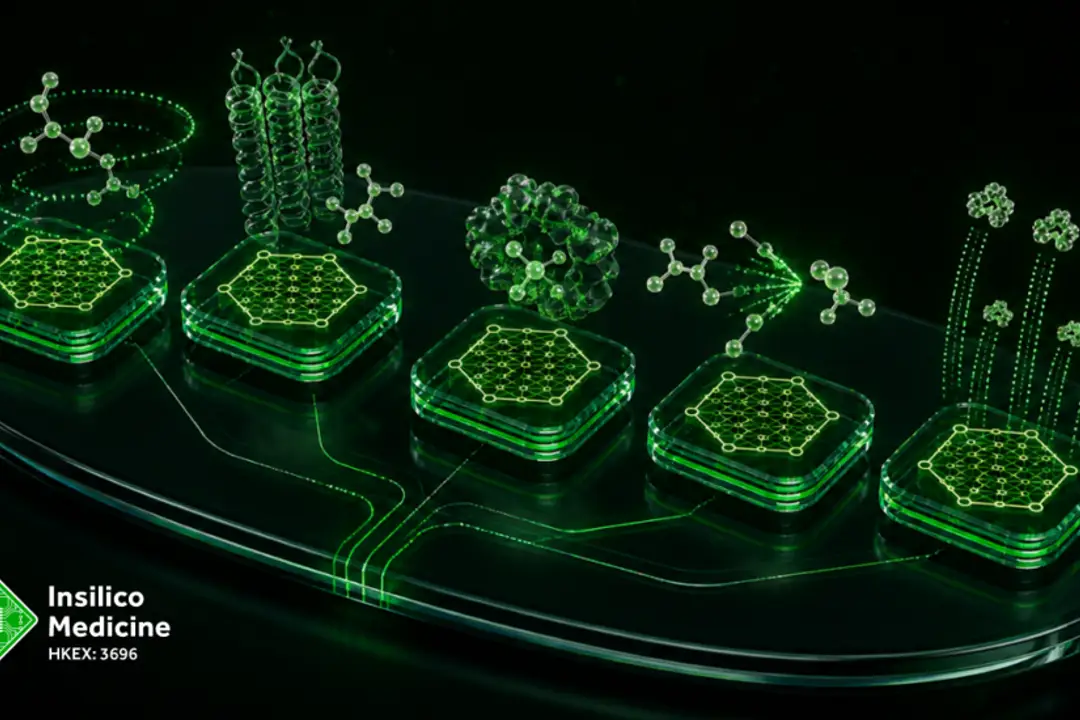
Meanwhile, Chinese AI drug-discovery company Insilico Medicine (3696.HK) began a Phase III trial in July for rentosertib, a treatment for idiopathic pulmonary fibrosis, a chronic lung disease. It is the first drug developed through an end-to-end AI-led process combining AI target discovery and molecule design. If approved, it could reshape the industry’s economics and competitive landscape.
Changing the discovery process
Traditional drug discovery relies heavily on screening huge libraries of compounds through high-throughput experiments — essentially searching for a needle in a haystack.
AI changes the process by improving the discovery of promising targets and molecules before costly laboratory work begins. Ren Feng, co-CEO and chief scientific officer of Insilico Medicine, told Beijing Business Today that successful drug development depends on finding the right target, the right molecule and conducting the right clinical trial.
AI can improve the first two. By integrating vast amounts of multi-omics data, it can identify targets more closely linked to disease mechanisms and virtually screen molecules before they are synthesized, eliminating some high-risk candidates earlier.
Insilico says its Pharma.AI platform has reduced the average time needed to nominate a preclinical drug candidate from 2.5-4 years to 12-18 months. XtalPi’s (2228.HK) AI drug-delivery platform, NanoForge, contains a database of more than 10 million lipid structures and can cut development time for targeted drug delivery from several years to two or three months. A platform developed by Tsinghua University researchers, DrugCLIP, has increased the speed of virtual screening by as much as one million times.
Just the beginning
AI can predict drug metabolism and toxicity during preclinical development and help optimize patient selection and trial design. Yet its impact diminishes once trials begin. AI-developed drugs have achieved Phase I success rates of 80%-90%, compared with 40%-65% for conventional approaches. By Phase III, however, the success rate falls to around 10% — broadly comparable with traditional drug development.
The next test is clinical success
That is why 2026 is being seen as a testing year for AI drug discovery. “The first half was about algorithms and platform capabilities; the second half is about whether companies can produce clinical results,” Ren said.
The pressure is already reshaping business models. XtalPi has positioned itself as an AI-powered contract research organization, providing drug-discovery services to pharmaceutical companies. Its revenue rose 201% to 803 million yuan in 2025, when it recorded its first full-year profit.
Others are betting on proprietary drug pipelines and licensing deals. Insilico has struck partnerships with Servier, Eli Lilly, SK Biopharmaceuticals and Takeda since the start of 2026, with cumulative business-development deals approaching $7.5 billion. But its adjusted loss widened to $43.8 million in 2025 from $21.2 million a year earlier.
Some companies are pursuing both strategies, effectively “selling the shovel while digging for gold.” Insilico describes software as its “door opener”: once customers use it and see the results, they may expand their cooperation, while the company’s proprietary pipeline demonstrates its core capabilities. METiS TechBio (7666.HK) is taking a similar approach: its revenue rose 13,399% year on year to 154 million yuan in the first half of 2026, while its adjusted net loss narrowed 56.4%.
For established drugmakers, AI is more often an extension of existing research capabilities, from bioinformatics and computer-aided drug design to generative AI. Their advantage is decades of proprietary R&D data, including records of failed experiments that can be as valuable as successful ones.
Efficiency will determine the survivors
AI can shorten preclinical development by an estimated 40%-60% and cut costs by millions of dollars, allowing companies to concentrate scarce capital and talent on the most promising candidates.
Capital is already following the technology. According to an Orient Securities report, AI-related drug-development financing accounted for 11.5% of innovative-drug financing events and 19.2% of funding in the first half of 2026, making it the sector’s third-largest segment after small-molecule and antibody drugs.
More than 173 AI-discovered drug programs are now in active clinical development globally, including 56 in Phase II and 15 in Phase III, according to Healthcare discovery AI. Another 15-20 programs are expected to enter pivotal clinical trials this year.
The results of rentosertib’s Phase III trial are still years away. But whether it succeeds or fails, AI has already changed the economics and logic of drug discovery. Its ultimate test is not how quickly it can create molecules, but how quickly it can help patients access safe and effective medicines.
AI cannot eliminate uncertainty in drug development, said Wu Xiaoying, managing partner of consulting services at EY Greater China. It can, however, make that uncertainty more accurately priced. That may prove to be the real measure of the industry’s maturity.
Source:
The Economic Observer
https://mp.weixin.qq.com/s/QhIFke_5b6ypOyX9AL_sgA