Shares in the display maker have fallen more than 68% from their post-IPO peak as investors see balance-sheet risks outweighing display ambitions.
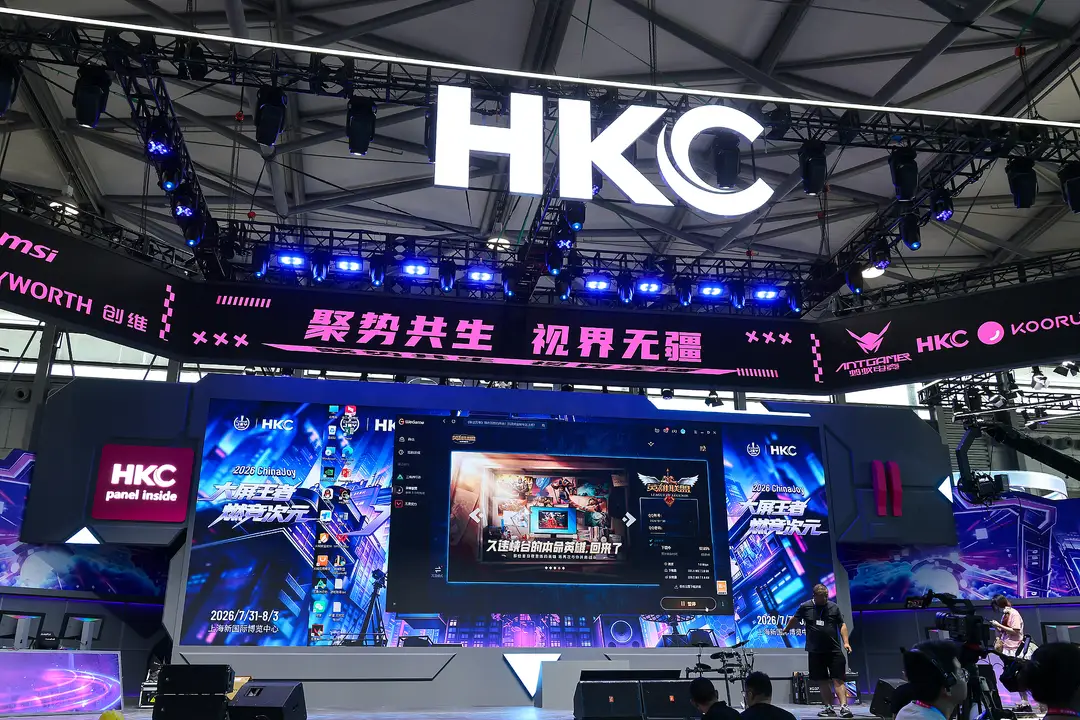
HKC’s (001399.SZ) spectacular stock-market debut has turned into one of China’s more dramatic post-IPO reversals. When the display-panel maker listed on the Shenzhen Stock Exchange’s main board on June 26, its shares briefly surged more than 650%, reaching 76 yuan.
The euphoria did not last. By the Aug. 6 close, the shares stood at 23.87 yuan, down more than 68% from their intraday peak, wiping more than 385 billion yuan ($57.1 billion) from its market value.
The selloff may represent more than the unwinding of a speculative frenzy. Investors appear to be reassessing a veteran panel maker operating in a capital-intensive, highly leveraged and deeply cyclical industry.
Scale is not the whole story
HKC has genuine industrial heft. It was the world’s third-largest LCD panel maker by TV-panel shipment area in 2025, behind BOE Technology (000725.SZ) and TCL CSOT (000100.SZ). It was also the world’s largest supplier of LCD panels measuring 85 inches or more, with a 30.6% share.
But its financial statements tell a less compelling story. Revenue rose from 35.82 billion yuan in 2023 to 40.28 billion yuan in 2024 and 40.90 billion yuan in 2025. But the growth rate slowed sharply, from 32.9% to just 1.5%.
The pressure has continued into 2026. First-quarter revenue increased 5.9% to 10.26 billion yuan, while net profit fell 1.6% to 995 million yuan. HKC said it expects first-half net profit of 1.85 billion to 2.05 billion yuan, representing a decline of 5.2% to 14.4% and its first half-year profit decline in recent years.
What truly unnerved investors was the liability side of HKC’s balance sheet. Capital-intensive panel production lines cost tens of billions of yuan each, and high debt is common across the industry. Yet HKC’s margin of financial safety looks notably thinner than its peers. As of end-June 2025, total liabilities stood at 69.15 billion yuan, with an asset-liability ratio of 67%, and interest-bearing debt of 42.71billion yuan. Liquidity metrics have long hovered in the danger zone: current ratios for the reporting periods were 0.64, 0.85, 0.99 and 1.17, only barely exceeding 1 in the first half of 2025, while quick ratios remained persistently below 1, signalling a sustained short-term funding gap.
Cash pressures meet ambitious expansion
Against that tight cash backdrop, the company paid out large dividends overwhelmingly benefiting its controlling shareholder: nearly 200 million in cash dividends in 2024, followed by roughly 400 million in the first half of 2025. In plain terms, cash was first distributed out of the corporate treasury, then replenished via a public listing—a capital move that drew wide scepticism.
There is another potential burden: equity buyback obligations linked to partnerships with local-government investment platforms in Chuzhou, Mianyang, Changsha and Chengdu. According to its prospectus and regulatory responses, these arrangements create potential obligations of around 12.9 billion yuan.
HKC’s IPO ultimately raised 8.19 billion yuan after the full exercise of its greenshoe option. Yet 7.5 billion yuan is earmarked for Changsha OLED, oxide technology and Mianyang Mini-LED, leaving only 1 billion yuan for working capital and debt repayment — small relative to its more than 40 billion yuan of interest-bearing debt.
A difficult industry cycle
Bullish analysts argue that display makers moving into glass-based packaging and display-driver IC testing could eventually reduce costs and create a second growth engine. But that opportunity is still some way off, with glass-based packaging expected to reach meaningful scale around 2028.
HKC has reached its current position largely through a model in which local state-owned investment platforms finance new production lines while the company provides technology and operational expertise. But its newer technologies remain at relatively early stages: it has achieved mass production of oxide LCD panels, while its OLED smartphone panels have only recently been lit up and Mini-LED products are still at an early stage of mass production.
China’s display industry also faces a difficult outlook. LCD remains dominant, but demand for TVs and IT devices remains weak. Major Chinese panel makers are simultaneously investing in OLED and Mini-LED capacity, raising the risk of oversupply as new facilities come online over the next two to three years.
HKC’s reliance on government support adds another vulnerability. From 2022 through June 2025, government subsidies recognized in its income totaled 5.38 billion yuan. Without these non-recurring subsidies, its underlying profitability would be considerably weaker.
On its first day of trading, HKC was valued at more than 93 times trailing earnings, compared with roughly 20 to 35 times for BOE and TCL Technology. That premium has now largely evaporated.
For investors, the lesson is that HKC’s debut rally said little about the economics of the underlying business.
Unless the company can restructure its buyback obligations, strengthen its internally generated profits and increase investment in research and development, its shares may remain vulnerable to the next downturn in panel prices — and to the financial pressure created by its own expansion plans.
Source: