

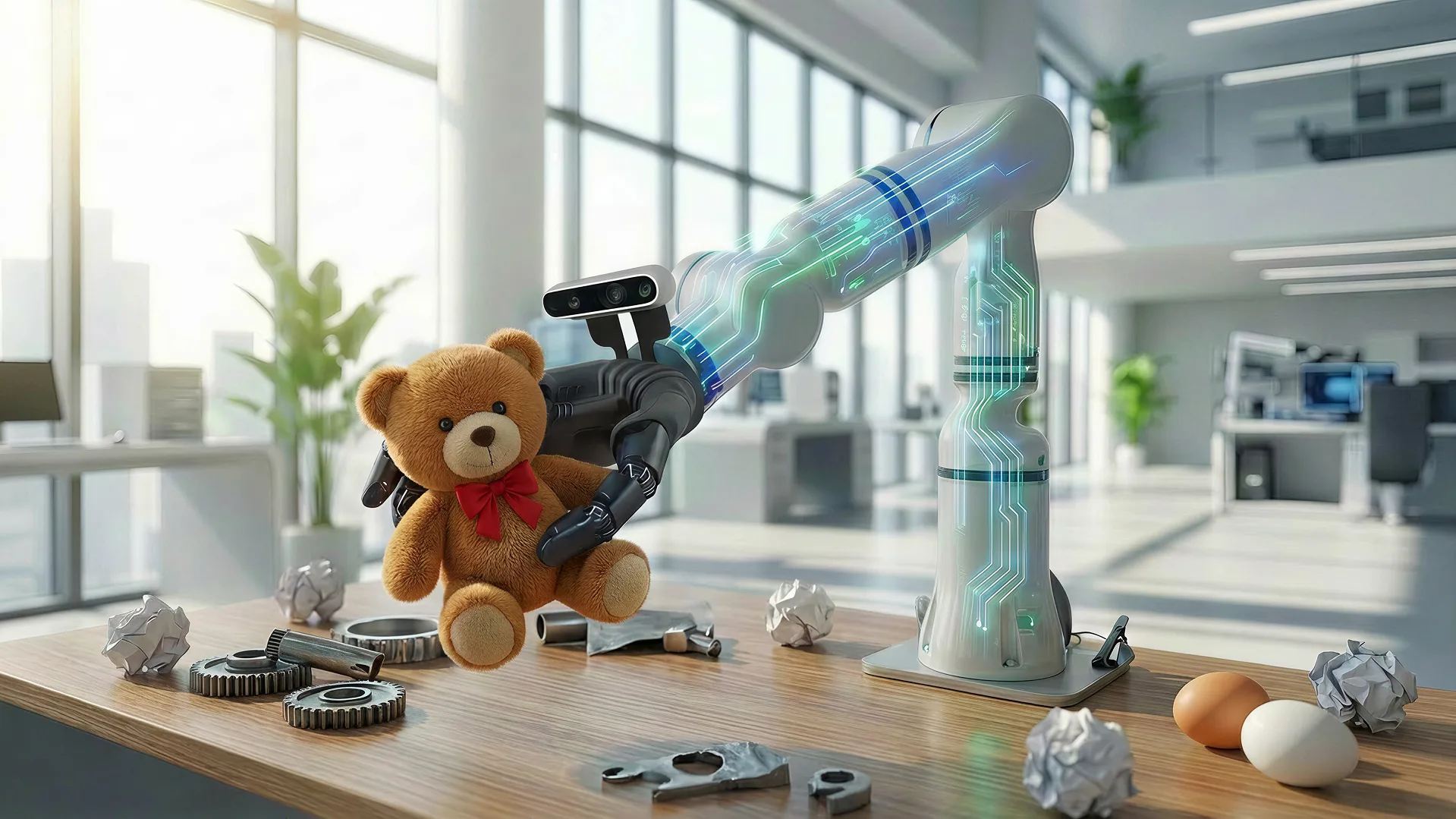
The Chinese robotics supplier is positioning itself for a listing after its conversion to a joint-stock company as demand for robotic touch sensing soars.
Chinese robotics supplier Tashan Technology has completed its conversion into a joint-stock company, a move that signals its push to become China’s first listed pure-play tactile intelligence firm.
The Beijing-based company formally completed the restructuring on Sept. 21, changing its name from Beijing Tashan Technology Co. to Beijing Tashan Technology Co. Ltd., a step typically required ahead of a potential stock-market listing.
The listing plan comes as demand for tactile sensing in robotics accelerates. Tashan says monthly deliveries of its tactile sensors have reached tens of thousands of units, while orders in the first half of 2026 were more than four times those recorded for all of 2025. The company says it has maintained a market share of more than 80%.
Building a tactile technology stack
Tashan had completed six funding rounds as of the end of July. On July 10, it announced a Series B financing worth several hundred million yuan, backed by investors including Taiping Innovation, Joyson Electronics, AUX Group, Pengling, Lavender Hill Capital Partners and Hongshan Capital. Existing shareholders Dowstone Technology and Binfucapital also participated.
The company is positioning itself beyond sensor manufacturing, aiming to build a technology stack spanning chips, sensors, algorithms and application scenarios.
Sensors are currently the first part of that system to achieve large-scale commercial deployment. Tashan says its products are designed for robots operating in real-world environments, where reliability, stability, durability and response speed are critical.
Its sensors can operate in complex outdoor conditions and underwater environments, according to the company, which says repeated measurements have a standard deviation of no more than 0.03, with a linear-fit R² of at least 99.9%.
The sensors have also undergone more than 3 million gripping operations and survived overloads exceeding 1,000 newtons while remaining operational, the company says.
Response time is another focus. Tashan has made temporal resolution a key product metric, aiming to give its tactile systems response speeds comparable with the rapid neural reflexes of a human finger.
From sensors to tactile chips
The company is also developing its own semiconductor technology.
At the World Artificial Intelligence Conference in July, Tashan unveiled the Emerald E10A chip, which it says is the first chip to convert tactile signals directly into pulse signals through a proprietary analogue pulse conversion block, or ASC.
Traditional systems typically rely on software to convert analogue signals into pulse signals. Tashan says its architecture removes that step and instead uses event-driven, sparse computing to achieve microsecond-level temporal resolution while reducing power consumption.
The chip is part of the company’s effort to move further down the technology stack rather than remain solely a sensor supplier.
Tashan is also building infrastructure for collecting the large volumes of tactile data needed to train robots.
This year it established two tactile-data collection centers, in Beijing and in Qianjiang in Hubei province. Rather than designing a data-collection system around a single robot model, the centers are intended to support heterogeneous robot training, accommodating different brands, configurations and technical architectures.
The system can also work with different end-effectors and hardware, including dexterous hands, mechanical grippers and single- or dual-arm workstations.
At the 2026 World Robot Conference, Tashan unveiled its TS-ECHO tactile-sensing glove. The device enables data to be collected without a robot body, separating tactile-data collection from the physical form of a particular robot.
That means data collected using the same system can potentially be transferred between different robot bodies and actuators, according to the company.
Training robots through physical interaction
Tashan is also experimenting with new approaches to robot training.
On Sept. 1, it officially opened a “Robot Kindergarten“, a project jointly developed with OpenMind, a team led by Richard Sutton, the 2024 Turing Award winner whose work helped establish modern reinforcement learning.
The project focuses on tactile sensing and continual learning. Tashan’s tactile technology provides the sensing layer, while reinforcement-learning methods are used to allow robots to learn through repeated interaction with the physical world.
The approach reflects a broader challenge facing robotics companies: developing systems that can learn from physical experience rather than relying solely on data generated in controlled or simulated environments.
Tashan says it now has deep commercial partnerships with more than 200 robotics-industry customers in China and overseas.
Those customers are also intended to form part of the company’s broader ecosystem. Its applications range from automotive supply chains and assembly to home appliances and manufacturing, as well as healthcare and elderly care.
The company’s model is to provide tactile technology across the value chain while industrial partners provide real-world environments and data, allowing both sides to develop and commercialise new applications.
For Tashan, the next step is to turn its position in tactile sensors into a broader platform spanning hardware, data, algorithms and robot applications — and ultimately into a public company focused on what it calls tactile intelligence.
Source:
IPO Early Insight