

By Brent Li
More than a year after the launch of its groundbreaking R1 model that reshaped the global artificial intelligence landscape, Chinese AI startup DeepSeek finally announced its V4 model on Friday after months of speculation.
DeepSeek’s R1, which shook the AI world in January 2025, proved that open-source models could rival their closed-source American counterparts. But for over a year, as AI advanced at a breakneck pace, the Chinese startup kept a low profile, offering only minor updates. Industry analysts largely attribute this slow progress to an immense underlying mandate from the Chinese state: DeepSeek is not only expected to deliver revolutionary software but also to pull China’s domestic AI chip industry forward alongside it.
For years, escaping the ecosystem built by Nvidia has been nearly impossible. The American giant’s hardware, paired with its proprietary CUDA software — a programming platform that allows developers to run complex AI calculations efficiently — forms a formidable moat for global developers. Breaking this dependency is fraught with technical hurdles.
Yet, as DeepSeek’s V4 technical documents suggest, Washington’s chip export bans may, ironically, have provided Chinese firms with a golden window. Operating under the dual protection of U.S. sanctions and Beijing’s state support, local companies are quietly building full-stack self-reliance from silicon to software.
The geopolitics of computing
DeepSeek’s official V4 technical report highlights its integration with hardware from Chinese tech giant Huawei. It says V4 runs efficiently on Huawei’s Ascend chips, and predicts a substantial drop in pricing once Huawei’s Ascend 950 mega-nodes enter mass production in the second half of 2026.
This domestic synergy poses a long-term threat to Nvidia. If Huawei’s AI hardware continues to improve and dominates the massive Chinese market, Beijing might eventually decline high-end American processors even if Washington were to lift its export bans.
Doing more with less
V4 debuted with two versions: the flagship Pro model and the more economical Flash model. Both operate as “Mixture of Experts” models, with the Pro version holding a massive 1.6 trillion parameters but only activates about 49 billion of them for any given task. For comparison, Elon Musk has disclosed that Anthropic‘s top-tier Opus model relies on roughly 5 trillion parameters — though this figure remains unconfirmed since the American startup keeps its architecture closed-source. By activating only a fraction of its total parameters, DeepSeek’s design saves immense computing power, according to the company’s technical reports.
DeepSeek has also focused on making what has historically been an expensive feature — the ability to digest vast amounts of text — both practical and affordable. The new model supports one million tokens of context by default, providing enough memory to swallow a majority of the book series A Game of Thrones in a single prompt. While this falls short of top-tier models from Google and Anthropic, which boast context windows large enough to swallow all five published volumes of the series whole, DeepSeek’s approach focuses heavily on cost efficiency. The company says it achieves this through a fundamentally redesigned attention mechanism that compresses information aggressively. In plain terms, the model learns to summarize large chunks of past data and only dives into the details when needed, drastically slashing the computing power and memory required. The result: deep analysis that, according to the company, costs just a fraction of previous versions.
Despite these feats, V4 carries a glaring limitation: it lacks true multimodal capabilities. Unlike its top-tier competitors, such as Google’s Gemini and Anthropic’s Opus, V4 cannot inherently “see” or understand images; it can only extract raw text from uploaded pictures.
The playground test
To look beyond the official metrics provided by DeepSeek, we conducted a test to gauge V4’s real-world coding and reasoning capabilities against Gemini 3.1 Pro and Opus 4.7. The models were given a single prompt: “Write an HTML and JavaScript-based 9×9 Go board game application where a user can choose black or white to play against the app.”
DeepSeek V4 swiftly generated an elegant user interface. It grasped the basic rules of Go and structured its logic clearly, resulting in an AI opponent with the playing strength of roughly a 5-year-old human. By contrast, Google’s Gemini produced a highly primitive, bare-bones interface and an opponent with the skills of a 3-year-old — barely understanding the rules. Anthropic’s Opus output an interface on par with V4, albeit with a minor usability bug, but programmed a slightly stronger AI opponent equivalent to a 6-year-old.
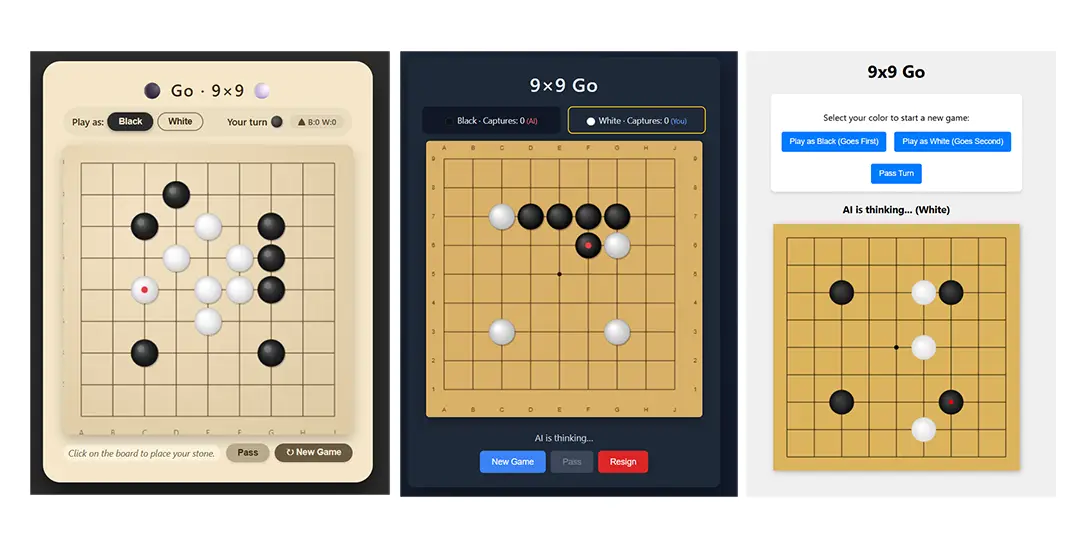
Interface programmed by DeepSeek V4, Opus 4.7 and Gemini 3.1 pro (from left to right)
When these programs played against each other, Opus won every match. DeepSeek thoroughly defeated Gemini — clearing its opponent’s pieces off the board — but only managed to capture a tiny sliver of territory when facing Opus.
Though far from a scientifically rigorous benchmark, this simple test offers a glimpse into DeepSeek V4’s true capabilities, showing it can hold its ground against rivals like Opus and Gemini to a certain extent. In terms of world knowledge, user interface design, and simple AI programming, Opus remains the undisputed leader, but DeepSeek surpassed Google’s Gemini in the test.
However, as the tech world embraces the era of AI agents — software designed to autonomously execute continuous, complex tasks — isolated coding tests are no longer enough. How effectively these large language models can support autonomous agents in complex workflows will ultimately determine the true victor in this new technological arms race.
Sources: