

By Da Cheung
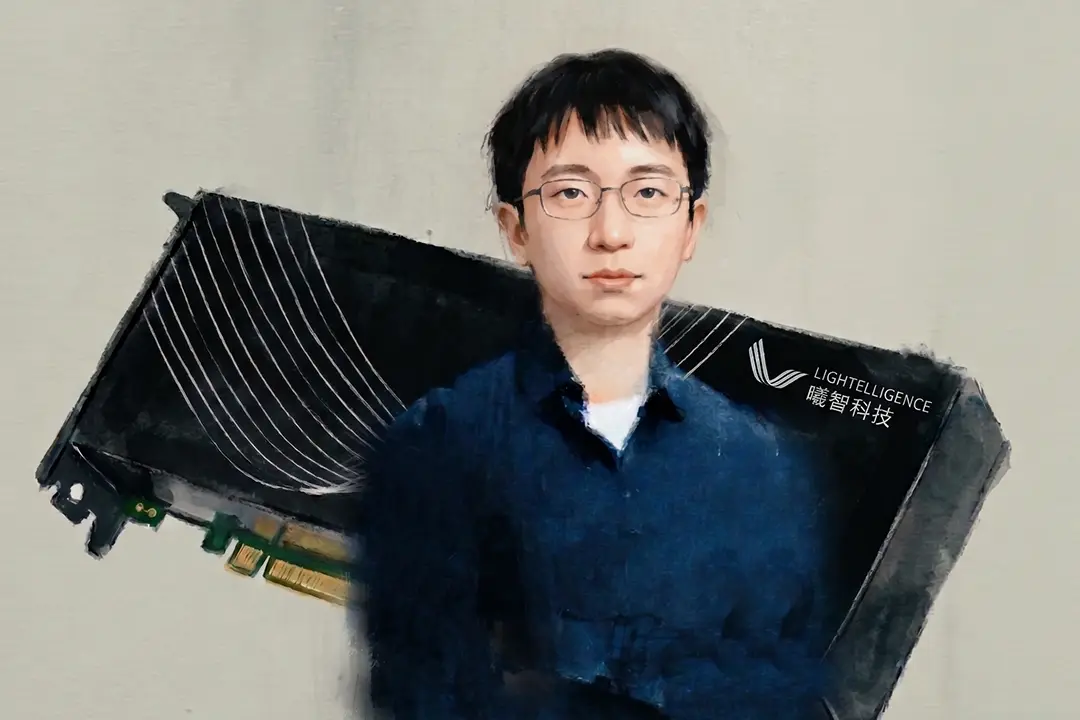
Shares in photonics chipmaker Shanghai Xizhi Technology Co. Ltd. (01879.HK) — also known as Lightelligence — surged in their Hong Kong trading debut on April 28. They were priced at HK$183.20 ($23.4) in the initial public offering, but opened at HK$880 when trading began and closed at HK$886 after reaching an intraday high of nearly HK$980.50. This was hardly surprising given the IPO was oversubscribed more than 5,700 times in its retail offering and over 50 times in the institutional tranche.
Lightelligence develops cutting-edge photonic computing and interconnect solutions, using light instead of electricity to process and transfer data. It represents one of China’s most ambitious bets on breaking free from conventional silicon limits and bridging the global tech divide.
Its story began in 2017. Shen Yichen, then a researcher at the Massachusetts Institute of Technology, published a cover paper in Nature Photonics, detailing the feasibility of using light (photons) to perform the matrix mathematics fundamental to today’s AI technology.
After his breakthrough, Shen launched his own company with early backing from prominent Chinese venture capital firms, while his classmate and paper co-author Nicholas Harris founded a competing U.S. firm called Lightmatter. In a recent interview with LatePost, Shen revealed that Google initially discussed the underlying technology with him but ultimately chose to back his American counterpart.
This geopolitical fork in the road set the stage for Lightelligence’s unique trajectory. Today, the company is attempting to do what many consider impossible: using light to bypass the protective ecosystems built by dominant players like Nvidia and Huawei, offering a critical lifeline to China’s domestic semiconductor industry.
Moving beyond Moore’s Law with light
For decades, the semiconductor industry has been governed by Moore’s Law, which posits that computing power roughly doubles every two years as more transistors are packed onto chips — driving exponential gains in performance and reductions in cost. But that trajectory is faltering as conventional chipmaking nears its physical limits, raising questions about how future gains in computing performance will be achieved.
Lightelligence is attempting a radical physical detour. Instead of relying on electrons flowing through circuits to perform computations, it aims to use light rather than electricity to execute the core mathematical operations of AI systems. Because light (in the form of photons) does not encounter electrical resistance in the way electrons do, light-based operations can drastically cut power consumption and improve processing speeds without the associated buildup of heat.
According to the company, photonics could potentially make AI chips run 1,000 times faster than current GPUs, while also making the manufacturing process less sensitive to extreme nanometer precision. This may help China mitigate its lack of cutting-edge extreme ultraviolet (EUV) lithography machines — technology heavily restricted by U.S. sanctions — and still dramatically boost its domestic AI computing performance.
Building a vendor-neutral super-brain
When OpenAI’s ChatGPT astounded the world in late 2022, it exposed a major bottleneck in the global AI boom. The enormous data demands of LLMs meant no single GPU was sufficient on its own to train or run them effectively. The industry was forced to pivot toward cluster-based architectures.
This shift brought scale-up networks into the limelight. A scale-up fabric is an interconnect architecture used to link multiple GPUs so that they function as one massive logical GPU. Nvidia and Huawei both have their own proprietary scale-up systems for specialized AI nodes.
These enclosed ecosystems left a massive void for other independent Chinese GPU developers, who desperately needed high-speed infrastructure to assemble large clusters of thousands, or even tens of thousands of GPUs.
Lightelligence capitalized on this gap by developing an open, vendor-neutral optical interconnect solution. Rather than relying on heavy, heat-generating copper cables that struggle to maintain high bandwidth over long distances, Lightelligence utilizes fiber optics. The optical cables allow a large number of GPUs to share memory directly, effectively turning them into a single logical machine.
If traditional optical module manufacturers are like highway contractors selling standard paved roads, Lightelligence is akin to a high-speed rail company, the technology outlet Huxiu observed. Their customized optical-electronic systems require deep engineering collaborations with clients, building much higher-performance architectures that can ‘transport’ data much faster than on highways.
Funding tomorrow’s computations with today’s cables
While optical scale-up networking serves as Lightelligence’s primary financial engine today, it was not the company’s original vision. The harsh reality of commercializing deep technology almost bankrupted the enterprise before the ChatGPT era even began.
In late 2022, Shen faced a severe cash flow crisis. Despite strong objections from his engineering staff, Shen took a pragmatic decision and suspended the ambitious computing chip project.
By shifting its full weight toward the optical interconnect business — essentially selling the high-tech optical plumbing for AI data centers — Lightelligence found a way to survive the notorious “valley of death” that plagues hardware startups. By 2025, Lightelligence had captured an 88.3% market share of China’s independent scale-up optical interconnect sector. The sales of these interconnect modules generated roughly 80% of the company’s total revenue that year.
The financials remain challenging. Bamboo Works notes that while revenue grew 76% in 2025, the company’s net losses nearly doubled to 1.34 billion yuan ($195 million).
Shen has acknowledged that he must leverage profits from the optical interconnect cables to eventually bankroll the true vision of photonic computing. With the IPO injecting HK$2.4 billion into its war chest, Lightelligence recently rebooted its photonic computing chip project, eyeing the immensely lucrative AI inference market.
Shen envisions his company operating like Tesla. Just as the early Tesla Roadster served as a low-volume validation for electric vehicle technology before the Model 3 disrupted the global mass market, Lightelligence is currently in the crucial transition phase from technological proof-of-concept to mass commercial deployment for its photonic computing chips.
Can Lightelligence ultimately sidestep the global tech monopolies and provide the majority of the world’s AI computing power? The company still has monumental engineering and scaling hurdles ahead. Yet, just as few could have accurately predicted how generative AI would profoundly reshape our daily lives prior to 2022, the semiconductor landscape remains inherently unpredictable. A decade from now, an unconventional leap into photonics might just crown the most valuable company of the next generation.
Sources