
A preliminary injunction barring sales of BYD’s Defender in the EU signals tougher European intellectual property enforcement as Chinese automakers expand overseas.
By Brent Li
For years, Western automakers mostly shrugged off Chinese vehicles that bore an uncanny resemblance to their own prized models, treating them as domestic oddities confined to China’s showroom floors. Now, as Chinese car manufacturers aggressively expand overseas, those look-alike designs are triggering unprecedented legal action in Europe.
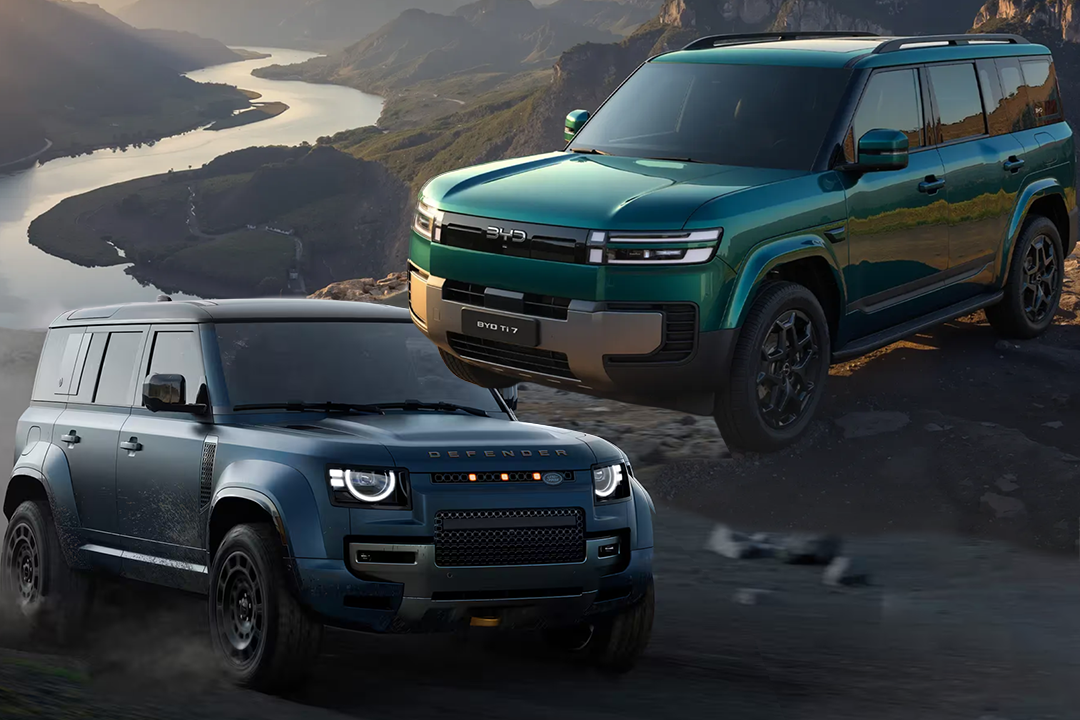
On Nov. 20, a district court in The Hague issued a preliminary injunction barring Chinese electric vehicle giant BYD (002594.SZ) (1211.HK) from importing, selling, or manufacturing its Fangchengbao Ti7 sport utility vehicle across the European Union. The judge ruled that the boxy seven-seater infringes on the registered design of the Defender, the flagship model of British luxury automaker Jaguar Land Rover (JLR), a unit of India’s Tata Motors.
Violating the order carries fines of 100,000 euros ($110,000) per day, capped at 10 million euros. Crucially, the ban also covers BYD’s new European passenger car factory in Szeged, Hungary.
While European courts have previously barred Chinese copycats — such as halting German sales of the Shuanghuan CEO for mimicking a BMW X5 and banning Great Wall Motor’s (2333.HK) Peri in Italy for resembling a Fiat Panda in 2008 — those injunctions arrived only after the cars hit the market. The Ti7 ruling marks a more aggressive pre-emptive strike: blocking a Chinese vehicle before a single unit is sold in the EU.
In a statement, BYD said it “strongly disagrees” with the ruling and vowed to appeal, asserting that the Ti7 is the product of independent design work.
The legal battle over ‘overall impression’
The Hague ruling highlights a growing friction between how Chinese automakers approach vehicle styling and how European intellectual property law defines originality.
In court, BYD did not deny certain similarities that JLR had pointed out, but argued that the Ti7 features distinct headlights, grilles, bumpers, tail lights, and spare-tire covers. The Dutch judge, however, applied the EU’s “overall impression” standard from the perspective of an “informed user” — a legal concept referring to someone who is familiar with the auto market and pays more attention than an average buyer, but is not a design expert who spots minor technical differences.
While acknowledging that a boxy, flat-roof silhouette is shared industry heritage seen in vehicles like the Ford Flex, Jeep Wrangler, and Mercedes-Benz G-Class, the court ruled that BYD replicated the specific combination of features that make the Defender distinctive. These include its bulging rounded shoulders, rounded wheel-arch openings, and a signature body-colored square panel on the rear pillar (known as the C-pillar).
“In law, it isn’t about whether two cars ‘look alike,’ it is about whether there is a substantial difference in the overall visual effect,” Zhao Zhanling, a lawyer at Beijing Weibo Law Firm, told Jiemian News when commenting on the lawsuit.
Because modern electric vehicles often share similar shapes due to battery layouts, aerodynamics, and safety rules, automakers frequently blame design convergence on engineering limits. However, EU law only excludes features dictated purely by technical function; wherever designers still have creative choices, the overall look remains protected.
The legal fight leading up to the ban was fierce. After JLR filed suit in mid-August alleging potential reverse engineering, court-appointed bailiffs entered two of BYD’s offices in the Netherlands later that month unannounced to copy digital research and development records related to the Defender and the Fangchengbao. BYD fought back and sued to overturn the seizure, calling the move a “fishing expedition” aimed at its core trade secrets. On Nov. 11, the court ordered JLR to tell the custodian of the documents to destroy them within 24 hours — only to hand JLR a provisional victory by banning BYD from importing, manufacturing, stocking, or selling the Ti7 across all 27 EU member states
This is a preliminary injunction — a temporary measure to prevent market damage before a final trial — so JLR must now file a full substantive lawsuit within six months to make the ban permanent. Zhao told Jiemian News that the ruling does not guarantee a final verdict of infringement and noted that the two sides could still use the standoff to negotiate a commercial settlement.
Why Porsche and Ferrari stayed out of court
The courtroom clash contrasts sharply with how other European luxury brands have handled even more high-profile design controversies involving Chinese automakers.
Before the BYD lawsuit, one of China’s most famous styling debates centered on Xiaomi. When the smartphone giant launched its first electric sedan, the SU7, in March 2024, industry observers and German media immediately noted its striking resemblance to the Porsche Taycan. The SU7 proved a massive commercial hit, generating nearly 500,000 orders up until Oct. 2026. In May 2025, Xiaomi unveiled its first SUV, the YU7, whose exterior profile — and even its flagship green paint — closely mirrored Ferrari’s Purosangue SUV.
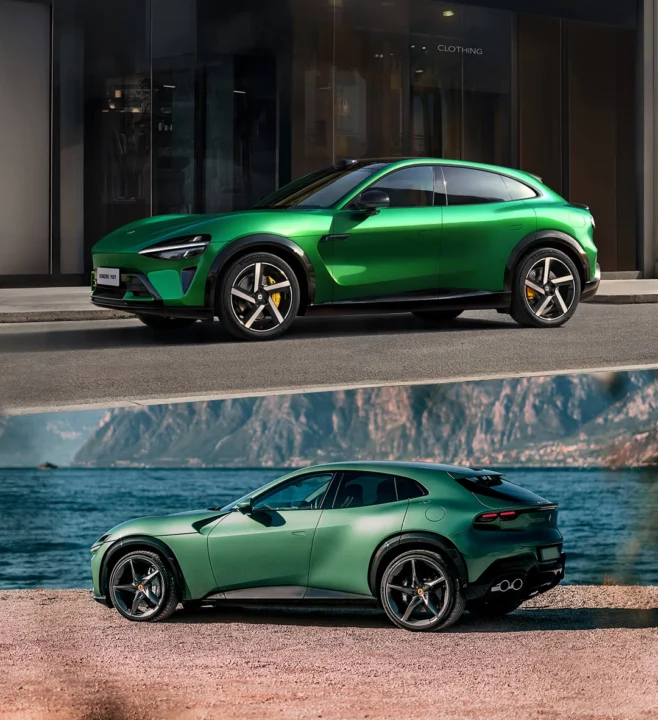
Photo: Xiaomi YU7 (above) and Ferrari Purosangue (below), from Xiaomi and Ferrari.
Neither Porsche nor Ferrari took legal action. Instead, they relied on subtle commentary. Porsche China responded to the SU7 comparisons by remarking that “perhaps good design always thinks alike.” On the eve of Xiaomi’s YU7 launch, Ferrari China posted photos of a green Purosangue on social media celebrating 60 years of original custom colors, while highlighting reader comments praising originality.
Why did JLR send in bailiffs and lawyers while Porsche and Ferrari settled for social media subtweets?
First, Xiaomi does not directly threaten Porsche or Ferrari’s core sales. It mainly targets the mid-end mass market, whereas the two foreign carmakers sit firmly in the luxury tier. Furthermore, suing a domestic tech darling inside China carries public relations risks. Domestic media rarely criticize local automakers directly over their copycat designs, and Chinese consumer sentiment is sharply divided. While some buyers call blatant copying embarrassing, others dismiss European complaints as overblown, arguing that borrowing advanced designs is an inevitable stepping stone. Online defenders frequently point to automotive history — such as when Toyota built its first military utility vehicle in 1951 to resemble the wartime American jeep and officially named it the “Toyota Jeep,” only renaming it the Land Cruiser in 1954 after receiving a legal threat from U.S. jeep maker Willys — or argue that in the modern market, whichever company sells the most cars defines the legitimate design.
For JLR, however, the commercial threat is immediate and existential. The Defender is JLR’s top-selling vehicle, moving over 100,000 units globally in 2025. JLR has long kept its guard up against lower-priced replicas: in 2019, it won a landmark ruling in a Beijing court that halted Jiangling Motors from producing the Landwind X7, an $18,000 copycat of the $52,000 Range Rover Evoque.
High stakes in the European market
In the short term, the Dutch court’s ban brings virtually zero financial damage to BYD. The company currently has no concrete plans to sell the Ti7 in the EU, and the court ruled it has no jurisdiction over BYD’s operations in non-EU markets like Australia or the United Kingdom.
In the UK, the battle is set to play out in showrooms. JLR initiated the Dutch lawsuit after BYD announced on its UK website that the Ti7 was open for orders, with deliveries starting in January 2027. Priced at around $62,900, the seven-seat Ti7 directly undercuts the seven-seat Defender 110, which starts at roughly $90,000.
Yet the broader strategic warning for Chinese automakers is clear. BYD has expanded rapidly since entering Europe in late 2022. Its European vehicle registrations more than doubled year-over-year to exceed 280,000 units in the first nine months of 2026, outselling Tesla, Ford, and Nissan, according to data from the European Automobile Manufacturers’ Association.
The EU injunction closes off the continent to a key large SUV model, complicates production planning for BYD’s new Hungarian plant, and forces the automaker to re-evaluate design compliance across its export lineup.
It also raises a looming question for the rest of China’s auto industry. Unlike BYD, which already boasts strong sales in the UK and the EU, Xiaomi has only recently begun signaling plans to expand into overseas markets. If Xiaomi attempts to bring its Taycan and Purosangue look-alikes into European showrooms, Porsche and Ferrari may no longer confine their responses to social media.
Feature photo: Jaguar Land Rover Defender 110 and BYD Fangchengbao Ti7 side by side. Photos sourced from JLR and BYD, edited by TIA.
Sources
- Dutch court bars Chinese SUV in Europe over resemblance to Land Rover Defender
- 被判抄袭路虎,钛7在欧盟被禁售禁产!比亚迪:独立设计,将上诉| 明镜pro
- 钛7和卫士,像到什么程度算侵权?
- Jaguar wins landmark case against Chinese copy of Evoque model
- Toyota Called the Original Land Cruiser a Jeep, and Willys Freaked Out
- 小米YU7发布,法拉利疑发文暗讽!此前保时捷也曾回应小米SU7“模仿”
- How Xiaomi Beat Tesla, Porsche and Apple by Copying Them