

The company has invested 105.5 billion yuan in chips, operating systems and AI over the past five years as it expanded its electric vehicle business and made safety a priority.
Xiaomi (1810.HK) plans to invest more than 200 billion yuan ($30 billion) in core technologies, including chips, operating systems, artificial intelligence (AI) and embodied intelligence, over the next five years, founder, chairman and CEO Lei Jun said on Oct. 21.
Speaking at the 2026 World Intelligent Connected Vehicles Conference, Lei said the Chinese technology group had invested 105.5 billion yuan in research and development in these areas over the past five years.
Xiaomi decided to enter the car market in early 2021 and delivered its first model in April 2024. In the two and a half years since then, cumulative deliveries have exceeded 800,000 vehicles, with an average selling price of more than 260,000 yuan, Lei said.
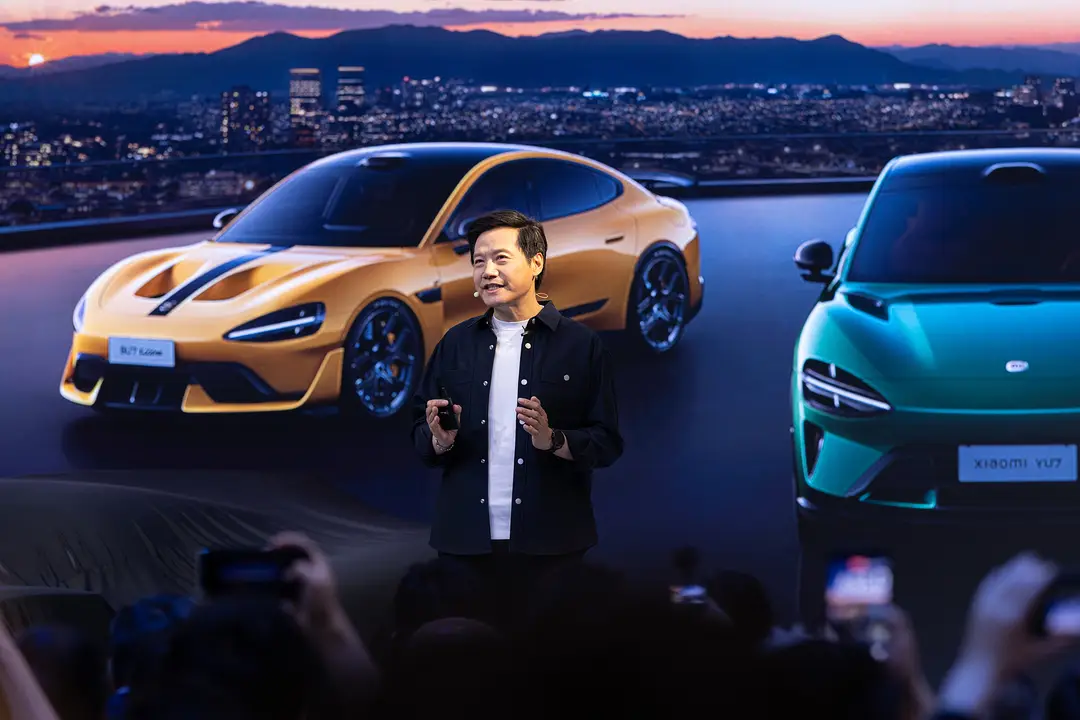
The company also unveiled two range-extended electric vehicle models under its new Pengcheng brand, the Xiaomi Pengcheng N70 and N90. Designed as spacious, adaptable vehicles resembling “mobile homes”, the models will complement Xiaomi’s SU7 and YU7 driving-oriented series, giving the company two distinct product lines focused on driving performance and interior space.
“Building cars is a marathon,” Lei said. Leveraging China’s distinctive advantages in intelligent ecosystems, Xiaomi aims to develop its own approach to innovation and help the automotive industry advance steadily.
AI will transform the entire vehicle
Lei outlined three key areas shaping the future of intelligent connected vehicles.
First, he said AI was moving the industry away from intelligence built around individual functions towards intelligence integrated across the entire vehicle.
Advances in AI are turning cars into simplified physical platforms for embodied intelligence — systems that combine AI with the ability to perceive and interact with the physical world.
Innovation should go beyond adding more features, Lei said. Instead, a powerful underlying AI model could transform the user experience by effectively giving the vehicle a new “brain.”
In September, Xiaomi released version 2.6 of its MiMo foundational AI model. At launch, it ranked fifth globally among foundational models and first among open-source models, according to the company.
As AI continues to evolve, Lei expects the driving and in-car experience to reach a new level.
Safety above all
Lei said safety had been Xiaomi’s overriding principle since it entered the automotive industry. Without safety, he argued, other innovations had little value.
Over the past year, the company has committed to building the safest vehicles in their respective price segments.
To support that goal, Xiaomi has established several dedicated safety teams and structures. These include an independent Vehicle Safety Research (VSR) centre responsible for end-to-end problem analysis and feeding findings back into product improvements, as well as a department overseeing vehicle-wide safety system design.
The company has also created a dedicated safety department led by safety experts to coordinate its overall safety work, strengthened the role of its automotive safety committee and established an advisory committee that brings in specialists from industry, universities and research institutions.
Xiaomi now has more than 3,000 people working in safety-related roles, Lei said.
The company is also conducting extensive real-world testing, including large-scale road tests, range tests on the Beijing-to-Shanghai route and 24-hour endurance challenges. It has held multiple livestreamed vehicle teardowns to show the public details of its vehicles’ construction, workmanship and safety features.
The strength of the connected ecosystem
Lei’s third point concerned Xiaomi’s “Human-Car-Home” ecosystem strategy, which connects smartphones, household devices and vehicles.
He argued that the next phase of competition in intelligent connected vehicles would depend increasingly on the strength of the surrounding ecosystem, rather than on the intelligence of individual cars alone.
China has several advantages in this contest, including a comprehensive industrial supply chain, an active AI innovation environment and the world’s largest single market, he said.
Xiaomi has built what it describes as the world’s largest consumer Internet of Things (IoT) platform. At the end of the second quarter, more than 1.1 billion AIoT devices were connected to its global platform.
The company has also opened up more than 30 types of hardware or interfaces for external use. It is working with automakers including BYD, GAC Toyota, Great Wall Motor and Zhengzhou Nissan, as well as other developers, to build a broader range of connected mobility applications.
For Xiaomi, the ambition is to bring its expertise in consumer electronics, AI and connected devices into the automotive industry — an effort that Lei described as a long-term undertaking.
Source:
IPO Early Insight