

Synthetic actors can now out-earn human influencers, but as Chinese producers capitalize on the boom, globally the AI micro-drama industry is facing a labor backlash.
By Da Cheung
Fang Taozi looks like any other lifestyle influencer on Chinese social media. She shares videos of her new apartment, her daily meals, and her pet dog. She has amassed over 412,000 followers on Douyin, the Chinese sister app to TikTok, and fans regularly flood her comments section to interact with her.
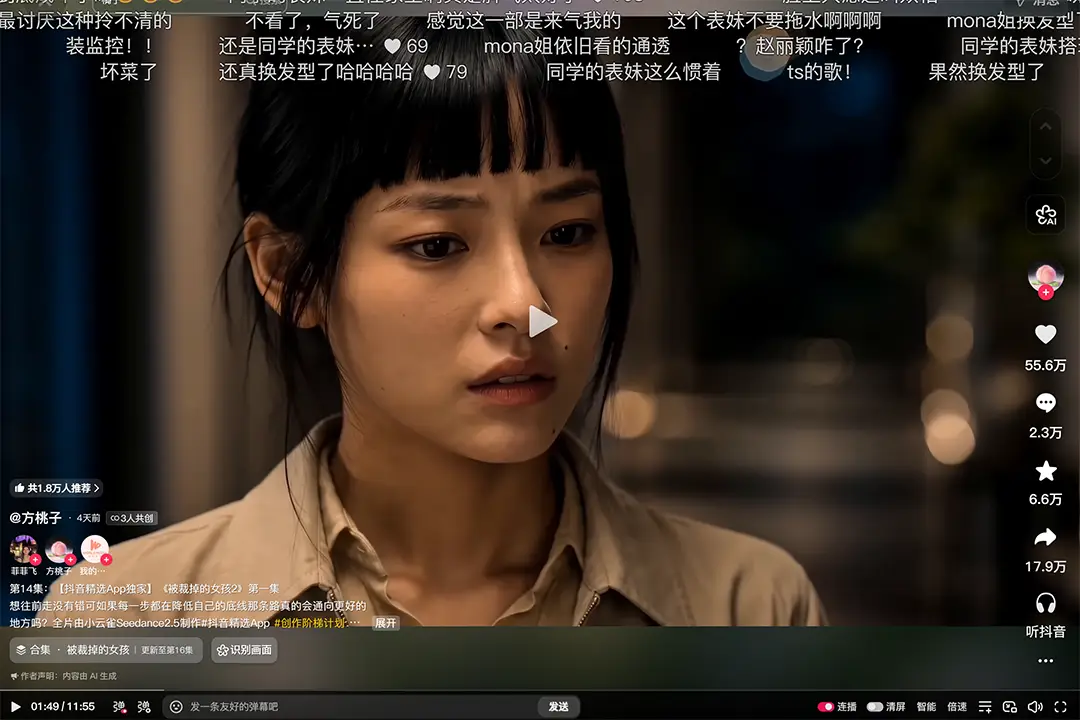
But Fang Taozi does not exist. She is an AI-generated character who made her debut this summer as the lead in the AI micro-drama The Laid-off Girl, which ran for 11 two-minute episodes in its first series and tells the story of a small-town girl who moves to the big city to pursue her dream of becoming a model.
According to data from Xingtu, a Chinese influencer marketing platform, Fang can earn around $36,000 for a 60-second video commercial. While this figure — which purportedly surpasses the rates of many real-life influencers — should be treated with skepticism as it may have been inflated by marketing agencies to hype the nascent AI sector, it reflects a growing reality: synthetic actors are becoming a lucrative business.
Micro-dramas are serialized shows shot vertically for mobile phones, characterized by fast-paced, melodramatic plots. While the format has already captured a massive global audience, the integration of generative AI is now stripping away the need for human actors, physical sets, and large production crews, creating both unprecedented profit margins and brewing labor conflicts.
The Chinese AI short drama market is projected to be worth 40 billion yuan ($5.6 billion) this year and Fang’s rise in popularity highlights a paradigm shift in the entertainment industry.
The sheer volume of AI content flooding the market is staggering. A report cited by the Economic Observer claims that in the first quarter of 2026, AI micro-dramas accounted for more than 95% of the 128,000 micro-dramas released in China. This exceptionally high percentage should be viewed with some caution, however, as it likely includes projects that use AI for minor editing or background generation rather than fully synthetic productions.
The economics of synthetic stardom
The financial appeal of AI-generated content lies in the dramatic reduction in production costs. A traditional premium micro-drama costs up to $220,000 and takes between one and two months to shoot. In contrast, an AI-generated series can be produced for as little $28,000 and as much as $56,000 and can be turned out in 15-20 days.
This low barrier to entry has empowered non-traditional creators. The Laid-off Girl, which has garnered over 200 million views, was created by a three-person team led by a 37-year-old former fashion model. Using an AI video generation platform, the team meticulously designed the character’s micro-expressions, lighting, and wardrobe. According to the creators, the AI’s ability to tirelessly render exact emotional cues, lights and sets allowed them to create higher quality content than they could with traditional means given their limited budget.
Taking a closer look at The Laid-off Girl, Fang Taozi has been generated so convincingly that it’s hard to tell whether she’s a real person or AI generated. But other supporting actors’ faces and expressions look highly similar to common AI generated characters across Chinese video platforms, which hits the uncanny valley — close enough to human to feel familiar, but just off enough to trigger a deep sense of unease in viewers.
The difference between the star of the show and the other characters suggests that the creation team spent most of their budget on the leading actress. It also implies that while current AI video generation technology is good enough, generating every character to the same level of human resemblance would push the micro-drama’s overall production cost far higher and possibly unaffordable.
Global ambitions and cultural roadblocks
Chinese studios are now aggressively targeting the international market. Chinese-produced micro-dramas exported to international markets via apps like ReelShort and DramaBox, generated an estimated $4 billion in revenue in 2025, figure forecast to exceed $5 billion in 2026 .
However, exporting AI dramas is proving more difficult than producing for the domestic market. Industry insiders report that the success rate for Chinese AI micro-dramas abroad is currently less than 1%.
The primary hurdle is cultural localization. Simply swapping a Chinese character’s face for a Western one is not enough to engage international audiences. Creators must adjust micro-expressions, speaking cadences, and cultural nuances — such as replacing a plot about a food delivery rider with one about a security guard, which resonates better with North American viewers.
This intensive localization drives up computing costs. AI models charge based on tokens — the fundamental units of data processed by the algorithm. Because creators must repeatedly generate and discard scenes to perfect foreign cultural nuances, the token cost for an 80-episode international AI drama can exceed 200,000 yuan compared with 60,000 and 70,000 yuan for a domestic audience.
Labor clashes and regulatory reality
As technology improves, the human cost of AI production is becoming increasingly apparent. Western actors are beginning to report that their performances are being cloned into synthetic knockoffs without their consent.
Actor Ashley BeLoat told Business Insider that after starring in a micro-drama for the app MoboReels, she discovered an AI-generated remake of the series on the same platform. The synthetic actor had been altered to look younger but mimicked BeLoat’s exact movements and voice. Other actors have reported similar experiences, raising alarms about intellectual property theft and job displacement in an industry that often relies on non-union, early-career talent.
While Hollywood’s SAG-AFTRA union secured some AI protection for its members in its 2026 contract with studios, the micro-drama space remains largely unregulated in the West, serving as a potential testing ground for broader studio cost-cutting.
In China, the format is already crossing into the mainstream. Traditional television networks began airing fully AI-generated dramas in prime-time slots this summer. Yet, the explosive and largely unchecked growth of the sector has prompted government intervention. On July 1, Chinese regulators implemented the world’s first targeted guidelines for AI-generated audiovisual content, signaling an end to the industry’s wild-west era of unbridled expansion.
Whether audiences will continue to embrace synthetic stars remains to be seen. While AI can drastically reduce production costs, early viewer feedback on sequels to popular AI shows has highlighted a recurring problem: algorithms can generate a flawless face, but they still need to prove that they can consistently write a compelling, human story.
Feature photo: A screenshot from the AI micro-drama, “The Laid-off Girl.”
Sources