
By Su Da
At the 2026 China Household Appliances and Consumer Electronics Expo (AWE 2026), e-commerce giant JD.com signaled a pivot from being a mere retailer of hardware to becoming the central nervous system of the Chinese robotics industry.
The company officially launched its Intelligent Robot Industry Acceleration 2.0 Plan, a sweeping initiative to help its partner brands achieve a cumulative revenue of 10 billion yuan ($1.4 billion) by the end of 2026. To anchor this ambition, JD.com showcased a massive Robot Alliance matrix, featuring over 60 star products from top-tier partners including Unitree Robotics, Shenzhen Zqgame, Cloud Depth, Yuandian Intelligent (Zeroth), and MirrorMe Technology.
The JoyInside strategy
The most significant technical reveal was the deeper integration of JoyInside, JD’s proprietary embodied AI module. Based on the company’s JoyAI large language model, the module acts as a plug-and-play brain for third-party hardware.
By providing the software layer that handles complex human-machine interaction, JD.com is essentially offering an “Android for Robots.” Instead of every startup building their own natural language processing system, they can simply integrate JoyInside. This allows robots to understand nuanced commands and perform complex tasks while maintaining a more empathetic human-like touch, or what the Chinese industry describes as a high-EQ conversational style.
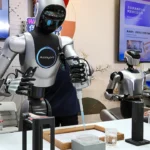
One of the showstoppers at the event was the Unitree R1 JoyInside Edition. This exclusive blue-and-white humanoid robot pairs Unitree’s world-leading motor control—capable of running, boxing, and even backflipping—with JD’s AI brain. The result is a robot that can not only navigate a home but actually hold a natural, fluid conversation with family members.
From silver care to horses
While the heavy industry players like Cloud Depth focused on rugged industrial dogs, the consumer-facing robots stole the spotlight for their focus on the silver economy and lifestyle companionship.
One showstopper was the Zeroth M1 from Yuandian Intelligence — a compact “mini-humanoid” specifically designed for senior care. It doesn’t just monitor for falls or remind owners to take medication; it uses AI to conduct traditional Chinese medicine consultations and can even help elderly users write their memoirs by prompting them with questions about their past.
Another was the BaoBao Robot from MirrorMe — a dual-form robotic unit that can switch between a bipedal humanoid and a quadrupedal dog form. It is designed to follow its owner around the house, acting as an AI tutor for children or a mental wellness companion for adults, switching its physical posture based on the emotional needs of the user.
And there was the Robot Horse from Cloud Depth — a uniquely shaped quadrupedal robot horse focused on emotive, sensory-driven walking, which saw its exclusive pre-sale launch on JD’s platform during the event.
Solving the hardware headache
Beyond the software, JD.com is tackling the two biggest pain points for robotics startups: power and procurement.
The company introduced a standardized battery solution for the industry. By unifying physical structures, interfaces, and communication protocols, JD aims to solve the short-range issue of current robots while significantly lowering the cost of parts for brand partners. Under the 2.0 plan, JD is also opening up its massive internal demand, announcing “hundred-million-level” scale procurement orders to deploy these robots across its own retail, logistics, and healthcare ecosystems.
JD.com says it has already integrated over 200 robot brands into its ecosystem and its message at AWE 2026 was clear: the e-commerce giant is no longer just selling the future of robotics—it is providing the infrastructure to build it.
Source: