

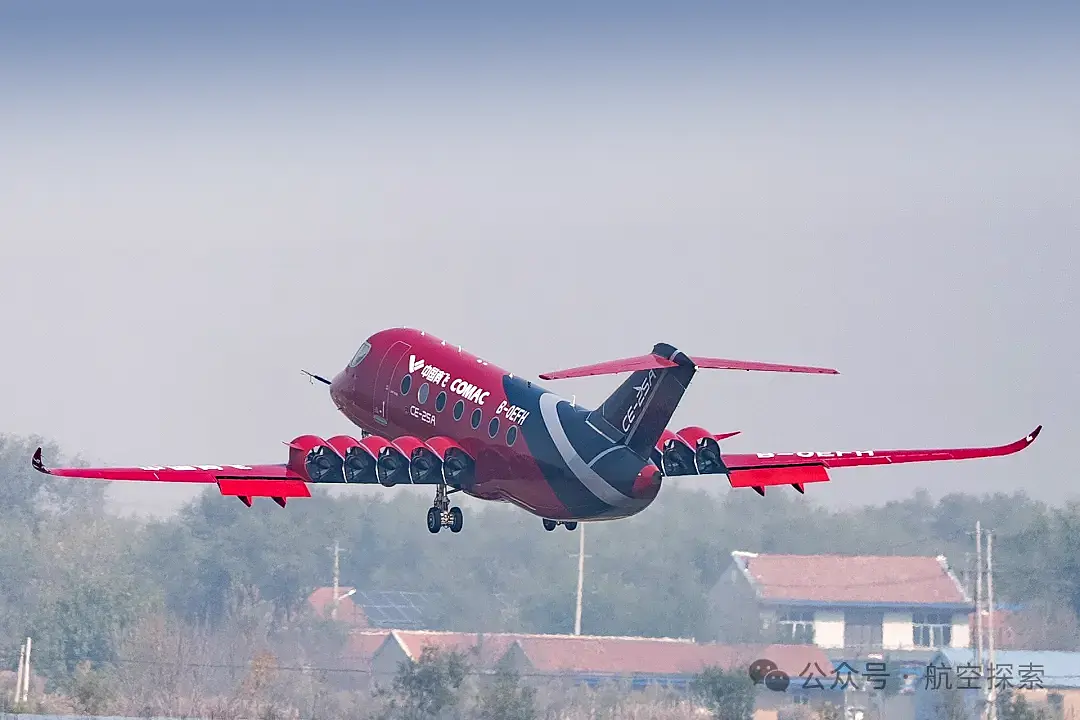
Following its first crewed test flight, COMAC’s 19-seat electric plane highlights China’s supply chain strengths and the steep hurdles facing battery aviation.
By Brent Li
In the electric vehicle market, Tesla is already fending off a wave of aggressive Chinese challengers. Now, in the nascent race to electrify commercial aviation, China and the U.S. find themselves in a remarkably similar position.
On Nov. 14, state-owned Chinese aerospace manufacturer COMAC completed the first crewed flight of its CE-25A, a 10-ton (approximately 22,000-pound), 19-seat all-electric regional aircraft. Taking off from Binzhou, Shandong province, the plane carried two pilots and a flight test engineer, spending 16 minutes and 38 seconds airborne across 60.4 kilometers during a roughly 58-minute total test session, according to the company.
The milestone follows an initial uncrewed flight on Feb. 2 followed by 19 separate autonomous test flights. According to a report by the China Association for Science and Technology, the shift to a crewed cockpit was designed to test human-machine coordination — ensuring pilots can work seamlessly alongside automated flight systems playing a background role.
The flight puts China’s state-backed aviation giant firmly in the global race for battery-powered regional travel, just as several Western competitors face financial and technical turbulence. In August 2026, Los Angeles-based Heart Aerospace flew an even larger all-electric demonstrator, the 25,000-pound X1, in upstate New York. Yet the broader Western sector has struggled with lengthy development timelines. Eviation, whose 16,500-pound Alice demonstrator flew for nine minutes in 2022, laid off most of its staff in early 2025 and placed its project on indefinite hold. Heart Aerospace has pushed its commercial certification target from 2028 to 2031 and shifted its upcoming commercial passenger airliner toward a hybrid-electric design — 30-seat ES-30 backed by United Airlines. The hybrid path is also being taken by France’s Aura Aero for its 19-seat ERA aircraft.
Tapping China’s private EV supply chain
To keep its all-electric ambitions moving, COMAC is leaning heavily on the supply chain built by China’s booming EV and air-taxi industries.
The CE-25A is being developed through a partnership that includes Shanghai Jiao Tong University, Northwestern Polytechnical University, and Chinese battery giant CATL (300750.SZ) (3750.HK), which formed a joint venture with COMAC in July 2023 to develop aviation electric propulsion. CATL has also partnered with domestic electric vertical takeoff and landing (eVTOL) developers to build helicopter-like electric aircraft for short urban hops.
More notably, the CE-25A marks the first time a private Chinese company has supplied the primary flight control computer for a state-developed commercial airplane. That critical system — which acts as the plane’s brain, translating pilot inputs into safe flight maneuvers — has long been dominated globally by Western aerospace suppliers like Honeywell and Collins Aerospace.
For the CE-25A, COMAC turned to Boundary.AI, a Shenzhen-based startup founded in 2020 that previously focused on the eVTOL market. Using its REG300 series flight control platform, the startup adapted computing architecture and testing tools originally built for vertical-takeoff craft to COMAC’s fixed-wing plane.
An unnamed executive at Boundary.AI told Jiemian News that domestic flight control systems can now compete with international suppliers on next-generation electric aircraft projects, though the executive acknowledged that proving international competitiveness will ultimately depend on final certification, delivery, and commercial operation results.
Weight limits, speed trade-offs and ticket realities
Despite the test flight’s success, COMAC’s technical disclosures reveal the steep engineering compromises required to get heavy batteries into the air.
Unlike Heart Aerospace’s X1, which uses four traditional open propellers, the CE-25A is powered by 10 electric ducted fans — five mounted on the upper surface of each wing. Enclosing the spinning nine-blade fans inside cylindrical casings significantly reduces noise and vibration compared to open propellers.
However, the aircraft pays a penalty in weight and speed. With a maximum takeoff weight of 10 tons (22,000 pounds) — largely driven by heavy battery packs likely housed behind six large panels under the fuselage — the CE-25A exceeds the 19,000-pound threshold normally applied to 19-seat commuter planes like the Cessna SkyCourier under standard aviation rules. As a result, COMAC says it is pursuing China’s stringent CCAR-25 transport-category certification, the regulatory equivalent of the U.S. Federal Aviation Administration’s Part 25 rules for large commercial airliners.
While China’s aviation regulator has accepted the CE-25A’s certification application, clearing transport-category hurdles is a lengthy process. Still, an unnamed eVTOL engineer told Jiemian News that because the CE-25A is a conventional fixed-wing plane that uses existing airport runways, it avoids the complex regulatory unknowns facing vertical-takeoff air taxis and will likely reach commercial service sooner.
Slower speeds, higher costs and uncertain economics
Even so, the plane will fly slower than initially promised. COMAC currently lists the CE-25A’s cruising speed during the test at 300 km/h (about 186 mph) with a range of 400 kilometers and a cruising altitude of 2,400 meters. That speed is a sharp downgrade from the 400 km/h advertised when COMAC first unveiled a model of the plane at a Shanghai import expo in 2023, and lags well behind conventional 19-seat fuel-powered turboprops like the Beechcraft 1900 (500 km/h).
The economic case remains equally unproven. While some domestic market projections have claimed the CE-25A could bring one-way intercity ticket prices below 200 yuan ($30), independent experts caution against such promotional hype.
Shen Haijun, a professor at Tongji University’s School of Aeronautics and Astronautics, told Jiemian News that a 200-yuan fare is an idealized calculation lacking real operational data. While electric planes save money on fuel and motor maintenance, Shen noted that battery depreciation, certification costs, airport charging infrastructure, and scheduling expenses remain heavy burdens. Achieving ultra-low fares would require major drops in battery costs and consistently full passenger cabins — conditions unlikely to materialize in the short term.
Unlike electric cars, which have already proven they can challenge and potentially replace internal combustion vehicles, electric commercial planes face much harder physics and economics. How long it will take for battery-powered airliners to offer travelers a cost-effective alternative — or whether pure-electric commercial aviation can truly scale at all — remains an open question.
Feature photo: COMAC CE-25A in its test flight, by Aviation Explore (航空探索)
Sources
