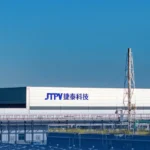


China’s solar giant is battling overcapacity, mounting debt and a costly transition into energy storage as its founding family reshuffles control.
By Feng Ye
JA Solar (002459.SZ), once regarded as one of China’s most resilient photovoltaic manufacturers, is facing its toughest test in three decades. The company reported a net loss of 3.64 billion yuan ($546 million) in the first nine months of 2026, bringing cumulative losses over the past two years to approximately 12 billion yuan. Its debt-to-asset ratio has climbed to nearly 80%.
The figures are striking given that JA Solar remains among the world’s leading solar module manufacturers. It shipped 36.22 gigawatts of modules in the first three quarters, keeping it firmly in the industry’s top tier. But strong shipment volumes have failed to translate into profits.
Revenue fell 23.62% year on year to 28.11 billion yuan, while the loss excluding non-recurring items reached 4.14 billion yuan.
The balance sheet is equally concerning. Total assets stood at 99.3 billion yuan against liabilities of 79.4 billion yuan. Short-term interest-bearing debt totalled 24.2 billion yuan, almost exactly matching the company’s 24.1 billion yuan in cash, leaving virtually no financial cushion.
Foreign-exchange movements have pushed up financing costs, while geopolitical conflicts affecting overseas operations have generated contractual claims and other losses.
The underlying economics of the core business remain challenging. JA Solar’s module gross margin was a negative 4.03% in 2025, meaning higher sales volumes translated into greater losses. It recovered to 1.97% in the third quarter of 2026, but profitability remains wafer-thin.
In October, the company scrapped its 2025 employee share ownership plan, returning 39.5 million shares at their original purchase price. Rivals including Trina Solar (688599.SH), JinkoSolar (JKS.US), Shanghai Aiko Solar Energy(600732.SH) and TCL Zhonghuan (002129.SZ) have also abandoned equity incentive programmes, reflecting the severity of the industry downturn.
A pivot towards energy storage
At 74, founder and chairman Jin Baofang is attempting to reposition the company through an integrated solar-and-storage strategy. He has handed responsibility for energy storage to his elder daughter, Jin Junhui, as JA Solar searches for new sources of growth.
But the business remains small. Revenue from energy storage and related activities totalled just 610 million yuan in the first half of 2026, accounting for 3.5% of total revenue. Rivals including JinkoSolar and Trina Solar have already established more substantial storage businesses.
Whether energy storage can help plug a 12 billion yuan hole is an open question.
Jin’s reputation for caution has long defined JA Solar. Its predecessor, Jinglong Group, entered the solar business in 1996, and the company survived successive industry crises, including the 2008 financial crisis, U.S. and European trade restrictions in 2012, and China’s 2018 subsidy cuts.
One celebrated example of Jin’s risk management came in 2008, when he reportedly cleared the company’s entire inventory as the industry expanded rapidly, avoiding the collapse in prices that devastated competitors holding expensive silicon stocks.
JA Solar became the world’s largest solar cell manufacturer in 2010, with annual cell and module shipments of 1.46 gigawatts.
After delisting from Nasdaq in 2018, it returned to China’s A-share market through a reverse merger in 2019. The timing proved favourable: between 2019 and 2023, revenue rose from 21.16 billion yuan to 81.56 billion yuan, while net profit climbed from 1.25 billion yuan to 7.04 billion yuan.
Jin’s guiding principle was simple: never insist on being number one but always remain among the leaders.
That strategy is now being tested as the industry struggles with massive overcapacity and collapsing module prices. JA Solar is abandoning its previous emphasis on shipment volumes, turning away loss-making orders and shifting towards a balance between price and volume.
The next generation takes charge
The business transformation is unfolding alongside a family succession plan that has gathered pace since 2020, when Jin Baofang was placed under investigation and detained for five months.
His elder daughter, Jin Junhui, resigned from her government position in Hebei and joined JA Solar in 2021. She became a director the following year, took over as chairman of the energy storage business in 2025 and assumed greater responsibility for the company’s China operations in 2026.
Her younger sister, Jin Junmiao, has held positions including procurement director and assistant president, focusing on supply-chain management and strategic partnerships.
Jin Baofang holds 51% of JA Solar’s controlling shareholder, Jintaifu, while Jin Junhui owns 24% and Jin Junmiao 25%.
But their operational responsibilities suggest different roles. The elder daughter is emerging as the leader of the company’s business transformation, while the younger appears more focused on safeguarding the family’s assets.
The eventual succession remains unresolved, however, and there is no guarantee that the energy storage business will provide the breakthrough JA Solar needs.
A brutal industry shakeout
China’s solar industry has undergone two major periods of expansion. The first was characterised by rapid growth, speculation and aggressive capacity investment. Companies led by Suntech Power’s Shi Zhengrong, LDK Solar’s Peng Xiaofeng and Hanergy’s Li Hejun produced a succession of billionaires before excessive expansion and insufficient technological innovation brought many of them down.
The second phase was built on technological progress and domestic supply-chain capabilities, led by companies including Longi, Tongwei and JA Solar. China has since become the world’s dominant solar manufacturing centre, leading in production, installed capacity and generation.
The long-term outlook remains promising. Bloomberg forecasts that solar and wind could together account for 48% of global electricity generation by 2050, attracting more than $4.2 trillion in investment.
But the current downturn is exposing the difference between companies capable of surviving the industry’s brutal cycles and those that expanded too aggressively.
For JA Solar, the immediate challenge is no longer staying among the world’s leading manufacturers. It is finding a way to survive the crisis and emerge ready for the next phase of the energy transition.
Source:
Zhengshang Canyue