
A major compressed-air storage project in Jiangsu is being billed as a breakthrough for long-duration energy storage and renewable power integration.
A major salt-cavern compressed-air energy storage project in Jintan district, Changzhou, Jiangsu province, began full-system operation on Sept. 12 after both generating units completed integrated start-up testing and the stability of the entire system was verified.
The project is being hailed as a milestone for China’s large-scale salt-cavern energy storage industry, demonstrating advances in core technology and system integration while providing a potential blueprint for the wider deployment of long-duration energy storage.
A giant underground battery
Salt-cavern compressed-air energy storage works on a straightforward principle: abandoned underground salt caverns are converted into enormous reservoirs for storing compressed air, allowing the grid to shift electricity from periods of low demand to periods of high demand.
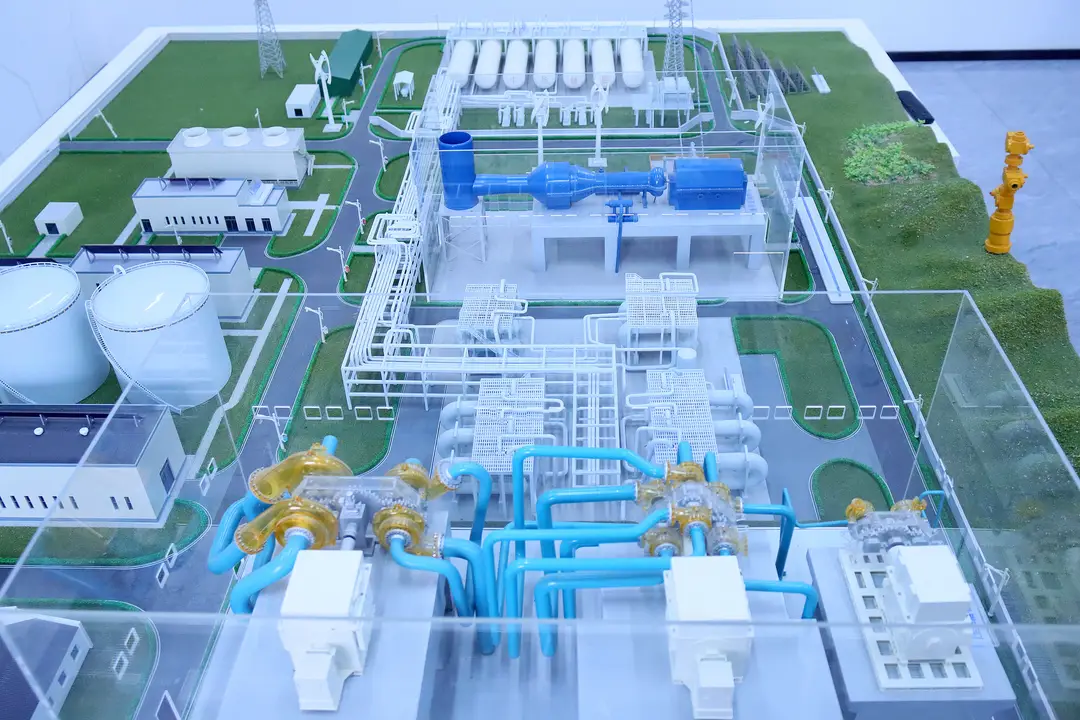
During charging, surplus electricity from sources such as wind and solar power is used to drive compressors, forcing air to pressures of more than 130 times atmospheric pressure. The compressed air is then stored in a salt cavern about 1,000 meters underground. A thermal-storage system captures the heat generated during compression to reduce energy losses.
When electricity demand peaks, the high-pressure air is released in a controlled manner and sent to surface equipment, where it drives generating units and converts the stored energy back into electricity for the grid.
The Jintan facility claims to be the world’s largest project of its kind. At full charge, it can store about 2.8 million kWh of electricity — roughly equivalent to a day’s consumption by more than 10,000 households. It is designed for about 330 charge-discharge cycles a year, allowing it to respond flexibly to fluctuations in grid demand.
Why salt caverns?
China has a range of energy-storage technologies, from pumped hydro and lithium-ion batteries to flow batteries. Salt-cavern compressed-air storage has attracted attention because of the unusual advantages offered by the underground formations themselves.
Salt caverns are a byproduct of salt production. When underground salt deposits are mined, fresh water is injected to dissolve the salt and produce brine. Once the brine is extracted, large cavities remain underground.
These caverns offer three important advantages for compressed-air storage.
First, they are highly impermeable. Salt rock is considerably denser than many other geological formations, making it well suited to containing high-pressure air with minimal leakage.
Second, they can support large-scale storage at relatively low cost. Existing caverns can range from hundreds of thousands to more than a million cubic meters in volume. With relatively limited modification, they can be converted into large underground storage facilities without taking up additional surface land.
Third, they offer long operating lives and high safety. Unlike lithium-ion batteries, they do not face the same risk of thermal runaway, while they are not subject to the geographical and water-resource requirements associated with pumped-hydro storage. Their operating lives can extend for decades, making them particularly suitable for large-scale, long-duration storage.
The concept effectively turns depleted underground salt resources into energy infrastructure, combining resource reuse with the transition to a lower-carbon power system.
A potential answer to renewable curtailment
The significance of the Jintan project goes beyond its status as a large demonstration facility. Its broader value lies in addressing one of the central challenges facing China’s rapidly expanding renewable-energy sector: how to absorb electricity generated when the sun is shining or the wind is blowing, but demand is elsewhere.
Solar generation, for example, can peak around midday, when the grid may have limited capacity to absorb additional power, while evening electricity demand rises after solar output has fallen. Wind generation can similarly fluctuate sharply depending on weather conditions.
Energy storage can bridge that mismatch between when electricity is generated and when it is consumed.
Salt-cavern compressed-air storage is particularly suited to longer-duration applications. Compared with lithium-ion batteries, it is designed for applications lasting four hours or more, with the potential cost advantage becoming more significant as storage capacity and duration increase. It also avoids some of the degradation and safety issues associated with electrochemical batteries.
Compared with pumped hydro, it is less dependent on mountainous terrain and water resources. Locations with suitable depleted salt caverns could potentially be developed even where pumped-hydro facilities would be difficult to build.
For Jiangsu’s power system, the Jintan project is expected to provide peak-load support and help ease pressure during periods of exceptionally high demand. It should also improve the ability of the regional grid to absorb wind and solar generation, storing electricity that might otherwise go unused and releasing it when demand is high.
From demonstration to replication
Perhaps the project’s most important contribution is the validation of a complete large-scale salt-cavern storage system. China has extensive salt resources, and provinces including Jiangsu, Shandong, Henan and Anhui have significant numbers of depleted salt caverns.
If the technology proves commercially viable and can be replicated at scale, those underground formations could provide a substantial new resource for long-duration energy storage.
The Jintan project therefore represents more than an engineering milestone. It is part of China’s broader effort to develop new forms of energy storage capable of supporting a power system increasingly dominated by intermittent renewable generation.
What lies 1,000 meters underground is not simply a store of electricity. It is a potential new piece of infrastructure for managing the transition to a more renewable power system.