
As global demand surges, a brutal domestic price war and cash flow crisis are wiping out smaller Chinese storage firms
By Da Cheung
The global push to integrate renewable energy and power massive AI data centers has created an unprecedented demand for energy storage. Yet, behind the surging installation numbers, China’s energy storage sector is undergoing a brutal wave of bankruptcies and unpaid wage scandals that is wiping out smaller domestic firms.
While top-tier battery manufacturers and system integrators are posting billions in profits, mid-sized and smaller energy storage companies are collapsing under severe cash crunches. They’re trapped in a vicious cycle of relentless domestic price wars, payment delays from state-owned clients, and immediate capital requirements needed to sustain aggressive expansion.
The paradox of booming demand and widespread financial ruin highlights the sector’s transition from a speculative, policy-driven bubble to a more mature market — one where only companies with deep pockets and global reach can survive.
The cash flow trap
For many Chinese energy storage firms, the crisis stems from a flawed business model that prioritized scaling up before profitability.
Companies spent heavily on massive factories, expecting funds to keep flowing and quick returns. However, the reality has proven harsh. Energy storage is a capital-intensive business with notoriously long return cycles. According to industry reports, suppliers typically demand payment within two to five months, while major clients — often state-owned enterprises — frequently delay payments for six to 18 months.
This mismatch has drained corporate reserves. Weijing Energy Storage, a prominent domestic player, recently faced public backlash over unpaid wages from February to July this year, with hundreds of employees seeking arbitration. The company previously raised over 1 billion yuan ($140 million) to build a gigawatt-scale factory, but its flagship facility was operating at only one-third of its designed capacity, according to its chairman. It remains unclear if this utilization rate has improved this year, but the financial strain is evident.
Other established players have already fallen. Narada Power entered a debt restructuring in July after accumulating over 4.1 billion yuan in losses over the previous two years, and Beijing National Battery has entered bankruptcy liquidation.
Compounding the cash flow crisis is a severe domestic price war. Over the past two years, the price of energy storage systems has plummeted by more than 60%, dropping below 0.6 yuan per watt-hour. While this drop makes energy storage more economically viable for grid operators, it has decimated profit margins for system integrators, pushing many into the red.
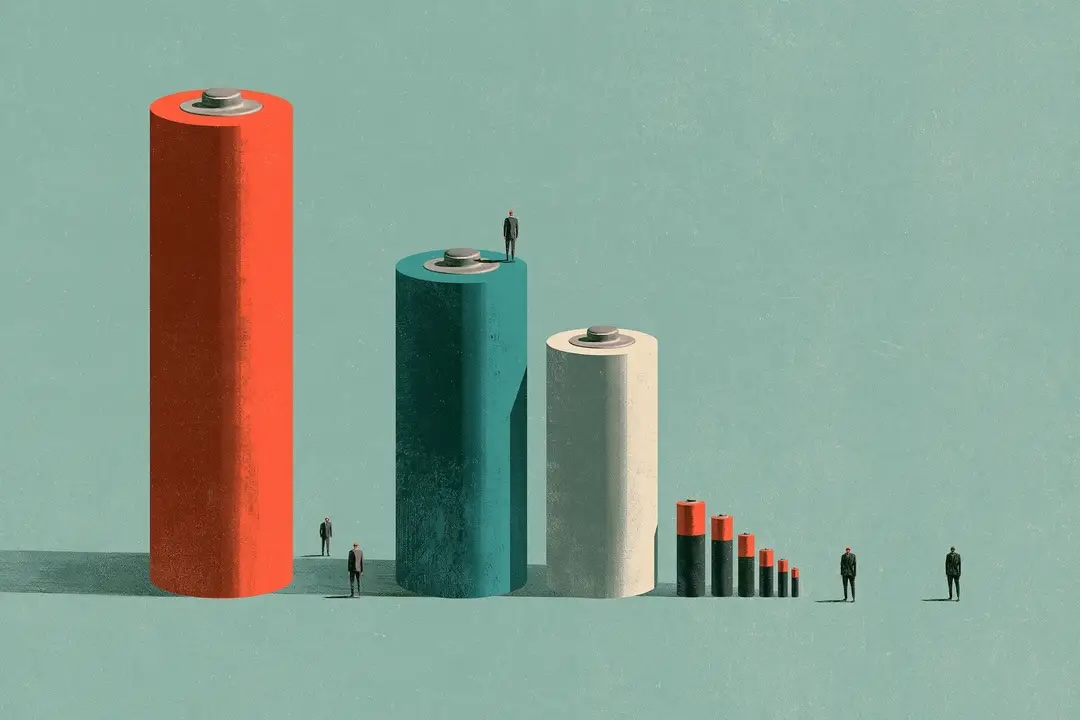
The ‘Matthew effect’ and battery giants
As smaller firms suffocate, a classic “Matthew effect” — where the rich get richer and the poor get poorer — is taking hold. The market is rapidly consolidating around companies that can deliver massive, gigawatt-hour (GWh) scale orders. A single GWh represents enough capacity to power a small city for an hour, and these massive projects require suppliers with proven operational stability and deep financial resources.
Deep-pocketed market leaders are capturing the lion’s share of these contracts. In the first half of 2026, Contemporary Amperex Technology Co. Ltd. (CATL)(3750.HK; 300750.SZ), Hubei Zhongchuang Chuneng New Energy, and EVE Energy (300014.SZ) secured over 45% of domestic battery cell bids. Similarly, top system integrators like CRRC Zhuzhou Institute are dominating large-scale state procurements.
Financial reports from the top eight Chinese battery makers show a combined net profit of over 56 billion yuan in the first half of 2026. However, these figures, often highlighted in company press releases to project industry dominance, require critical context. The primary revenue engine for these battery giants remains electric vehicle batteries, not energy storage.
For example, while CATL reported 53.26 billion yuan in energy storage revenue for the first half of 2026, its automotive battery revenue was nearly four times larger at 192.1 billion yuan. Furthermore, despite the revenue growth in energy storage, CATL’s gross profit margin for the segment actually dropped by 1.56 percentage points compared to the previous year, underscoring intense price pressure even the biggest players face.
Looking abroad for survival
To escape razor-thin domestic margins of 10% to 15%, Chinese energy storage firms are aggressively targeting overseas markets, where margins can reach 20% to 30%.
Global demand is accelerating, driven by the urgent need for grid flexibility to support renewable energy and the massive electricity requirements of emerging AI data centers. Markets in Europe, the U.S. and emerging regions in Asia and Africa are increasingly relying on battery storage to stabilize their power grids.
However, transitioning from a domestic manufacturer to a global operator presents mounting hurdles. Western trade protectionism, such as measures contained in the U.S. Inflation Reduction Act and Europe’s Net-Zero Industry Act, imposes strict compliance standards and push for localized manufacturing.
According to the companies, major players like CATL and Sungrow (300274.SZ) are accelerating their overseas capacity layouts, planning factories in Europe, the U.S., and Southeast Asia. Yet, for smaller firms lacking the capital to build overseas facilities or navigate complex international certifications, the global market remains out of reach.
Domestically, the sector is finding a more sustainable footing through new market-driven capacity pricing — a system that provides stable base payments to storage facilities just for being available to the grid. While this signals a shift toward long-term economic viability, the ongoing industry shakeout suggests that the benefits of this “real growth” will be reserved exclusively for the giants left standing.
Sources