

Meituan Longzhu and Hillhouse double down as new strategic backers join, fueling the 16-month-old company’s quest for net-energy gain by 2029.
By Peng Li
Chinese fusion energy startup NovaFusionX has raised 1.2 billion yuan ($165 million) in a new Pre-A financing round, with existing investors Meituan Longzhu and Hillhouse Capital increasing their stakes and Lenovo Capital and Guozhong Capital joining as new strategic investors.
The funding will support the company as it simultaneously pursues Q>1 net fusion energy gain and develops the infrastructure needed for a commercial fusion power plant.
Founded just 16 months ago, Nova Fusion has now raised a total of 2.4 billion yuan, giving it a post-money valuation of more than 10 billion yuan. It is currently China’s highest-valued privately owned fusion company.
A team focused on FRC-SMR
NovaFusionX was founded by Dr. Guo Houyang, a fellow of the American Physical Society and a national-level foreign expert in China. He is a pioneer and inventor of FRC-SMR, a small modular fusion technology based on the field-reversed configuration (FRC).
Guo has worked on major tokamak projects in China, the U.S. and Europe. In the FRC field, he previously led a major U.S. Department of Energy research program and served as chief scientist and head of experimental R&D at TAE Technologies, a leading FRC fusion company.
The company now has more than 60 employees, with senior experts leading its core technical areas. The team includes researchers and engineers from leading institutions, universities and technology companies in China and overseas.
“People used to question whether we could build a cohesive team,” Guo said. “But over the past year, we’ve assembled a very strong group.”
Nova 1 enters assembly
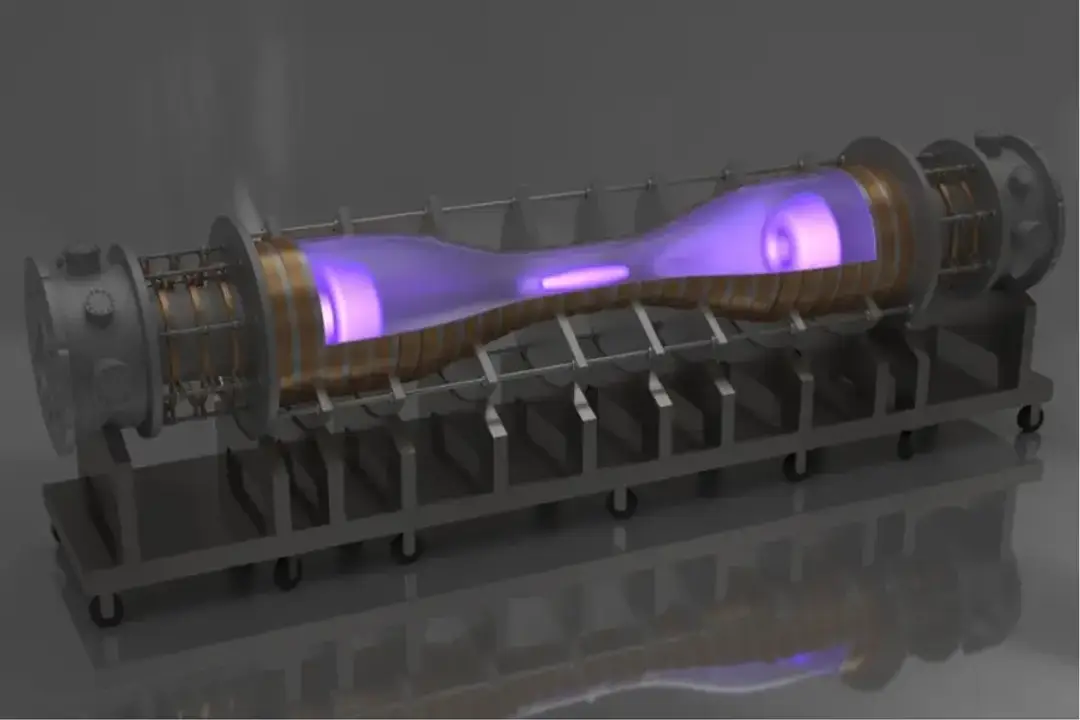
The company’s first device, Nova 1, has completed engineering design and development of its core components and has entered final assembly and integration.
NovaFusionX says it has made breakthroughs in four areas needed for the device. These include a high-power, all-solid-state pulsed-power supply that overcomes bottlenecks in peak current and current rise rate, potentially reducing system costs and improving reliability.
The company has also developed modular high-field magnets designed to strengthen the compression field and extend plasma confinement time, as well as large quartz vacuum chambers produced with a Chinese specialty-materials manufacturer.
The fourth technology is a nanosecond-level control and data-acquisition system using an all-optical communications architecture designed to protect against electromagnetic interference in the fusion environment.
Guo said key components in all four areas have been developed in-house, with the pulsed-power systems and magnets already entering large-scale production. The breakthroughs have also helped fill gaps in China’s domestic supply chain for the FRC-SMR approach.
Nova 1’s vacuum pumping, diagnostics and fueling systems have been finalized, its testing platform is ready and the foundation work is complete. The company is targeting first plasma discharge by the end of 2026 and aims to achieve a plasma temperature of 100 million degrees Celsius in 2027.
It is targeting Q>1 by 2029 and hopes to build a 50-100 MW commercial demonstration plant in the first half of the 2030s.
Parallel development to save time
Guo said achieving 100 million degrees Celsius will be a critical milestone because it is a basic condition for controlled fusion and a prerequisite for reaching Q>1.
He argues that the FRC approach could require less energy to reach net power generation because it uses magnetic compression to heat plasma efficiently, with fewer intermediate energy losses.
“Once Q>1 is achieved, we’re just one step away from net power generation,” Guo said, estimating that a Q of around 1.5 could be sufficient, compared with Q>20 potentially required by some other approaches.
For the next stage, NovaFusionX plans to develop its technology in parallel rather than sequentially.
“The most important issue for us now is no longer simply technology, but time,” Guo said.
The company plans to begin construction of Nova 2 before Nova 1 has achieved all its milestones. It is also studying how to bring forward construction of a demonstration reactor, initially targeting Q>1 with Nova 2.
Rather than building a new reactor afterward, NovaFusionX hopes to upgrade the same device with improved power and control systems and ultimately turn it into a 50 MW power plant. Guo said this could save several years of construction time, with the company targeting a demonstration reactor by 2030.
Investors see a market beyond fusion
The company is also considering commercializing some of its technologies outside fusion. Guo said its high-power pulsed-power technology could have applications in nuclear medicine, electromagnetic launch systems, rail transportation, electricity and energy storage.
Investors are particularly focused on the potential demand for electricity from AI data centers.
Meituan Longzhu partner Wang Xinyu said FRC technology could be well suited to the large and rapidly growing power requirements of AI data centers, adding that the fund has confidence in NovaFusionX’s engineering roadmap.
Lenovo Capital said fusion could become a huge market and a major area of U.S.-China technological competition. It sees tokamak technology as suited to large-scale power generation, while FRC-SMR’s potentially lower cost and modular design could make it suitable for distributed energy supplies for AI, aerospace and other applications.
Guozhong Capital likewise described controlled fusion as a strategic future energy technology, saying the AI boom could make it an important option for powering data centers. It highlighted FRC’s relatively simple structure, lower costs and potential for rapid iteration, as well as Guo’s experience in the field.
For NovaFusionX, the latest funding provides the capital to pursue an aggressive development strategy: advance FRC-SMR toward Q>1 while laying the groundwork for a commercial fusion power plant.
Source:
HardCore