

China’s push into nuclear fusion is no longer just a state-led moonshot. A fast-rising private startup, NovaFusionX, is positioning itself at the intersection of next-generation energy and the exploding power demands of artificial intelligence—backed by some of the country’s most influential investors.
The Shanghai-based company said last week it raised an additional 700 million yuan ($103 million), bringing total funding to about 1.2 billion yuan just one year after its founding. The speed of that fundraising — unusual even by China’s standards — signals growing investor conviction that fusion could move from scientific ambition to commercial infrastructure, especially as AI workloads strain existing power systems.
Unlike many of China’s large-scale energy initiatives, NovaFusionX is not state backed. Its investors include Hillhouse Capital, Legend Capital and Luminous Ventures, along with a fund linked to internet giant Meituan. That last name is particularly telling: China’s tech platforms are rapidly scaling AI capabilities and could become major future buyers of fusion-generated electricity if the technology delivers on its promise of abundant, low-cost power.
Private capital enters a strategic sector
China is still playing catch-up with the U.S. in nuclear fusion, where companies have spent decades refining competing approaches. But momentum is building quickly. Alongside NovaFusionX, state-owned heavyweight China National Nuclear Corp. last year launched China Fusion Energy Co. with 11.5 billion yuan in initial capital, backed by major state players including PetroChina, state-backed National Green Development Fund, and large power utilities.
The contrast highlights a two-track strategy: state-led, large-scale infrastructure on one side, and more agile, venture-backed experimentation on the other. NovaFusionX currently stands out as the most prominent private contender.
A similar dynamic is unfolding globally. In the U.S., Big Tech has already moved aggressively into fusion as both investor and future customer. Google has backed TAE Technologies and struck power purchase agreements with Commonwealth Fusion Systems, while Microsoft has signed a deal to buy electricity from Helion Energy. These arrangements underline a central shift: fusion is increasingly being driven not just by governments, but by hyperscale computing demand.
A modular approach to fusion
Technologically, NovaFusionX is pursuing a different path from many of its rivals. Its focus is on field-reversed configuration small modular reactors (FRC-SMR), designed to generate power at a smaller, distributed scale rather than through massive, centralized plants.
That approach could prove significant. Modular systems producing 50 to 100 megawatts per unit would be better suited to on-site or near-site deployment—potentially attractive for data centers and industrial users seeking dedicated, stable power supplies. In contrast, traditional fusion concepts tend to mirror today’s large power stations, which require extensive grid infrastructure.
The company’s founder, Guo Houyang, is a key part of its appeal. A former researcher in the U.S. and China with deep experience in plasma physics, Guo has worked on cross-border fusion projects and is considered a specialist in FRC-based systems. His international background reflects a broader trend of overseas-trained scientists returning to China to commercialize advanced technologies.
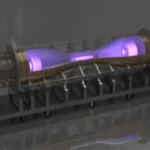
NovaFusionX’s first prototype, known as Nova One, is currently under construction. The company aims to achieve its first plasma discharge—an early but critical milestone—by the end of this year.
Long timelines, rising capital needs
Despite rapid early fundraising, NovaFusionX remains at a very early stage. Like all fusion developers, it faces long timelines, high technical uncertainty and substantial capital requirements. The company is targeting commercialization in the mid-2030s, broadly in line with industry expectations.
Its funding to date also remains modest compared with global peers. Commonwealth Fusion Systems has raised roughly $3 billion, while TAE Technologies and Helion Energy have each secured more than $1 billion. Even China Fusion Energy Co., the state-backed entrant, launched with funding exceeding NovaFusionX’s total so far.
That gap underscores a central reality: fusion remains one of the most capital-intensive bets in deep tech. Startups must continuously raise funds over many years before generating meaningful revenue—if they succeed at all.
Still, investor appetite is strengthening. Global fusion funding reached $2.2 billion last year, up sharply from the previous year, according to the Fusion Industry Association. The resurgence reflects both technical progress and the growing urgency of energy supply as AI scales.
From science project to capital markets story
With commercialization still a decade away, the next question is when fusion companies might tap public markets. Profitability has rarely been a prerequisite for listings in high-growth sectors, and fusion’s strategic importance could make it attractive to investors even in its pre-revenue phase.
Some early moves are already underway. TAE Technologies recently outlined plans to go public through a merger with U.S. President Donalt Trump’s Trump Media & Technology Group, although other major players have yet to announce listing timelines.
For NovaFusionX, continued access to private capital should sustain operations in the near term. But if China’s IPO markets remain receptive—and if AI continues to drive demand for new energy solutions—the company could emerge as a candidate for a high-profile listing later this decade.
In that sense, NovaFusionX is not just another fusion startup. It represents an early test of whether private capital, rather than the state, can accelerate China’s entry into one of the most technically challenging and strategically important industries of the AI era.
Source:
NovaFusionX shines as China’s private sector answer to nuclear fusion