

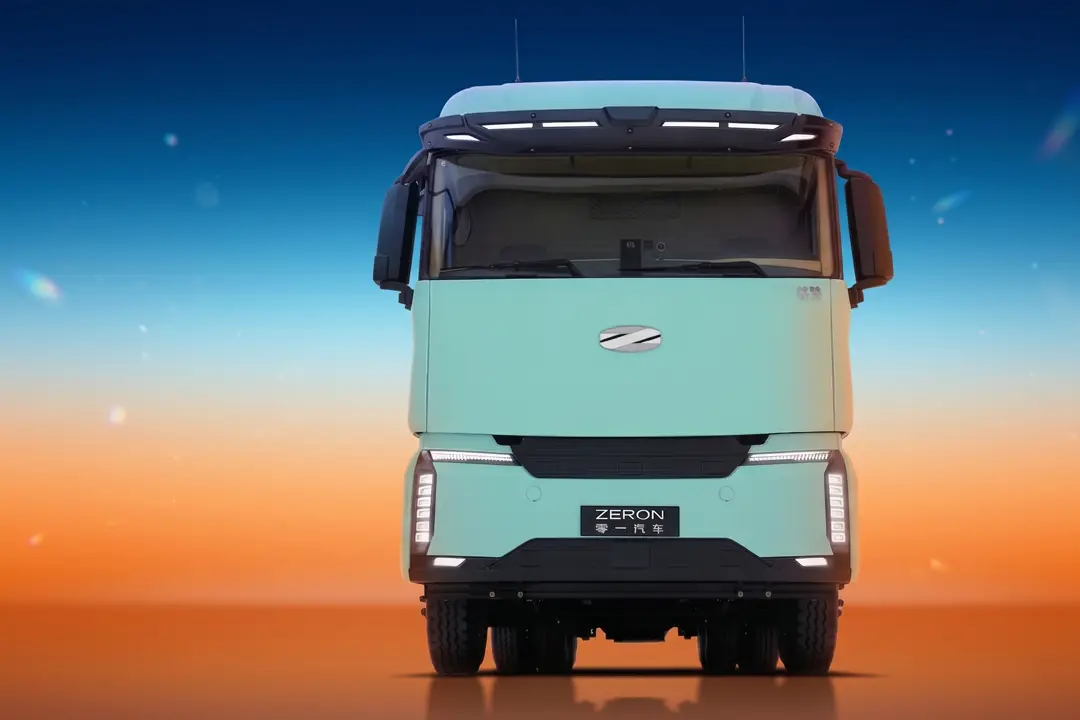
By Da Cheung
Unlike new energy passenger vehicles, heavy-duty trucks have historically flown under the radar of the general public. However, a quiet revolution is taking place on China’s highways. On Thursday, Zeron, a Chinese electric commercial vehicle startup focused on autonomous trucking, officially filed a prospectus for a listing on the Hong Kong Stock Exchange.
Set up by Huang Zehua, co-founder of the autonomous driving pioneer TuSimple, and Zhang Hongsong, former general manager of Sany Heavy Truck, the startup is backed by heavyweights including battery giant CATL (3750.HK) (300750.SZ), Singapore sovereign wealth fund Temasek, and autonomous driving software developer Momenta. The company recently announced an additional, large Pre-IPO funding round, bringing its total capital raised to more than $310 million.
Shifting gears from software to hardware
Zeron’s trajectory is deeply tied to the fate of TuSimple, which went public on the Nasdaq in 2021 only to delist three years later. Once hailed as the world’s first publicly traded autonomous driving company with a valuation exceeding $16 billion, TuSimple struggled to make driverless vehicles commercially viable. In addition to geopolitical aspects, a key reason for its downfall was the lack of hardware integration; traditional manufacturers were reluctant to custom-build trucks for them, forcing TuSimple into expensive, retrofitted solutions — often referred to as “oil-to-electric” models — that failed to achieve commercial scale. These retrofitted trucks suffered from limited cargo space, poor range, and unstable overall performance, making them a mere stopgap rather than a long-term solution for commercial autonomous trucking.
Learning from TuSimple’s failure, Zeron and its peers are embracing a “forward engineering” approach — designing electric and autonomous truck architectures from scratch rather than modifying existing diesel models. Zeron claims to be the world’s first company to simultaneously possess forward-engineered vehicle development capabilities and an end-to-end multi-modal large language model for autonomous driving. (An end-to-end model simplifies autonomous systems by using artificial intelligence to directly translate sensor data into driving commands, completely replacing complex modular programming). The startup delivered 1,176 vehicles in 2025 and 778 vehicles in the first four months of 2026.
Zeron is not alone in this race. Another major player, DeepWay, filed its IPO prospectus in November 2025 and claims multiple industry-leading positions. DeepWay says it is the first company globally to achieve mass delivery of forward-engineered intelligent new energy heavy-duty trucks. It delivered 8,020 vehicles in 2025 and 1,409 in the first quarter of 2026. DeepWay also claims to have a paid subscription rate of 30% for its advanced driver-assistance systems — compared with an estimated 12% reported by Tesla’s FSD.
Industry experts argue that autonomous heavy-duty trucks will likely achieve commercial viability much faster than autonomous passenger vehicles, or robotaxis. That’s because trucks primarily operate on predictable, fixed highway routes and carry freight rather than human passengers, which means the technical challenges and safety liabilities are significantly lower.
Consolidation and legacy transitions
The proliferation of startups and the rapid influx of capital have led to an early wave of industry consolidation, as companies recognize the need to integrate software and manufacturing early on. Because the market is highly fragmented with numerous emerging players, alliances are forming rapidly. This is clearly visible in the recent partnerships forged by China’s autonomous driving technology leaders. Momenta led a 500 million yuan ($69 million) Series A investment round in Zeron.
Meanwhile, robotruck and robotaxi developer Pony.ai announced a partnership with Sany Heavy Truck and Dongfeng Liuzhou Motor to jointly develop and mass produce trucks using its fourth-generation autonomous driving system. Traditional heavy machinery giants are placing bold bets on this transformation. Sany Heavy Industry (600031.SH), one of China’s largest heavy equipment manufacturers, closed its internal combustion engine (ICE) truck production lines in 2021 to go all-in on new energy models.
Economics over emotion
China’s logistics industry relies heavily on road transport, creating a massive addressable market for heavy-duty trucks. New energy vehicles are gaining ground in this sector. In December 2025, the sales penetration rate of new energy heavy trucks in China crossed 50% for the first time. While Net Zero Age notes that this milestone was partly driven by the impending reduction of government subsidies in 2026, the overarching trend is undeniable.
In the passenger car market, consumers often buy ICE vehicles for emotional reasons, brand loyalty, or driving feel. In contrast, logistics fleets are governed by the total cost of ownership. CATL claims an electric heavy-duty truck can save operators around 1.2 million yuan over a 10-year life cycle compared with its diesel equivalent. The expansion of charging infrastructure is fueling this shift. Major routes, such as the 220-kilometer Ningbo–Yiwu corridor — a key freight link between one of China’s largest ports and the world’s biggest wholesale market — are now fully supported by battery-swapping and fast-charging networks. Swapping stations allow trucks to replace depleted batteries in minutes, removing the range anxiety problem. Because commercial buyers prioritize economic viability above all else, the penetration rate of electric heavy-duty trucks could eventually surpass that of passenger vehicles once infrastructure becomes universally accessible.
In China’s passenger vehicle market, emerging domestic EV brands often outpace legacy automakers on terms of sales. With consumer electronics giants like Xiaomi entering the fray and rolling out chart-topping models, early pioneers like Tesla are starting to feel almost like traditional brands. If this dynamic is applied to the commercial vehicle sector, it is highly likely that startups like Zeron and DeepWay will soon leave legacy truck manufacturers in the dust.
Original Sources