
By Li Hezi
Three companies. Less than two months. Three different claimants to the title of world’s fastest electric vehicle (EV) charging.
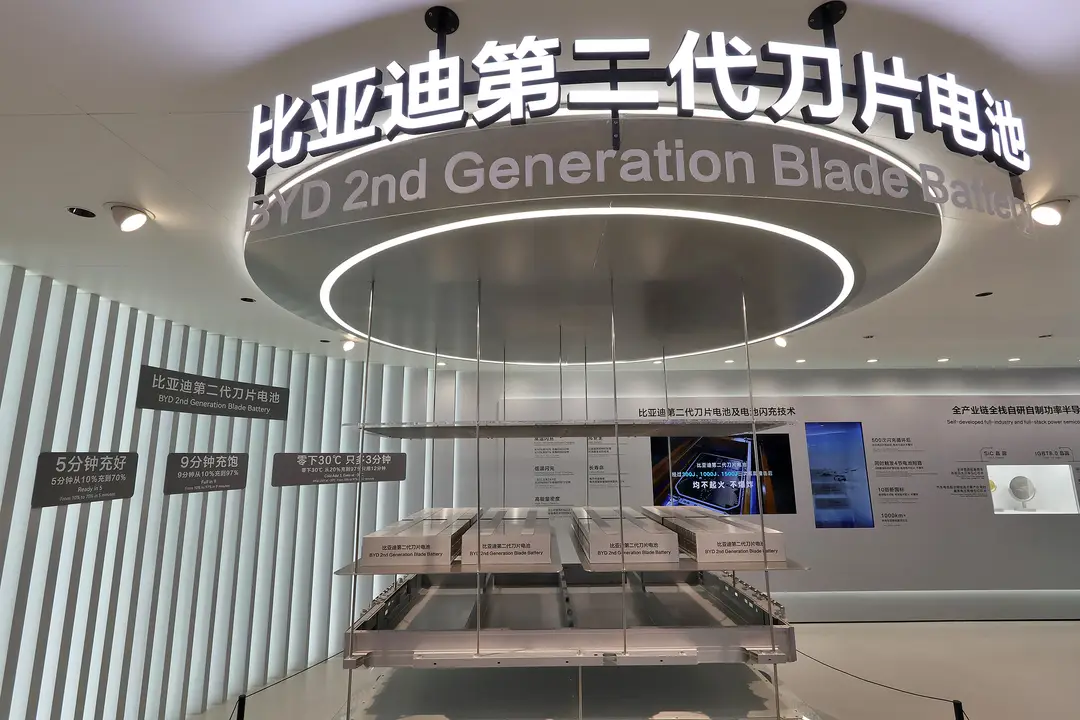
First came BYD (002594.SZ) (1211.HK). On March 5, Chairman Wang Chuanfu unveiled the company’s second-generation Blade battery, claiming it could charge from 10% to 70% in five minutes and from 10% to 97% in nine minutes — describing it as a new world record.
The same day, BYD launched its “Flash Charging China” strategy, pledging to build 20,000 flash-charging stations nationwide by the end of 2026 and unveiling more than 10 compatible vehicle models.
Just 33 days later, Geely’s (0175.HK) Lynk & Co 10 sedan overtook the record. With Geely’s new 900-V Energee Golden Brick battery technology, the car charged from 10% 70% in four minutes and 22 seconds.
Two weeks later, CATL, the world’s largest manufacturer of lithium-ion batteries for EVs, claimed another breakthrough, unveiling its third-generation Shenxing battery with a 10% to 98% charging time of six minutes and 27 seconds.
The rapid succession of announcements has exposed both the intensity of China’s EV charging race and the absence of any agreed definition of fastest.
A race without standards
The competition is not simply about batteries. It is increasingly a struggle over standards, infrastructure and control of the EV charging ecosystem.
The problem is that no one agrees on the definition of ultra-fast charging. Local governments in some regions of China classify chargers above 350kW as ultra-fast, while others use 500kW as the threshold. China’s megawatt-level charging standards and communication protocols also remain fragmented, with rival companies lobbying regulators to adopt their own systems.
“Whoever gets their standard adopted gains the upper hand,” said one industry executive.
The lack of standardisation creates immediate compatibility problems. Vehicles optimised for one company’s charging network may perform far more slowly on another’s infrastructure.
Lynk & Co’s record-setting results, for example, were achieved on Zeekr’s proprietary charger, while BYD’s figures relied on its own 1,500kW charging piles.
The result is a fragmented market in which operators are uncertain which systems to build, automakers do not know which standards will prevail, and drivers risk finding future cars incompatible with older charging stations.
Three competing approaches
BYD is pursuing a vertically integrated strategy spanning batteries, vehicles, charging stations and energy storage. The company has moved faster than rivals in commercialising the technology, launching more than 10 compatible models on the same day it unveiled its latest Blade battery.
But the infrastructure rollout will be expensive. Chinese media estimates suggest each flash-charging station costs around 700,000 yuan ($103,000), implying total investment could exceed tens of billions of yuan.
CATL has taken a different route, positioning itself as an open battery supplier rather than a vehicle maker. Alongside its fast-charging battery technology, it plans to build 4,000 combined battery-swapping and charging stations by the end of 2026 with partners including Changan Automobile and Chery.
Huawei has adopted a third model focused purely on infrastructure. Rather than making cars or batteries, it is building charging equipment and energy-management systems, particularly for electric heavy trucks.
Huawei has helped establish high-capacity charging corridors for commercial vehicles across China and is promoting shared standards that would allow multiple brands to use the same charging network.
Do drivers really need five-minute charging?
For all the hype, one key, but rarely asked question is: do consumers actually need batteries that charge this fast?
Automakers often compare ultra-fast charging with refuelling petrol cars, but the comparison is imperfect. Charging claims typically measure only the time electricity flows into the battery, excluding the time needed to locate chargers, connect cables and complete payment.
Performance also depends heavily on ideal conditions, including battery temperature, low starting charge levels and exclusive access to high-powered chargers.
Even if “refuelling parity” becomes technically possible, the practical gains may be limited. The jump from overnight charging to one-hour charging transformed EV usability. Reducing charging times from 30 minutes to five minutes, however, offers diminishing returns for most drivers.
According to China’s National Energy Administration, private chargers now account for 77% of the country’s charging infrastructure. Most drivers travel less than 50km a day and recharge overnight at home.
For them, reliability matters more than headline charging speeds. The bigger frustrations are broken chargers, long queues and unavailable charging bays.
Commercial fleets are different. Electric trucks, logistics operators and ride-hailing vehicles can directly convert faster charging into higher revenues because reduced downtime improves utilisation.
The likely outcome is not a single dominant solution but a mixed ecosystem: home charging for daily use, battery swapping for fleets and ultra-fast charging for long-distance travel and emergency top-ups.
The battle over the “world’s fastest charging” title is about far more than speed. It is a contest over who will define the standards, infrastructure and user experience of the next generation of electric vehicles.
Source:
Auto Business Review