

By AGI-Signal
China’s hydrogen bus industry is caught between two conflicting realities. While policymakers continue to promote hydrogen as a strategic emerging industry and local governments place large procurement orders, operators across the country are quietly sidelining vehicles that have become too costly to run.
The contradiction highlights a deeper question facing China’s hydrogen economy: whether the technology is commercially viable or primarily a vehicle for industrial policy.
At a recent hydrogen energy conference in Kunshan, Jiangsu province, officials described the sector as entering a new phase of large-scale development. Industry data show that 1,832 hydrogen fuel-cell vehicles were delivered in the first four months of 2026, while Beijing has launched a second round of national hydrogen demonstration programs.
Yet in Foshan, one of China’s leading hydrogen hubs, dozens of nearly-new hydrogen buses sit idle in a parking lot. Notices on their windshields explain that the vehicles have been withdrawn from service after reaching required operating mileage targets.
The buses are not broken. They have simply become uneconomic to operate.
Physics and economics
Hydrogen-powered buses appear attractive on paper. Fuel cells generate electricity through a reaction between hydrogen and oxygen, producing only water as a byproduct. Refueling takes less than 15 minutes and vehicles can travel 500 to 800 kilometers on a full tank.
The challenge lies in efficiency. Producing hydrogen, compressing it, transporting it and converting it back into electricity involves substantial energy losses. Researchers at the University of Strathclyde estimate that battery-electric vehicles ultimately utilize 70% to 80% of the electricity supplied to them, compared with roughly 30% for hydrogen vehicles.
Hydrogen also requires costly infrastructure. Refueling stations can cost tens of millions of yuan to build, while storage and transport remain expensive because hydrogen must be kept under very high pressure.
The economic case is equally difficult. Foshan invested more than 1 billion yuan ($148 million) to acquire nearly 1,000 hydrogen buses, many costing around 1.8 million yuan each, more than double the price of comparable electric models.
Purchases were supported by subsidies of up to 800,000 yuan per vehicle, provided operators accumulated at least 20,000 kilometers of service mileage. That encouraged bus companies to keep vehicles running despite losses.
Industry data suggest hydrogen buses cost about 1.8 yuan per kilometer to operate, compared with roughly 0.8 yuan for electric buses. Once subsidy requirements were met, operators had little incentive to continue using the more expensive vehicles.
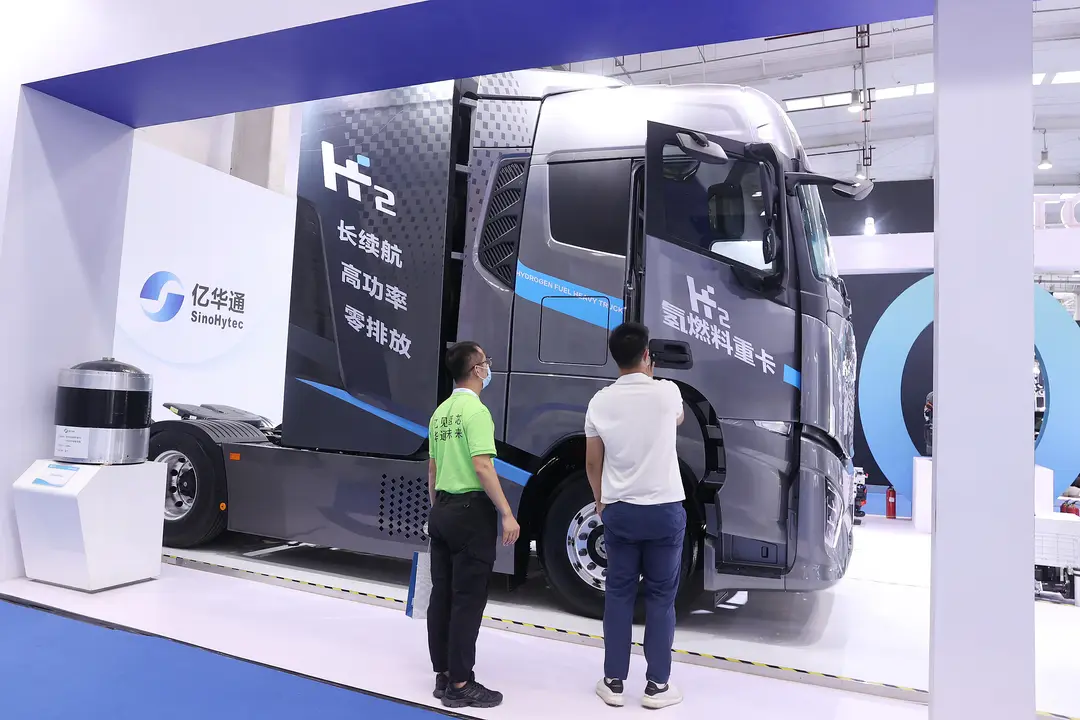
The same pressures have hit suppliers. Hydrogen fuel-cell maker SinoHytec (2402.HK) (688339.SH), often described as China’s leading hydrogen company, reported a net loss of more than 671 million yuan in 2025 on revenue of just 259 million yuan. The company has recorded losses for six consecutive years.
An industrial policy tool
Despite these challenges, local governments continue to invest heavily — in December 2025, the city of Guangzhou announced a procurement order worth 483 million yuan for 450 hydrogen buses.
The reason lies less in transportation than in industrial policy. Large vehicle orders help attract manufacturers and suppliers, supporting the development of local hydrogen clusters.
Foshan’s Nanhai district, for example, has used government procurement to help build the Xianhu Hydrogen Valley industrial cluster, which hosts more than 100 hydrogen-related companies and has attracted more than 40 billion yuan of investment.
Guangzhou is following a similar approach. The latest order is expected to generate demand for more than 20 local hydrogen component suppliers, creating a localized industrial ecosystem.
This logic differs sharply from the economics facing bus operators. Local governments are focused on investment, jobs and supply chains, while transport companies must deal with operating costs.
Beyond buses
If hydrogen buses are struggling, where might the technology succeed?
Many industry participants increasingly point to heavy-duty trucks. China sold more than 230,000 new-energy heavy trucks in 2025, but most battery-powered models are used on short routes in ports and industrial sites.
For long-haul freight, mining operations and extremely cold regions, batteries can become a disadvantage because their weight reduces payload capacity and charging times slow operations.
Hydrogen trucks offer faster refueling, lower vehicle weight and better performance in harsh conditions. In May, state-owned Dongfeng Motor Group (0489.HK) unveiled a 400-kilowatt fuel-cell system for heavy trucks, claiming hydrogen consumption of just 7 kilograms per 100 kilometers for a 49-ton tractor unit.
The contrast with buses is increasingly clear. In urban transit, hydrogen struggles to compete with battery-electric vehicles on both efficiency and economics. But in heavy-duty transport, where batteries face their own physical limitations, hydrogen may yet find a commercially viable role.
After years of subsidies and policy support, China’s hydrogen sector is converging on a more modest conclusion: the future of hydrogen transport may lie not in city buses, but in long-distance freight and other heavy-duty applications where batteries cannot easily compete.
Source:
Titanium Media