
By Brent Li
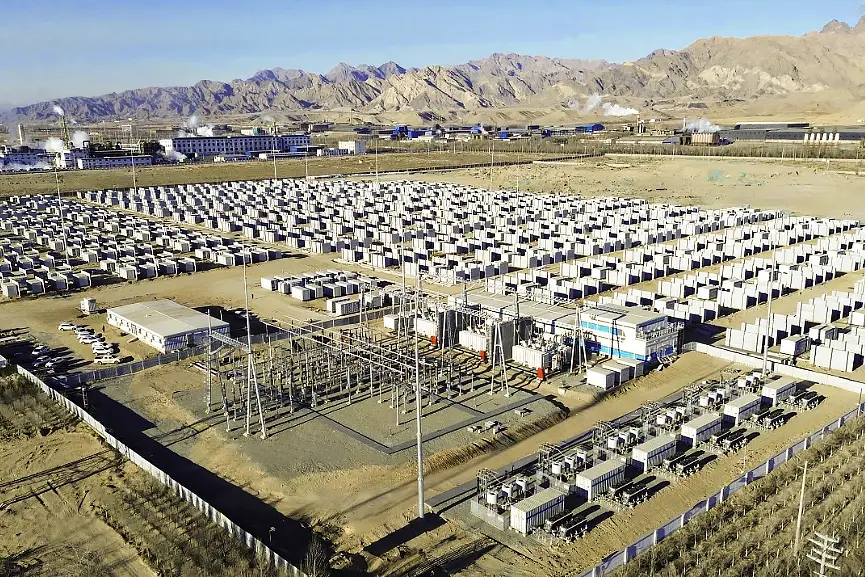
Inner Mongolia, China’s vast northern region, recently announced two massive projects to build energy bases that will transmit green electricity to Shanghai and its surrounding coastal areas. Alongside the sprawling solar and wind farms, the bases include energy storage systems nearing a total of 17 gigawatt-hours (GWh), with combined investment exceeding 120 billion yuan ($16.7 billion).
To put that into perspective, the storage capacity of just these two regional projects equates to roughly 4.5% of China’s total installed new energy storage capacity — which stood at 373.68 GWh at the end of 2025. That national total represents a staggering 45-fold increase since the end of 2020.
“The new energy storage capacity added in the single year of 2025 is almost equivalent to all cumulative installed capacity of pumped storage over its nearly 60 years of history,” Chen Haisheng of the Chinese Academy of Sciences, said in January 2026.
The numbers underscore a monumental shift in how electricity grids are being designed. As nations race to decarbonize, energy storage has transformed from a grid accessory to the core infrastructure of new power systems. Yet, despite the breakneck speed of deployment, China’s storage development is struggling to keep pace with the explosive growth in renewable generation — leading to rising volumes of wasted clean energy and forcing a pivot toward experimental, long-duration storage technologies.
The growing pains of renewable power
In 2025, China passed a historic milestone: its combined wind and solar capacity reached 1.84 billion kilowatts, officially surpassing coal-fired power capacity, and accounting for nearly 60% of the total. Energy generated from these two renewable sources reached approximately 4 trillion kilowatt-hours, some 22% of the country’s total electricity production, official figures show.
For comparison, wind and solar power together accounted for 17% of total electricity generation in the U.S. in 2025, producing 0.76 trillion kilowatt-hours. China’s 4 trillion kilowatt-hours of renewable generation not only exceeded the total electricity consumption of all 27 European Union nations combined — which is about 3.8 trillion kilowatt-hours — but also approached roughly 95% of the total annual electricity consumption of the U.S.
However, the rapid expansion of wind and solar installations has exposed a critical structural bottleneck: the grid’s inability to absorb all the power when the sun shines brightest or the wind blows hardest. According to Bloomberg, the amount of solar power generated but unable to be delivered to customers in China, known as curtailment, rose to 9.2% in the first two months of 2026, up from 6.1% during the same period in 2025. Wind curtailment rose to 8.5% from 6.2%.
Understanding this bottleneck requires looking at China’s geographical realities. The nation’s richest solar and wind resources are highly concentrated in the vast deserts and plateaus of its western and northern provinces, far away from the economic powerhouses and main centers of primary electricity demand on the eastern and southern coasts. While China has built an extensive network of ultra-high-voltage transmission lines to bridge this gap, transmission alone cannot solve the mismatch between when solar and wind generate the most power and when demand is highest.
Solar power generation peaks at noon, which coincides with a relative dip in industrial electricity demand, while wind power often peaks late at night. Without adequate, long-duration energy storage to hold this power for the evening demand peak, grid operators are forced to disconnect renewable sources, letting free, clean energy evaporate into thin air.
To combat this, the installation of energy storage batteries has soared globally. In 2025, China added new electricity storage capacity of 66.4 gigawatts, pushing the nation’s total electricity storage capacity to 213 gigawatts, a 54% increase on 2024. The U.S. has also seen record growth, adding 18.9 gigawatts of new battery storage in 2025. But power capacity alone is not enough; storage duration — how long a storage system can deliver its full power before running out of stored energy — has become the defining challenge.
A shift in energy storage technology
Before 2020, China’s predominant energy storage technology was pumped storage hydropower. However, the geographical requirements and long construction times of pumped hydro stations could not keep up with China’s exploding demand for grid flexibility. By the end of 2025, pumped hydro’s share of total energy storage capacity had dropped to around 31%.
The void was rapidly filled by lithium-ion batteries. Mainstream battery manufacturers and EV makers like Tesla have scaled up their utility storage businesses aggressively. In Inner Mongolia, renewable energy company Envision Energy recently connected a massive 4 GWh battery storage cluster to the grid, and claims it’s the world’s largest single-site battery energy storage station.
But lithium-ion batteries have a significant weakness: their optimal storage duration is generally limited to one to four hours. This short duration cannot fully bridge the massive peak-to-valley gaps of renewable generation over a full day or across multiple days.
To solve this, China is diversifying its technological bets. Projects using molten salt storage, flow batteries, compressed air, flywheels, sodium-ion batteries, and supercapacitors are all seeing substantial growth. As we have previously reported, underground geological formations like salt caverns are increasingly being used in the hydrogen industry to store compressed air for large-scale, long-duration power storage.
The gravity alternative
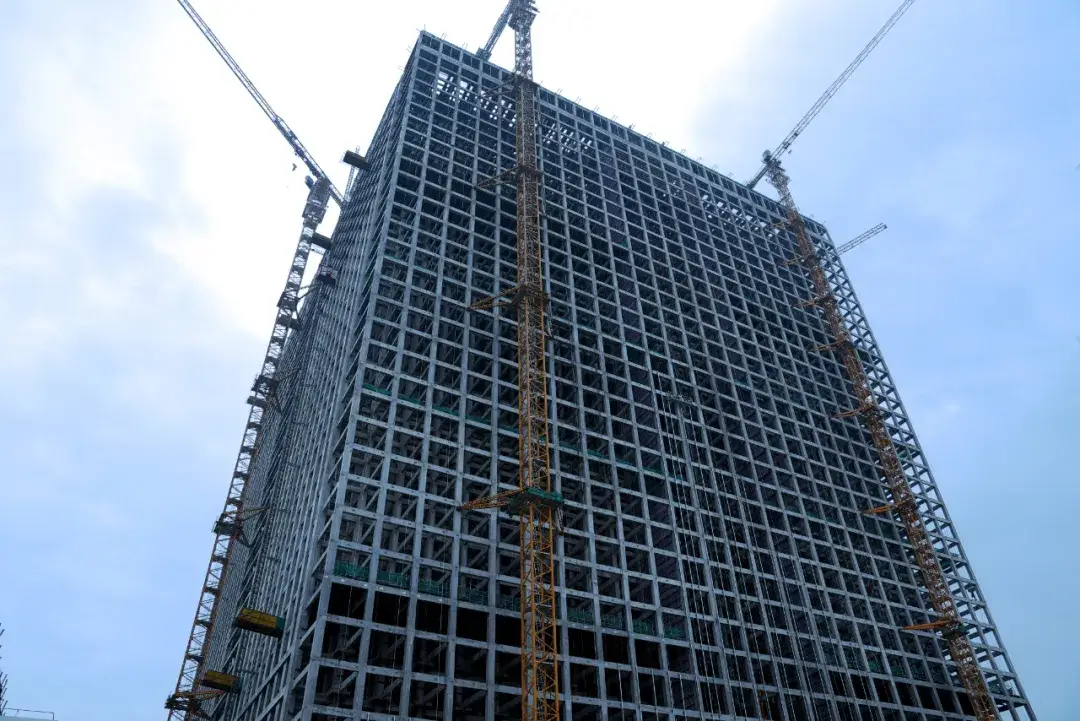
The 35-story gravity storage tower by China Tianying
Beyond these relatively mature solutions, some companies are taking a gamble on gravity energy storage — a technology that sounds deceptively simple. Much like pumped hydro, gravity storage uses surplus electricity during off-peak periods to lift massive heavy weights. During peak hours, the weights are lowered, using gravity to drive generators and release electricity.
In theory, gravity storage offers infinite energy retention time with minimal degradation. Furthermore, the technology relies on cheap materials — weights can be made from construction waste, mine tailings, or retired wind turbine blades — and, crucially, it requires no water. This means it can be built on plains or use the massive elevation drops of abandoned coal mine shafts.
In 2022, China Tianying (000035.SZ), a dominant domestic enterprise in waste incineration and environmental equipment, imported technology from Swiss company Energy Vault. Tianying invested 650 million yuan to build a 35-story, 148-meter-tall gravity storage tower, designed to hold 100 megawatt-hours of energy. It was hailed as the country’s first major demonstration project for the technology.
Yet, progress has stalled. Up till now, the project has not officially entered operation more than four years after construction began. Following likely pressure from shareholders worried about return on investment, Tianying has publicly shifted its strategic focus toward hydrogen-based energy products, stepping back from its high-profile gravity storage ambitions.
While Tianying’s stumble highlights the steep curve from engineering concept to commercial viability, the sector is far from dead. Other state-owned grid operators and private startups are continuing to test vertical shaft and slope-style gravity systems. The technology remains in its infancy, but the relentless pressure to eliminate renewable energy curtailment ensures that the search for the ultimate long-duration battery — whether chemical or mechanical — will only accelerate.
Sources
- 投资1200亿,配储17 GWh,储能大时代刚刚开始
- 激增4500%!储能的黄金时代,现在才刚刚开始!
- 2025年中国新型储能新增投运66.43GW/189.48GWh
- 2025年可再生能源并网运行情况
- 我国建成全球最大的可再生能源体系 每用10度电就有近4度是绿电
- 2025年我国可再生能源发电量达到约4万亿千瓦时 油、气产量双双创历史新高
- 从“装得上”到“用得上”:中国新能源消纳瓶颈的结构性分析
- 12.8GWh!全球最大储能群并网,远景引领AI储能
- 长时储能风起,万亿赛道求变|钛媒体深度
- 中国天楹转身,重力储能哑火了吗?
- 长时储能系列观察|重力储能:长时调节需求下的技术路径与产业化窗口
- 【睡前消息1060】地下储能项目 高考出题人的“富矿”