
China is scaling up molten salt thermal batteries to stabilize the grid, but high costs and technical hurdles remain
By Da Cheung
China is transforming itself into an economy driven by renewable energy, notably solar power, but still faces a glaring problem: storing electricity ready to feed the power grid when the sun goes down.
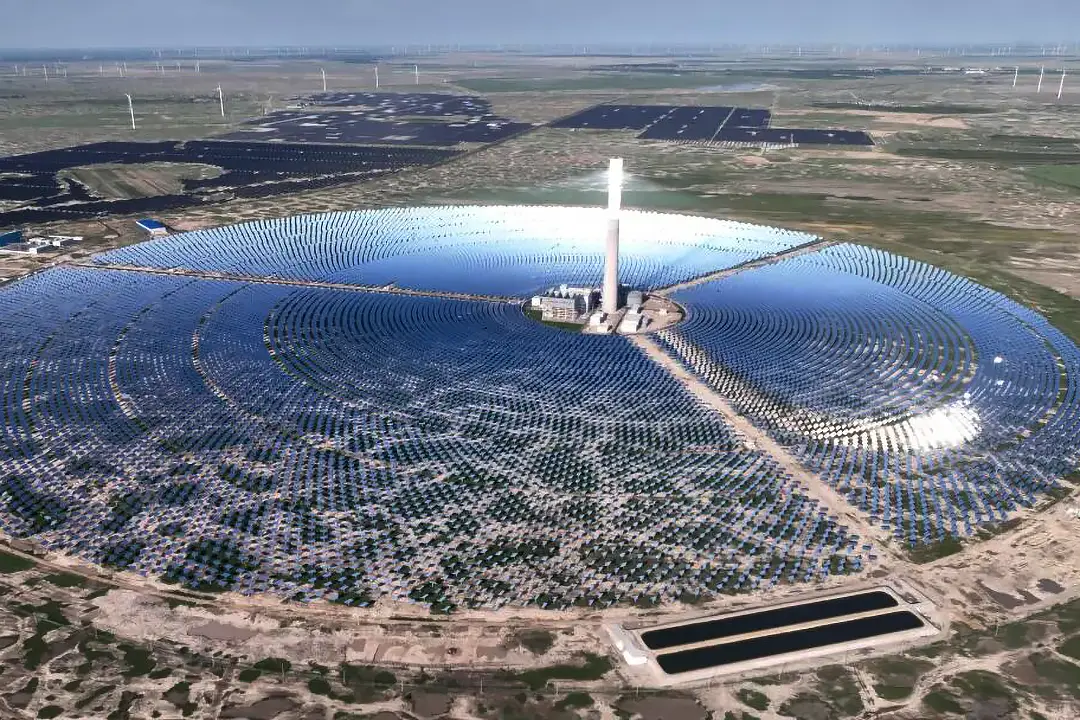
To stabilize its rapidly expanding renewable energy infrastructure, China is turning to an older, more expensive technology — Concentrated Solar Power (CSP) plants. Unlike standard photovoltaic panels that convert sunlight directly into electricity — a “use-it-or-lose-it” proposition — CSP uses thousands of computer-controlled mirrors to track the sun and focus its rays onto a central tower.
This intense heat melts a salt mixture, which acts as a massive thermal battery. The molten salt can store heat for 8 to 16 hours, allowing operators to boil water, spin turbines, and dispatch electricity long after sunset.
While the technology has existed for decades — Spain launched the world’s first commercial tower CSP plant in 2007 — China is now attempting to scale it up to solve the intermittency of wind and solar power. By the end of 2025, China’s CSP capacity had risen to roughly 1.73 gigawatts, ranking third globally, behind Spain and the U.S.
Pushing into extreme climates
Historically, CSP plants have been confined to vast, sun-drenched deserts due to their immense land requirements. However, Chinese developers are attempting to push the technology into harsher environments.
In late June, state-owned China General Nuclear Power Group (CGN) began generating power at a 100-megawatt CSP plant in northeast Jilin province. Located in a region with bitterly cold winters, the facility is designed to operate in temperatures as low as minus 37.3 degrees Celsius ( minus 35.1 degrees Fahrenheit).
The plant is a key component of a 1.4 GW “New Energy Base” that combines wind, solar PV, and CSP to provide a more stable power supply.” It uses excess electricity from wind and PV to heat the molten salt, effectively acting as a large battery to stabilize the output of the entire renewable energy complex.
Zhao Xiong, head of the CGN Jilin CSP project, told China Electric Power News that the company has mastered anti-freezing technologies for the molten salt and wind-resistant designs for the mirror field. The plant will absorb excess wind and solar power from nearby facilities, storing it as heat to prevent energy waste. CGN also claims the Jilin facility provides a “replicable model” for regions with similar climates.
Through domestic supply chains, China has managed to slash the cost of CSP electricity from about $0.16 per kilowatt-hour in early demonstration projects to about $0.08. This is significantly lower than early European tariffs, which in Spain ranged from $0.22 to $0.4.
Financial strain on domestic pioneers
Even with strategic backing from the central government, the massive capital requirements of CSP are squeezing the industry’s domestic pioneers. Building a CSP plant requires an initial investment of roughly $2,000 per kilowatt, far exceeding the cost of standard solar farms.
This financial burden is evident in the struggles of Cosin Solar, a company that controlled over 50% of China’s tower CSP market between 2021 and 2024. It is currently making a second attempt at a Hong Kong initial public offering after a previous application lapsed in late 2025.
Cosin Solar’s revenue growth stalled dramatically last year, inching up just 0.2%, according to its prospectus. More concerning for potential investors, its cash flow turned negative in 2025, recording a deficit of 253 million yuan ($34.8 million), while its cash reserves shrank by nearly 75% in the two years through 2025.
The company’s vulnerability is compounded by its dependence on a handful of state-owned energy giants. In 2025, 98.5% of Cosin Solar’s revenue came from its top five clients, leaving it highly exposed to shifts in government spending.
Technical hurdles and bold claims
Beyond financial pressures, the sector faces unresolved technical bottlenecks. Molten salt is highly corrosive at high temperatures, and China still can’t make enough of the specialized alloy materials required for durable pipes and storage tanks. Furthermore, the industry suffers from a lack of unified safety and construction standards, leading to uneven quality across projects.
To overcome efficiency limits, Chinese firms are touting next-generation upgrades, though some claims warrant skepticism.
Tech giant Huawei says it is providing artificial intelligence algorithms for a new CSP project in Gansu province, claiming its system can control the tracking precision of individual mirrors to within 0.1 degrees.
Meanwhile, Shougang Group, a steel company majority owned by the Beijing government, recently launched a commercial “supercritical carbon dioxide” generator — a system that uses highly pressurized CO2 instead of steam to drive turbines, which could theoretically be paired with future CSP plants.
While molten salt thermal batteries offer a compelling solution to the renewable energy storage problem, the path forward requires navigating steep costs, harsh environments, and the financial realities of scaling heavy infrastructure.
Sources