
By Da Cheung
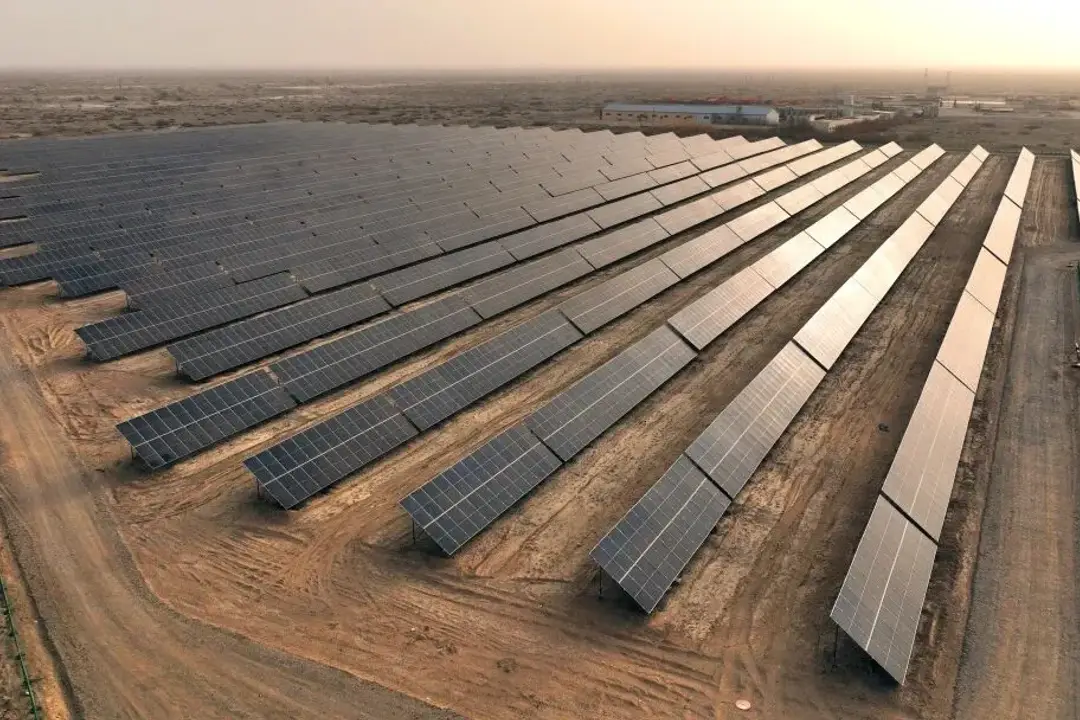
Deep in the Taklamakan Desert, known for its harsh conditions and sprawling sand dunes, China’s third-largest onshore oil and gas field is quietly undergoing a radical transformation. State-owned PetroChina, which operates the Tarim oilfield in Xinjiang, is turning swathes of the desert into a gigantic solar farm to power the extraction of the fossil fuels.
As of June 6, 2026, the field had generated a staggering 1.1 billion kilowatt-hours of green electricity in the current year, equivalent to saving over 330,000 tons of standard coal and reducing CO₂ emissions by 860,000 tons.
PetroChina’s pivot into green energy is not just about corporate diversification. It is a microcosm of China’s urgent national drive to slash reliance on fossil fuels amid shifting global geopolitics and evolving economic realities.
Profiting from the desert sun
To date, the company has constructed five centralized photovoltaic stations with a combined capacity of 2.6 gigawatts, taking full advantage of the region’s intense solar radiation, expansive uninhabited desert, and existing grid infrastructure. Its flagship Shangku project, which connected to the grid in early 2025, is its largest single solar plant. It covers around 5,700 acres and features a 130-megawatt energy storage system to stabilize power output.
PetroChina says developing renewable energy directly on-site makes sound financial sense. Extracting oil and gas from depths of 6,000 to 7,000 meters under complex geological conditions requires an enormous amount of continuous electrical power. Installing solar panels directly above and around the oilfields allows the company to consume the generated power internally. This closed-loop system means it can bypass external grid fees, effectively lowering its overall production costs while shielding operations from external power price fluctuations.
Furthermore, green electricity offers lucrative market opportunities beyond operational savings. Under China’s renewable energy certificate system, one “green certificate” represents 1,000 kilowatt-hours of renewable electricity and can be traded separately from the physical power. The Tarim oilfield recently sold one million such certificates — legally representing 1 billion kilowatt-hours of clean power — to a sister petrochemical refinery in Guangdong province. By purchasing these certificates, the refinery can officially count that amount of green energy toward its own consumption targets, even though the actual electricity stays on the grid in Xinjiang. This administrative transfer allows the company to turn its geographical advantage in the sun-drenched desert into tangible economic returns.
A geopolitical catalyst
The aggressive expansion of clean energy by China’s largest oilfield operator is not an isolated corporate initiative; it closely mirrors a broader, state-led imperative. Like many nations across the globe, China is rapidly accelerating its transition away from fossil fuels. This pivot is driven equally by long-standing environmental protection commitments and the increasingly harsh realities of global energy security.
According to a recent analysis published by Energy Investment, the global energy landscape is currently experiencing a massive structural shock. The 2026 closure of the Strait of Hormuz, triggered by regional conflicts, has effectively blocked roughly 25% of the world’s traded oil and 20% of its liquefied natural gas. Analysts describe this supply chain rupture as a market disruption comparable in scale to the 1970s oil crisis. Energy expert Michael Liebreich refers to this era as the “Great Clean Energy Acceleration 2.0,” predicting that the geopolitical crisis will push the global peak for fossil fuel demand forward to before 2030.
Unlike the 1970s, the current energy crisis is being mitigated to some extent due to a viable, cheaper technological alternative. The levelized cost of energy (LCOE) — a financial metric used to gauge the average cost of electricity generation over the lifetime of an energy asset — for solar, wind, and battery storage has now fallen below that of traditional fossil fuels according to BloombergNEF. For China, the world’s largest crude oil importer, relying on highly vulnerable maritime choke points constitutes a critical strategic weakness. Consequently, substituting imported fossil fuels with domestic clean energy has been elevated to a top national security priority.
Redefining the energy giant
PetroChina’s metamorphosis extends far beyond the Tarim basin, signaling a definitive shift in how Beijing views the future energy landscape. Across the nation, legacy extraction sites like the Yumen and Daqing oilfields are also installing massive wind turbines and solar arrays. These renewable projects are designed to offset the declining yields and steadily rising extraction costs associated with aging oil wells.
In 2025 alone, the company invested a record 41 billion yuan ($5.75 billion) into its new energy portfolio, officially laying out comprehensive operational tracks for wind, solar, geothermal, and hydrogen power. But its ambitions are not limited to large-scale power generation. Through its subsidiary Kunlun Network Power, the company says it now operates an expansive network of over 6,000 electric vehicle charging stations across the country.
The oil behemoth is also actively laying the financial groundwork for next-generation frontier technologies. In 2025, its investment arm poured 5.9 billion yuan into the nuclear fusion industry, aggressively stepping into what scientists widely consider the ultimate clean energy source.
For a mammoth state-owned enterprise historically defined by drilling, refining, and selling oil, these investments are highly symbolic. The company’s strategic evolution suggests that for China’s top energy planners, renewables and advanced future technologies are not just a peripheral side business — they are the core engines for survival and sustained growth in an inevitable post-fossil fuel era.
Sources