

By Angmobile
China is preparing to aggressively ramp up its low-earth orbit (LEO) satellite ambitions as it steps up efforts to compete with Starlink, the satellite-based internet service owned by Elon Musk’s SpaceX.
Shanghai-based Yuanxin Satellite, the state-backed operator of the Thousand Sails constellation, said in an April 10 announcement that it is seeking contractors to provide flight control support services during a period of “intensive launches” in 2026. Although this is a procurement notice, the language marks the first time Yuanxin has formally referred to such a concentrated launch campaign — suggesting it is gearing up for a phase in which dozens, or even hundreds, of satellites could be deployed into orbit over a short period.
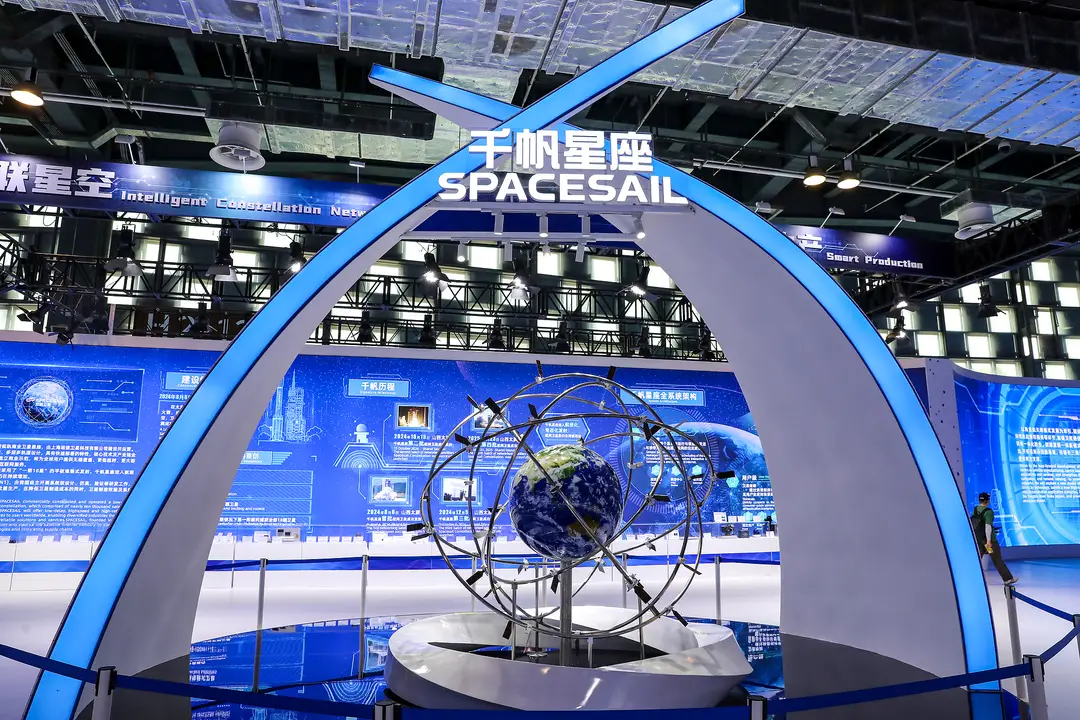
The Thousand Sails constellation, also known as Qianfan and marketed internationally as SpaceSail was launched in 2024 to compete with SpaceX’s Starlink, it aims to eventually deploy more than 15,000 satellites to provide global, high-speed, low-latency broadband coverage.
Narrowing the Starlink gap
SpaceX is currently the dominant player in the provision of global satellite internet networks. The Starlink constellation has already deployed thousands of satellites and is widely seen as setting the pace in low-earth orbit communications infrastructure.
In contrast, China’s efforts have progressed more slowly and remain fragmented across multiple programmes. Qianfan is among the more prominent initiatives aimed at narrowing the gap with Starlink, with ambitions to provide global coverage and support both commercial and strategic communications.
Yuanxin Chairman Zhang Qi said during this year’s Two Sessions political meetings in Beijing in March that the constellation aims to achieve preliminary global coverage by the end of this year. To meet his goal, at least 324 satellites would need to be in orbit. With 126 satellites currently deployed, that implies launching a further 198 this year. Assuming payloads of 18 satellites per launch, this would require around 11 successful launches in the remaining months of the year.
Ambitious launch targets
Industry estimates, however, point to more aggressive — and potentially unrealistic — internal targets. Some projections suggest that Yuanxin aims to deploy 324 satellites by mid-2026 and expand that number to 648 by year-end. Under that scenario, more than 500 additional satellites would need to be launched within the next eight months, implying close to 30 launches — a pace that would test even the most established launch providers.
The scale of the challenge underscores the significance of the company’s latest procurement. Intensive launch campaigns depend not only on rocket availability but also on the ability to manage satellites once they reach orbit. In a high-frequency deployment model, the performance of one batch directly affects the timing and feasibility of subsequent launches.
If flight control systems fail to perform — for example, if satellites cannot be stabilised, accurately positioned, or integrated into a functioning network — even technically successful launches can fall short of their objectives. The procurement of specialised flight control support services appears designed to mitigate such risks.
The notice also suggests that Yuanxin may have secured access to substantial launch capacity through a mix of state-owned and private Chinese aerospace firms. The state-backed Long March rockets are expected to play a central role, alongside a growing cohort of private-sector launch providers, including LandSpace, with its Zhuque rockets, and Space Pioneer (Tianbing Technology), which operates the Tianlong rockets. These vehicles are increasingly capable of carrying large batches of satellites, enabling deployments of 18 or even 36 spacecraft in a single mission.
On the manufacturing side, dedicated satellite factories are reported to have reached annual production capacity of around 600 satellites, suggesting that production bottlenecks are easing.
Geopolitical tensions add urgency
Even so, analysts say shifting from incremental deployments to an “intensive launch” model represents a significant operational leap. Unlike traditional satellite programmes, which are spaced out over longer timeframes, large constellations require tightly coordinated, near-continuous execution across manufacturing, launch and in-orbit operations. Overcoming these technical risks through flight control support is the specific focus of the recent procurement notice.
The acceleration of the Thousand Sails Constellation project comes against a backdrop of increasing geopolitical tension. As SpaceX continues to dominate the LEO landscape, Beijing has designated the satellite internet sector as one of the “new quality productive forces,” a term used by China’s leadership to describe industries deemed critical to future national power.
LEO satellite networks are increasingly viewed as critical infrastructure, with applications ranging from broadband connectivity in remote regions to military communications and resilience in times of conflict. For China, accelerating deployment is therefore not only a matter of technological capability but also of strategic positioning. Whether Yuanxin can meet its 2026 targets remains uncertain, but the latest procurement suggests that preparations for a more rapid rollout are now underway.
Source:
5G and 6G
With additional reporting by The Insight Asia