

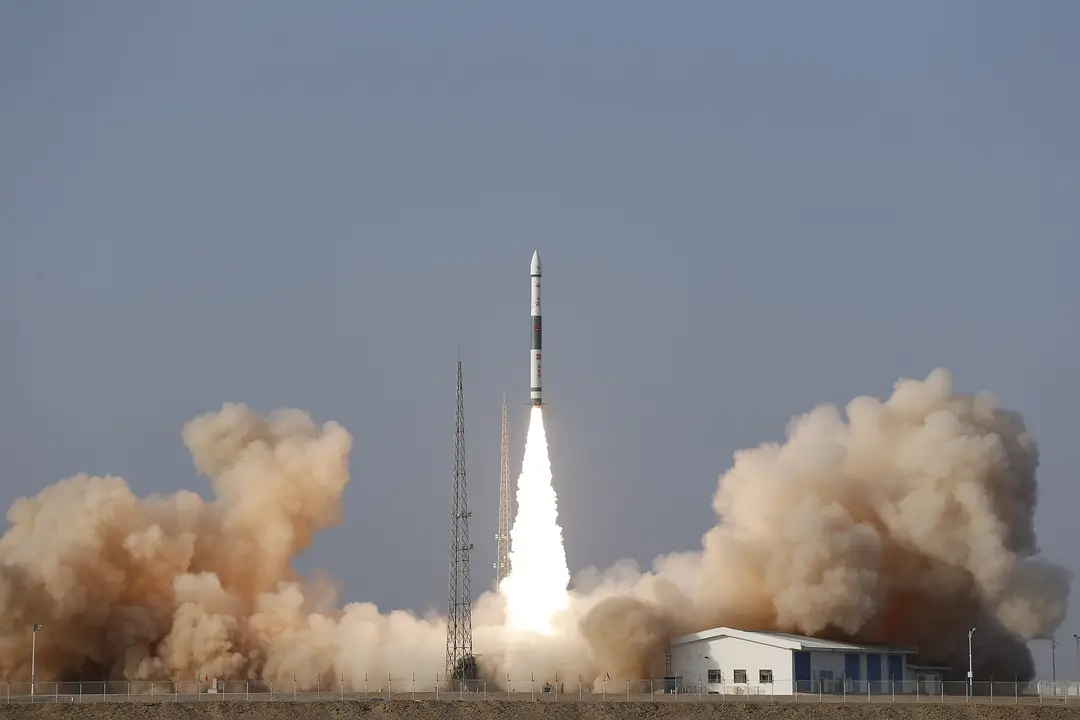
China’s state-backed commercial rocket group Expace Technology has begun recruiting senior finance staff with experience in IPO preparation, signalling an acceleration in plans for a domestic stock market listing as Beijing’s commercial space sector enters a wave of expected flotations.
The company, a subsidiary of state-owned China Aerospace Science and Industry Corp. (CASIC), published a recruitment notice on May 19 that included explicit references to IPO financial verification, listing guidance, and the establishment of governance structures compliant with public market requirements.
The advert comes just 28 days after CASIC transferred control of the company to state-backed investors in Expace’s home city of Wuhan in a 3.3 billion yuan ($460 million) deal that valued the rocket group at around 11.2 billion yuan. It was widely viewed as part of a broader restructuring ahead of a planned listing on Shanghai’s STAR Market, China’s Nasdaq-style technology board.
Industry executives and bankers said the recruitment drive was one of the clearest public signs yet that Expace has moved beyond exploratory discussions and into substantive IPO preparation.
“The finance lead is effectively the first operational executor of an IPO,” said one veteran Chinese investment banker. “When a company specifically recruits someone with full-cycle IPO experience, it usually means the strategic decision to go public has already been made and dedicated listing teams are now being assembled.”
The job advertisement requires applicants to hold a CPA qualification and have experience in internal controls, accounting rectification and IPO compliance reviews. Among the stated responsibilities are establishing financial systems that meet listing standards and coordinating with intermediaries during the listing guidance process.
Capital market beckons
Expace’s listing ambitions come as China’s commercial space industry enters what many domestic investors have labelled the country’s Year 1 for commercial aerospace IPOs.
More than 10 Chinese space companies are now considered to be in substantive listing preparation, according to industry estimates, reflecting both strong state support for strategic technologies and investor appetite for sectors tied to national industrial policy.
Private launch companies including LandSpace and CAS Space have already submitted STAR Market listing applications. CAS Space is currently responding to its first round of regulatory inquiries, while other launch groups such as Space Pioneer, Galactic Energy and iSpace have completed listing guidance filings and are at varying stages of IPO preparation.
The rush to market marks a significant shift for China’s once state-dominated aerospace sector. Beijing has encouraged greater private participation in launch services and satellite manufacturing over the past decade as it seeks to build a commercially competitive ecosystem capable of rivaling US operators.
Founded in February 2016, Expace was China’s first commercial rocket company to operate under a market-oriented model, despite its roots within a major state-owned defence conglomerate. Its Kuaizhou series of solid-fuel launch vehicles has completed 31 commercial launch missions and at one stage accounted for roughly half of China’s commercial launch market.
The company is now accelerating development of reusable liquid-fuel rockets, a technology seen as critical to lowering launch costs and competing with global rivals. In 2024, Expace completed a vertical take-off and landing test for an experimental reusable rocket demonstrator.
Expace could reshape valuation benchmarks
Expace’s entry into the IPO race is expected to reshape competitive dynamics within China’s commercial aerospace financing market.
Until now, investor attention has focused largely on privately funded launch companies. But Expace, as a state-backed industry leader, is seen as having advantages including more stable government-linked orders, deeper engineering resources and closer ties to China’s aerospace supply chain.
Analysts said its eventual valuation could become an important benchmark for the wider sector, particularly as investors attempt to assess the long-term commercial viability of Chinese launch providers amid intensifying competition and heavy capital expenditure requirements.
The planned listing also reflects a broader trend in China’s industrial policy: the combination of central state-owned enterprise reform with local government efforts to cultivate strategic emerging industries. The acquisition of control over Expace by the Wuhan Investment and Control Group has been viewed domestically as a high-profile example of regional governments using capital injections to anchor advanced manufacturing ecosystems.
Whether China’s commercial rocket groups can translate technological ambition into sustainable profitability remains to be seen. But with reusable launch systems, satellite internet constellations and defence-linked aerospace technologies all receiving policy backing, investors are increasingly betting that China’s space sector could become one of the country’s next major capital markets stories.
Source:
5G and 6G