

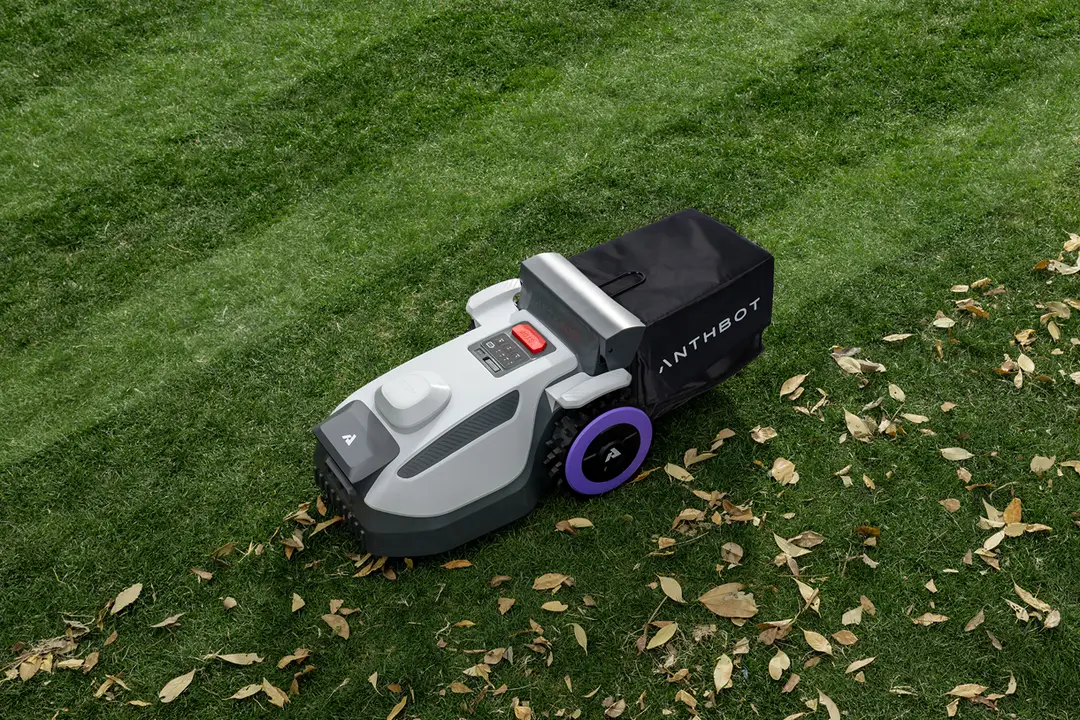
U.S. restrictions, European tariffs and mounting inventories are exposing the weaknesses in Chinese cleaning and gardening robot makers’ overseas expansion strategies.
By Lu Yao
Chinese manufacturers of cleaning and gardening robots are facing a growing squeeze overseas. U.S. market restrictions and European trade barriers are raising costs, while mounting inventories and weakening demand are exposing cracks in the industry’s growth model.
For years, Chinese companies expanded through supply chain advantages, competitive pricing and e-commerce. Now, that formula is becoming harder to sustain.
“The North American market is off the table. We’ll keep selling existing products, but there will be no new models.” Zhou Ming, a sensor-industry executive, said he heard this recently from a leading smart hardware company. Several major cleaning appliance manufacturers are also shifting new product plans toward Europe and Australia.
The turning point came July 28, when the U.S. Federal Communications Commission (FCC) added foreign-produced advanced robotics equipment to its controlled list. Although specific products were not named, the definition — autonomous mobility, sensors, connectivity and navigation software — effectively encompasses robot vacuums, robotic lawn mowers, and robotic pool cleaners.
Previously authorized models can remain on sale, with software updates exempted at least until Jan. 1, 2029. New models generally cannot obtain authorization unless they receive conditional approval from the Department of Defense or meet U.S. manufacturing requirements. These stipulate that U.S. and designated-source components must account for more than 65% of costs between 2024 and 2028, rising to 75% from 2029.
Swedish manufacturer Husqvarna received the first conditional approval on Sept. 9, covering its Automower robotic lawn mowers.
China’s march to Europe under threat
Europe is also raising barriers. On Oct. 21, the European Commission sent interested parties its pre-final disclosure in its anti-dumping probe into Chinese-origin robotic mowers: proposed duties of 45.6% to 53.3% on a CIF basis. Shenzhen Kuma Technology faces 45.6%, Suzhou-based Positec Technology 53.3%, other cooperating respondents 47.0%, and non-cooperators 53.3%. Final measures are due by Jan. 19, 2027, with a comment period and company defenses in between.
The Commission rejected Chinese manufacturers’ actual costs, citing significant distortions in the Chinese market, and used Malaysia as a reference country to calculate normal value.
The dispute reflects a dramatic market shift: Chinese-made lawn mowers’ share of the EU market rose from nearly 50% in 2022 to 79.2% during the investigation period. Husqvarna’s share fell from a peak of 70% to around 50% in 2025.
Their growth rode the shift from gasoline to electric power, followed by the convenience-driven demand established by robot vacuums. Pool cleaners adopted a similar model. But the overseas expansion strategy is now under pressure.
Shipments rise while inventory accumulates
The distinction between sell-in — shipments to distributors — and sell-out, sales to consumers, is becoming increasingly important.
IDC estimates global robotic lawn mower shipments jumped 63.8% to 1.992 million units in 2025. Boundary-free wire models accounted for 1.318 million units, or 66.2% of the total, with all six leading brands Chinese. But shipments do not necessarily reflect consumer demand.
Pool robot shipments are already showing weakness: the 2026 second-quarter peak season saw about 1.533 million units shipped globally, down 6.3% year on year, IDC data show.
Gu Yan, the head of a sensor supplier, said the leading brands including Ecovacs Robotics (603486.SH), Dreame Technology and Kuma are converging technically and premium manufacturers are introducing models priced at $300 to $400.
“Room for innovation is shrinking,” Gu said.
Inventory pressure is now affecting upstream suppliers. Manufacturers that previously produced 10,000 units of a new product may now make only 5,000, and a third to half of last year’s inventory is still unsold.
Some lidar sensor orders have fallen from 20,000 units last year to zero this year. Shipments of cheaper ultrasonic and single-point sensors have declined from 300,000 to 400,000 units to around 200,000.
Gu estimates the pool robot market may need another two years to stabilize, with resources increasingly concentrated among a handful of companies.
Financial statements offer another indication of flagging demand. Ecovacs reported inventory of 5.41 billion yuan ($811 million) at the end of the third quarter, up around 66% from the beginning of the year. Beijing Roborock Technology‘s (688169.SH) inventory reached 6.26 billion yuan, 136% higher than the end of 2025. Its inventory turnover days increased from 104.7 to 133.9. Combined inventory exceeded 11.6 billion yuan.
Both companies cited stockpiling in anticipation of rising component prices and overseas expansion. The figures cover their entire businesses, not just outdoor robots.
Former cleaning appliance executive Cheng Li warned that some companies could need two to three years to clear inventory.
Acquiring channels is no guarantee of sales
With trade barriers rising, some Chinese companies are acquiring overseas brands and distribution networks.
On Oct. 7, Ledong Robot (1236.HK), which operates internationally as LDRobot, announced plans to acquire German garden equipment manufacturer SABO through its Singapore subsidiary ANTHBOT for up to 6 million euros ($6.73 million). The equity purchase price is 1 million euros. SABO’s 2025 revenue was about 18.2 million euros.
The nearly century-old brand has more than 1,400 specialist retailers. Around 70% to 80% of its distribution is concentrated in Germany.
The acquisition offers Ledong brand recognition, dealer relationships and after-sales infrastructure. But industry observers caution that obtaining a distribution network does not guarantee sales. Integration costs, dealer relationships and product competitiveness remain critical.
Meanwhile, some pool robot startups are considering exits. Feng Qian, the founder of one such company, said he would be willing to discuss a sale at two to three times price-to-sales. His company has shifted from Amazon’s North American channel toward original design manufacturing, distribution, and upstream gyroscope modules.
He believes capital, channels and brands are increasingly concentrated among a small number of players, leaving startups with fewer opportunities to expand independently.
Revenue targets are also encouraging manufacturers to push inventory into distribution networks and open new channels. But industry sources say some large cooperation agreements and technology launches have limited commercial substance.
The resulting cycle is increasingly difficult to sustain: revenue pressure drives channel loading; distributors struggle to absorb products; manufacturers seek new channels or acquisitions; and those networks become destinations for further shipments.
The industry’s fundamental challenge is no longer simply getting products overseas. It is generating genuine consumer demand.
Chinese manufacturers have made substantial progress in supply chains, pricing and distribution. Their next challenge is converting shipments into consumer purchases.
Source:
Leifeng.com