

The chip designer, which has attracted investors including Renault, SAIC and Chery, is expanding from automotive computing into robotics and other physical AI applications.
By Stone Jin
XHEART, a Chinese chip designer focused on large-model computing, has completed a strategic funding round, bringing its total fundraising to nearly 5 billion yuan ($750 million) across four rounds since its founding in 2023.
Its investors include automakers SAIC Motor (600104.SH) and Chery (9973.HK), memory chipmaker ChangXin Memory Technologies (CXMT) (688825.SH), Renault-linked investment interests and automotive technology provider Joyson Electronics (600699.SH), alongside venture capital firms and state-backed funds.
XHEART designs chips specifically for large AI models rather than adapting general-purpose processors. Its chips are already in mass production and deployed in smart vehicles, with plans to expand into robotics. The company says its next-generation X9 chip will support a 100-fold increase in the scale of AI models that can run on devices.
Growing industry backing
The breadth of XHEART’s investor base highlights the strategic interest in its technology. CXMT’s investment could position it to benefit from growing demand for memory in edge AI applications. For XHEART, access to a memory supplier could help manage rising memory costs and secure supplies as production scales.
Joyson Electronics has already begun joint development work with XHEART. According to a summary of Joyson’s 2025 annual report, it is developing an advanced driver-assistance system domain controller based on XHEART’s chip platform. The chips have been powered on successfully and are undergoing in-vehicle testing.
SAIC has invested in all four funding rounds, beginning with the angel round, while Chery has increased its investment and Renault has joined the shareholder group. These relationships could provide customers and support international expansion, drawing on Renault’s global reach and Chery’s overseas experience.
Designing chips around AI models
As autonomous driving relies increasingly on large AI models, automotive chips must deliver greater computing power and real-time inference within tight constraints on cost, energy consumption and heat dissipation.
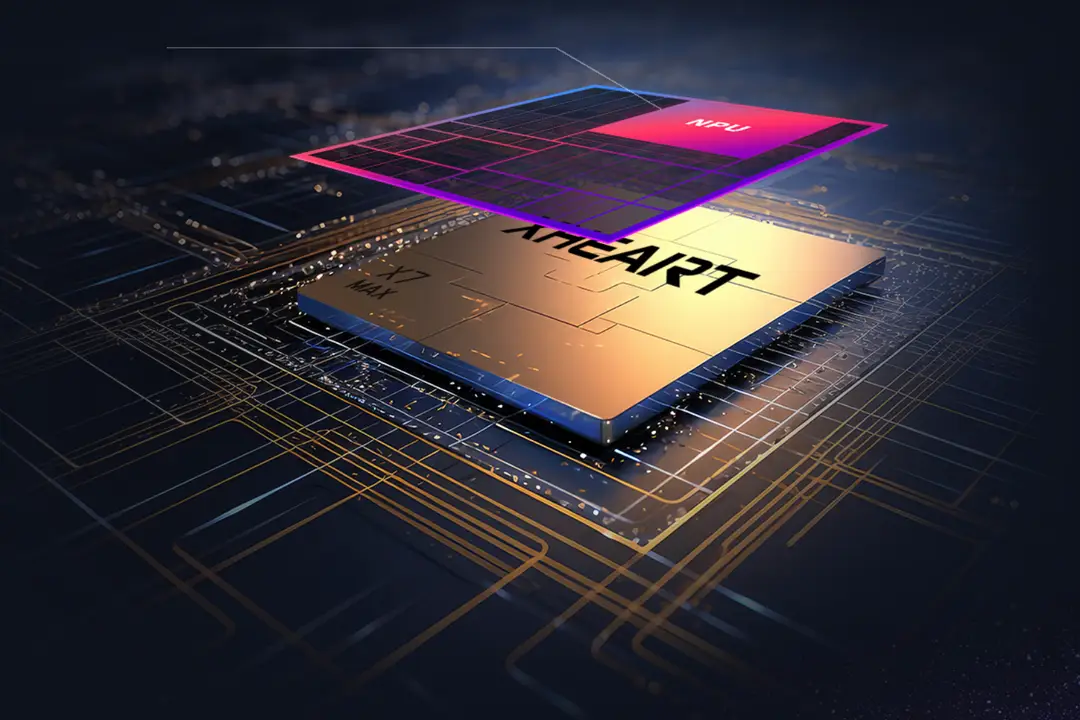
XHEART’s X7 is a vehicle-grade system-on-chip designed natively for Transformer models, rather than a general-purpose processor subsequently adapted for automotive use. Its architecture is customized for large-model operations instead of relying primarily on general-purpose matrix computing.
The company says this approach can deliver 10 times the parameter efficiency at the same cost, although it does not specify the benchmark behind that claim. The goal is to make better use of computing capacity rather than simply increasing headline performance measured in tera operations per second (TOPS).
XHEART’s strategy is to design hardware around the algorithms it will run, rather than adapting AI models to existing chip architectures.
X7 reaches mass production
Automotive chips must pass demanding qualification processes, including vehicle integration and functional safety testing. XHEART says the X7 completed tape-out in 14 months, powered on successfully within 24 hours, entered a test vehicle within three weeks and reached mass production within six months.
The company has partnered with autonomous driving technology provider Momenta and QNX to develop a production-ready platform combining the X7, Momenta’s full-stack autonomous driving solution and the QNX safety operating system built on QNX SDP 8.0. The partners say the platform is designed to help automakers deploy advanced driving technology while meeting international functional safety requirements.
The X7 is already used in several vehicle models, including the SAIC-Volkswagen ID.ERA 9X and vehicles from Cadillac and Chery.
An investor who has participated in multiple funding rounds said the company’s progress from research and development to mass production had strengthened confidence in its execution. In automotive chips, the ability to deliver products that withstand real-world use is as important as technical development.
Momenta partnership offers a route into physical AI
XHEART and Momenta have a close relationship as affiliated companies. Momenta’s world-model development could shape XHEART’s chip designs, while improvements in computing performance could support larger and more sophisticated models.
In principle, this could create a feedback loop in which better hardware supports stronger models, generating more data and further improving performance.
The partnership could provide a foundation for expansion into robotics and other physical AI applications. For now, automotive deployments offer an initial test of XHEART’s ability to commercialize its technology. Its longer-term prospects will depend in part on whether its claimed efficiency gains can be demonstrated across a broader range of applications.
Source:
IPO Early Insights