
Nvidia’s endorsement is raising 51World’s profile as its fast-growing simulation business gains ground, but mounting research costs and persistent losses remain challenges.
By Hu Minghe
When Li Yi founded Beijing 51World Digital Twin Technology (6651.HK) in 2015, he drew on his property and asset management background to commercialize virtual reality, selling developers digital tours of homes that had yet to be built. A decade later, the Hong Kong-listed company faces a new challenge: turning increasingly sophisticated technology into sustainable revenue.
51World received a boost last week when Nvidia named its simulation subsidiary, 51Sim, as a participant in a new initiative to help automakers assess the safety of autonomous-driving software. The announcement sent 51World’s shares up 30% the following day, reflecting investor enthusiasm for the endorsement from one of the world’s leading chipmakers.
But the company remains loss-making, and Nvidia’s recognition has yet to demonstrate that it can translate into substantial new business.
The original virtual-property business helped sustain 51World in its early years. However, China’s prolonged property downturn has weakened demand, while the search for new commercial applications has proved more difficult than expected. The company went public in Hong Kong in December 2025 amid questions about its widening losses and its ambitious Earth Clone project to create a digital representation of the planet.
Its growing simulation business now offers a more immediate route to commercial growth.
Nvidia partnership expands into safety testing
The link between virtual property models and autonomous-driving technology is more direct than it might appear. Both rely on digital representations of the physical world that can be used to test, plan, and manage real-world activities.
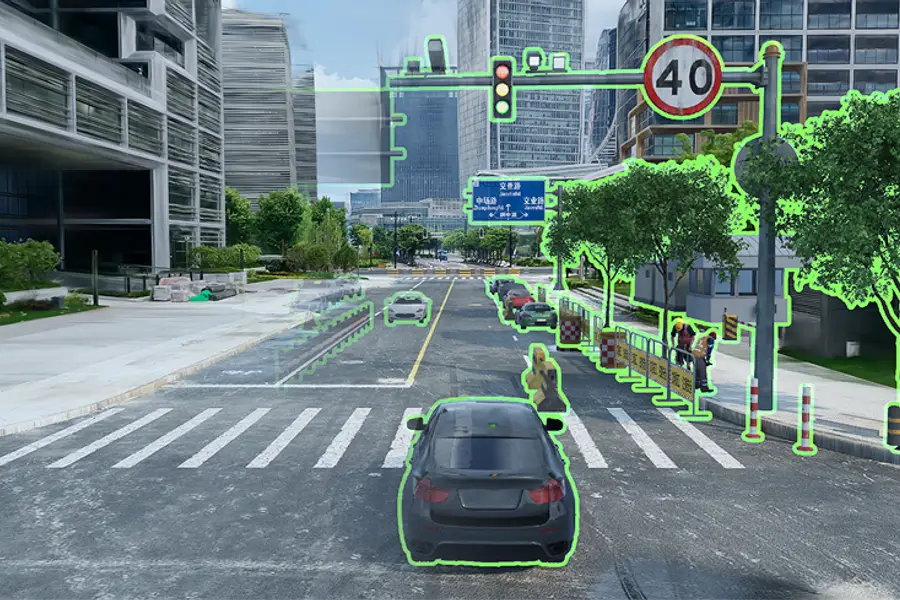
51World has expanded its modeling technology beyond buildings into cities, industrial facilities and water systems. Its driving-simulation business, established in 2017, allows automakers to test software in virtual road environments, including dangerous or unusual traffic scenarios that would be difficult or unsafe to reproduce on actual roads.
The company was already collaborating with Nvidia before the latest announcement. In March, the U.S. chipmaker named 51World among companies integrating technology that reconstructs real-world scenes in digital environments. The October announcement extends that relationship into safety assessment.
Nvidia’s Halos SAFE framework combines simulation, physical testing and monitoring to help automakers build evidence of how their autonomous-driving systems perform. 51World says 51Sim will work to integrate its simulation tools into the framework and describes itself as the only Chinese participant in SAFE.
The partnership could help 51World win more safety-testing contracts from automakers in China and overseas. China is a major market for smart-car technology, offering a substantial domestic opportunity. International expansion could be equally important: overseas customers accounted for less than 2% of 51World’s revenue in the first half of 2026.
Nvidia’s endorsement may help the company overcome some of the barriers to winning international business as it seeks to establish its technology with customers beyond China.
Simulation gains reshape the revenue mix
The latest financial results suggest that demand for 51World’s simulation technology is already increasing rapidly.
Revenue from the segment jumped 545% year over year to 51.2 million yuan ($7.8 million) in the first half of 2026, accounting for 41.4% of total revenue, up from 14.8% a year earlier. Although still relatively small in absolute terms, the business is becoming an increasingly important contributor to growth.
Beyond driving simulation, the segment likely includes two robotics-related products unveiled in August. AperData combines camera equipment worn or held by workers with software that converts recordings of their activities into training data for robots. AperOne helps customers train, test and operate robots in real-world environments.
Meanwhile, 51World’s established digital-twin business, which serves city and industrial customers, remains its largest revenue source. Sales in the segment rose 65% year over year to 72.3 million yuan, representing 58.5% of first-half revenue.
The shift toward simulation provides investors with a more tangible measure of commercial progress than the company’s longer-term ambition to create a digital replica of the planet.
Total revenue more than doubled to 123.7 million yuan in the first half, from 53.8 million yuan a year earlier. The net loss narrowed to 70.1 million yuan from 94 million yuan, while gross margin improved to 44.8% from 41.1%.
However, research and development spending increased 80% to 54.3 million yuan, absorbing much of the benefit from higher sales. The company must therefore demonstrate that revenue growth can eventually translate into stronger profitability without undermining investment in its technology.
Robot orders put year-end results in focus
51World has strengthened its finances through a volatile first year as a listed company. Following the Nvidia-related rally last week, its shares traded at more than twice their December 2025 IPO price, although they remained below half their all-time high reached in June. In July, the company raised HK$394.5 million ($50 million) by issuing additional shares, taking advantage of its elevated valuation. Its cash reserves stood at 656 million yuan at the end of June.
A key test of commercial momentum will be whether the company can deliver on its growing robotics orders. In September, 51World said combined orders for AperData and AperOne had exceeded 200 million yuan, more than its entire first-half revenue. It expected to deliver more than 90% of those orders during 2026.
The full-year results, typically published in March, should provide a clearer picture of how much the robotics business contributes to revenue and whether the company is making progress toward narrowing its losses.
Investors will also need to account for 51World’s pronounced seasonal revenue pattern. According to calculations based on earlier company filings, 84.5% of its 347.8 million yuan in revenue last year came in the second half. Simply doubling first-half revenue would therefore provide a poor estimate of its full-year performance.
Ultimately, 51World’s challenge is similar to the one it faced when it first commercialized virtual reality for property developers: finding customers with a compelling reason to pay for its technology. Nvidia’s backing could help open doors, but the more consequential evidence will come from new contracts, delivered orders and improving financial performance.
The second half of 2026 will show whether simulation can sustain its rapid growth and overtake the digital-twin business as 51World’s largest source of revenue.
Source:
Bamboo Works
To subscribe to Bamboo Works free weekly newsletter, click here