
By Yun Fan
China’s drone industry is stirring again, as one of the most persistent challengers to Shenzhen-based titan DJI makes its third attempt at an IPO.
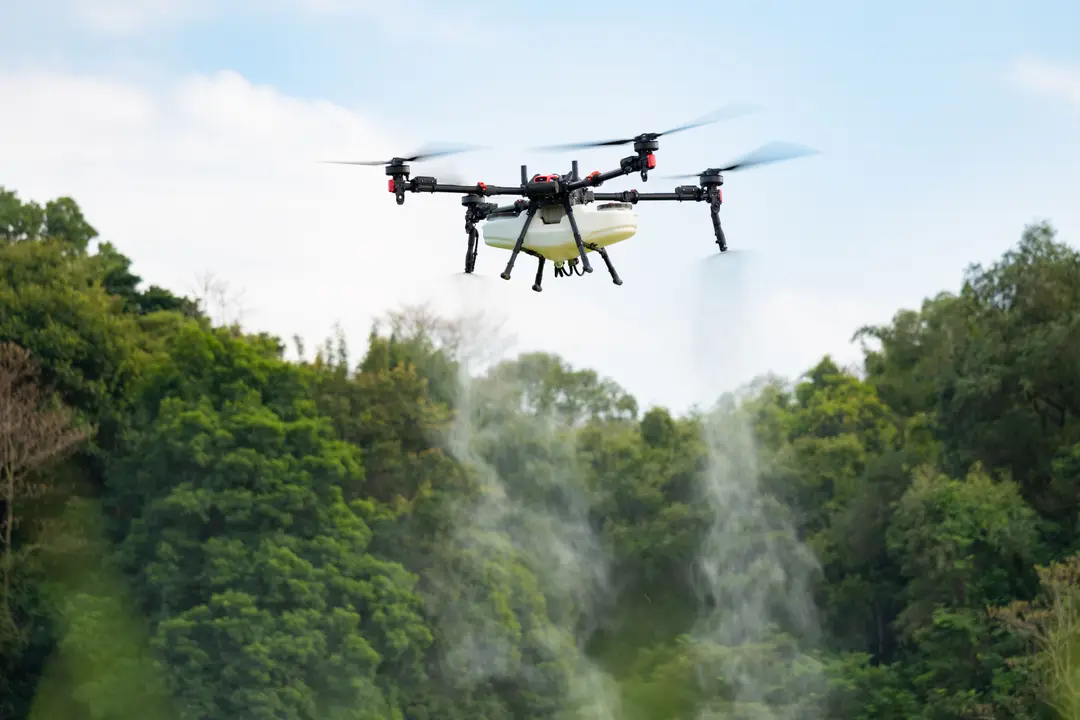
XAG, the world’s second-largest maker of agricultural drones by market share, has updated its prospectus for a listing in Hong Kong, with Huatai International acting as sole sponsor. If successful, it will mark the bourse’s first pure-play agricultural drone stock.
Founded in 2007, XAG is among the oldest players in China’s drone sector and widely regarded as DJI’s most credible rival in agriculture. Its founder, Peng Bin, is often portrayed as one of the few entrepreneurs capable of competing head-on with DJI’s Wang Tao. The parallels between the two are frequently noted: both were born in the 1980s, both were aviation enthusiasts from an early age, and they launched their ventures within a year of each other — DJI in 2006, XAG shortly after.
Their paths diverged in important ways. Wang benefited early on from the mentorship of Li Zexiang, often dubbed the “godfather of drones”, helping him assemble a world-class team and build formidable intellectual-property defences. DJI now holds more than 38,000 patents, nearly 60% of them inventions, forming a barrier few rivals have been able to breach.
The future is in agriculture
Peng’s trajectory was less conventional. After three years at Microsoft, where he was recognised as a “most valuable expert,” he left to found XAG’s predecessor, XAircraft, selling flight-control systems — the “pilot” of a drone. For six years he stayed focused on components, while DJI surged ahead, backed by early investment from Sequoia China.
A turning point came in 2013, when a trip to Xinjiang convinced Peng that the most practical application for drones lay in agriculture. He pivoted the company toward farming, rebranding it as XAG. Capital soon followed. The firm has gone through more than eight rounds of funding, drawing heavyweight backers including Hillhouse Capital and Masayoshi Son’s SoftBank Vision Fund.
Between 2015 and 2020, the company expanded rapidly from manufacturing drones to offering a broader agricultural technology ecosystem. By 2017, its drones had treated roughly 670,000 hectares of farmland, serving over 100,000 farmers. It subsequently introduced agricultural unmanned vehicles, autopilot systems for farm machinery and digital farm-management platforms.
Then DJI entered the fray. Having initially dominated consumer drones — where its global market share is estimated at 70–80% — DJI turned its attention to agriculture, deploying aggressive product upgrades and pricing strategies. The effect was swift. According to industry data, XAG’s share of China’s agricultural drone market fell from 37.6% in 2020 to 20.8% in 2024, while DJI’s share surged to 64%. Globally, it holds 17.1%, compared with DJI’s 59%.
Will it be third time lucky?
Such figures underscore the challenges facing drone companies seeking IPOs. Unlike other emerging technology sectors such as humanoid robotics, where multiple firms compete for investor attention, drones remain overwhelmingly defined by DJI’s dominance. For bankers and investors, this complicates valuation: identifying credible peers, assessing market size and forecasting growth all become more difficult.
XAG is not alone in its struggle. Another Chinese drone maker, Autel Robotics, has also embarked on the IPO process and completed its IPO preparation filing in December 2025. But the company, which once ranked second globally in small civilian drones, has yet to submit a prospectus.
XAG’s latest financials show improvement, but the disparity with DJI is stark. The company reported revenue rose 9.4% in 2025 to 1.17 billion yuan ($170 million) while net profit jumped 75.9% to 124 million yuan. DJI’s net profit was estimated at 13 billion–14 billion yuan for the same period.
An IPO is now a necessity for XAG from the perspective of its investors — after more than eight rounds of financing, its backers need an exit to bank their profits. For the company itself, the rationale for an IPO is different — it wants to raise funds to accelerate its global expansion, consolidate its technological barriers, and leverage capital to complete its strategic transformation from an agricultural drone manufacturer to a provider of comprehensive smart agriculture solutions. But whether the third time will be the charm remains to be seen.
Source:
investorscn