
By Brent Li
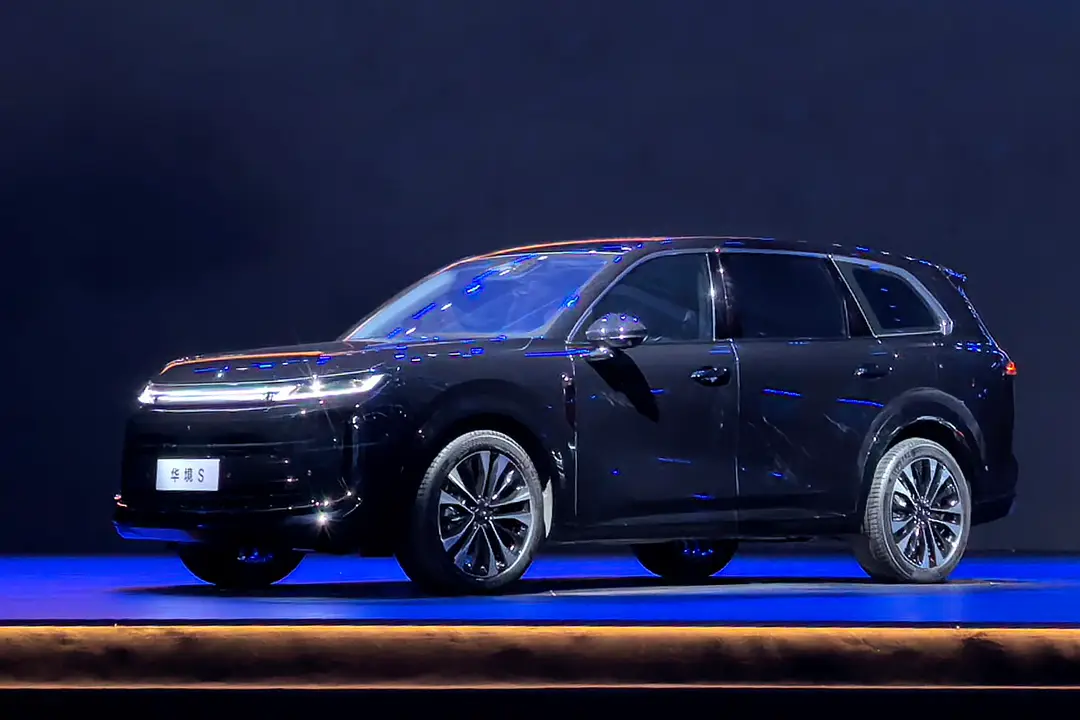
Tech giant Huawei and SAIC-GM-Wuling — a joint venture between General Motors and two Chinese automakers — launched their first collaboratively developed plug-in hybrid electric vehicle, the Huajing S SUV, on April 7.
The large, six-seater SUV is packed with Huawei’s advanced autonomous driving and smart cockpit systems. With an expected starting price of around 200,000 yuan ($30,000), the vehicle is a competitive offering that pairs a telecommunications powerhouse with a budget-car king looking to push into a more premium segment.
According to Caijing Tianxia, the two companies are executing a deep collaboration model. SAIC-GM-Wuling is in charge of product specification and vehicle manufacturing, while Huawei provides the core technology for assisted driving, smart cabins, and intelligent manufacturing.
The rise of a ‘national divine car’
The name SAIC-GM-Wuling may not be familiar to those outside China, but the joint venture has dominated the country’s roads for years. Headquartered in Guangxi — a southwestern province renowned for its stunning scenery and food rather than industrial prowess — the company released the Wuling Hong Guang microvan in 2010.
The van became a massive hit in the Chinese auto market, mainly due to its low cost, and quickly earned the nickname of “national divine car.” Viral videos of 20 people squeezing into a single van or the vehicle tackling complicated routes like a real racing car drew a mammoth online following. Having personally taken a Wuling microvan on a six-day trip, I can attest that while it didn’t inspire much confidence in terms of safety, its ability to navigate all kinds of rugged terrain without breaking a sweat was undeniably impressive.
Goodwood Road and Racing, a British website for motor sports and car culture, described the Wuling Hong Guang as the world’s best-selling car you’ve never heard of. In 2017, General Motors sold 8.9 million vehicles globally — trailing Volkswagen at 10.7 million and Toyota at 10.4 million — and roughly 500 thousand of those sales came from the Wuling Hong Guang model. Up until 2024, Wuling Hong Guang achieved a total all-time sales volume of 6 million units.
Since 2017, however, GM’s global sales have been steadily sliding on a global level as well as in China. Yet, the Wuling miracle persisted with the launch of the Hong Guang Mini EV, priced from just 30,000 yuan ($5,000). Some 436,000 units were sold in 2025, making it the second-best-selling EV in China that year. Its sales volume might have been even higher if major markets like Shanghai had not imposed tight restrictions on the sale of EVs under 4.6 meters in length or priced under 100,000 yuan.
Huawei’s tech powers an upscale push
Despite Wuling’s massive sales volume, its primary brand recognition remains firmly rooted in the low-end segment. Convincing consumers to pay $30,000 for a Wuling-made vehicle is a significant psychological hurdle. By launching the new Huajing S, the company aims to elevate its image through the tie-up with Huawei and its advanced technology.
The Huajing S comes equipped with Huawei’s latest autonomous driving system, a smart cockpit, and the Limera in-cabin laser vision system. Limera merges a camera with Lidar — a sensor technology that uses pulsed lasers to measure distances and map a three-dimensional model of the environment. According to Huawei, this system seamlessly fuses laser and camera data to precisely detect obstacles as small as 14 centimeters from 120 meters away, undisturbed by harsh lighting or extreme darkness.
Huawei has quickly become a leading force in China’s automotive supply chain. While it does not have its own EV brand, its technology powered roughly 5.5% of all passenger EVs sold in the country in 2025. In the premium segment, where prices start at over 350,000 yuan, Huawei dominates. According to statistics from the automotive site Yiche.com, the top three best-selling EV models in that price range — the Aito M7, M8 and M9 — are all backed by Huawei technology. The only international brand left in that top-tier list is the Buick GL8 Hybrid, produced by SAIC-GM.
Riding on the back of an EV boom
This new collaboration arrives against the backdrop of a booming Chinese EV sector that is increasingly capturing global market share.
While very few Chinese EVs are exported to the U.S. because of various restrictions imposed by Washington, they are aggressively gaining ground elsewhere. Chinese brands took more than 21% of the EV market in Europe during the first quarter of 2026, with BYD reaching the top five list of brands.
As consumers around the world increasingly turn to electric vehicles, the partnership could be a strategic win for both companies. SAIC-GM-Wuling has a strong brand its efforts to break into the premium segment could open an even bigger market for Huawei, while the tech giant sees significant potential in the lower-end of the market.
Sources: