

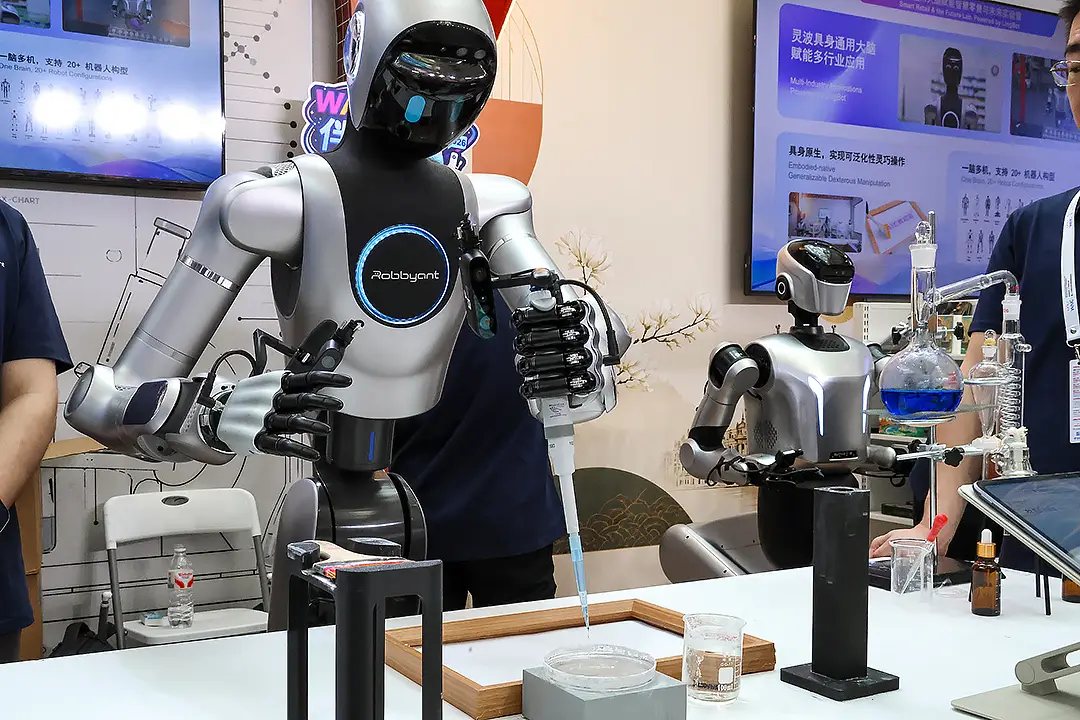
As the industry moves beyond flashy stunts, more than 200 companies at WAIC 2026 showcased diverse robots designed for real-world tasks.
By Da Cheung
China’s artificial intelligence sector is rapidly pivoting from digital generative AI — such as chatbots and image generators — to physical AI, signaling a new era where AI systems perceive environments and carry out real-world tasks traditionally done by humans.
At the 2026 World AI Conference (WAIC) in Shanghai, the shift was stark. More than 200 robotics companies showcased machines designed for practical work rather than wowing audiences with flashy stunts, like backflips and dancing. The industry is moving past the novelty phase, focusing instead on how robots can integrate into warehouses, factories, and homes and automate complex tasks.
However, as AI steps out of the digital realm and into the physical world, developers are encountering a new set of steep challenges: adapting software to work across countless different robot designs; building predictive ‘brains’ that can anticipate real-world physics and human behavior; and overcoming a severe lack of real-world training data — human movement and experience can’t just be downloaded from the internet to train robots.
Beyond humanoids
The industry is also moving away from its singular obsession with humanoid robots for the consumer market. While humanoids that walk on two legs remain popular, developers are diversifying into wheeled, four-legged, and hybrid forms tailored for specific industrial and commercial environments to ensure stability and cost-effectiveness.
At this year’s WAIC, AgiBot, also known as Zhiyuan Robotics, showcased wheeled robots designed for 24-hour continuous heavy lifting in warehouses, directly targeting the labor gap, such as worker shortages, in the logistics sector. Unitree Robotics, which is preparing for an IPO on Shanghai’s STAR Market, displayed a rideable, transforming mech — a large pilot-operated machine — priced at 3.9 million yuan ($536,000), and Songyan Dynamics introduced a humanoid less then 1 meter tall priced at just 9,998 yuan to make robots more affordable for consumers.
This diversification marks the dawn of a new era where robots will encompass a wide variety of form factors tailored to specific uses, rather than a one-size-fits-all humanoid approach.
The brain debate: VLA vs. world models
As robots take on more complex tasks, experts highlight a critical bottleneck: the cost of failure. Unlike generative AI, which can simply regenerate a flawed text or image with no real-world harm, physical robots must bear the irreversible consequences of their errors.
Gu Jie, CEO of Shanghai-based robotics company Fourier Intelligence, told Tencent Technology that a robot assisting an elderly person or handling fragile objects must “bear the consequences” of every movement, demanding a much higher threshold for reliability.
This reality has sparked a major technical debate regarding robot “brains,” pitting vision-language-action (VLA) models against world models. VLA models operate on direct task execution — mapping what the robot sees and hears directly to a physical action. However, these models often struggle when placed in unfamiliar environments.
World models, by contrast, allow robots to simulate and predict the physical outcomes of an action before executing it. Nobel laureate Thomas Sargent framed the debate vividly by comparing VLA models to Johannes Kepler’s descriptive astronomy — Kepler could precisely chart where planets traveled, but he didn’t know why. World models, Sargent argues, are more like Isaac Newton’s laws of motion: they get at the underlying mechanics. The takeaway, he says, is that AI must stop merely matching patterns in past data and start truly grasping physical cause and effect.
While some frame this as a competing choice, others view the two as complementary, blending VLA for direct execution with world models for predictive reasoning.
The data bottleneck and real-world deployment
To understand the physical world, these models need data. High-quality, real-world physical data has become the industry’s most critical bottleneck. You cannot simply scrape the internet for the tactile sensation of gripping a paper cup.
This shortage has sparked a new competitive sub-industry focused on specialized data collection hardware. Tech and ecommerce giant JD.com has taken a video-first approach. It has open-sourced EgoLive, a dataset containing 2,000 hours of first-person video capturing humans performing 346 real-world tasks. Recorded via proprietary wearable cameras, the data aims to teach robots spatial structures and task semantics without requiring expensive robots to physically perform the initial data gathering.
Other companies are incorporating tactile feedback into the data collection process. ACE Robotics, a startup backed by fintech behemoth Ant Group, announced a suite of data collection tools and wearables, including tactile gloves that the company claims can sense force changes as slight as 0.01 Newtons. The company also heavily promoted its new “Kairos 3.1” world model and its W1 robot, designed to navigate narrow 75-centimeter warehouse aisles to collect goods for instant-order fulfillment.
To build a comprehensive data pipeline, ACE Robotics introduced its “environment-style” data collection solution 2.0. This includes the ACE Ego Kit, a lightweight, wireless wearable system for the head, chest, and hands, which integrates the highly sensitive ACE Sense Glove with multiple cameras. The company also launched the ACE Data Engine, an automated platform featuring a generative 4D hand motion capture paradigm to process complex movements, and the ACE Ego Matrix, an open-source foundation designed to standardize data across different robot models. As JD.com has done, ACE Robotics open-sourced its “ACE-Data-0” dataset for complex household tasks — a strategy that echoes how Chinese large language model developers have used open-source models to rapidly capture market share.
While the controlled demonstrations showcased at the WAIC appeared flawless, industry leaders warn that true commercial deployment is still a distant prospect. Tao Dacheng, chief scientist at ACE Robotics, noted that the true measure of a robot is not its peak performance in a demo, but its reliability in its worst-case scenarios.
Before robots, or physical AI, can become a viable workforce either by replacing or working alongside humans in the real world, the industry still has significant hurdles to overcome: reducing mistakes in rare or unexpected situations, known as edge cases, and cutting the delays that happen when robots rely on cloud-based processing, known as latency. Ultimately the industry has to prove that these machines can not only perform, but work safely and consistently in the messy, unpredictable real world.
Feature photo: Robbyant’s robot performs a medical test at 2026 WAIC, by CFP.
Sources