

By Da Cheung
China National Offshore Oil Corporation this month started construction on the Dongfang 1-1 gas field carbon capture, utilization, and storage project in the South China Sea. The facility, heralded as China’s first offshore carbon-injection and gas-boosting demonstration project, is designed to capture and inject over 1 million tons of carbon dioxide annually into the seabed to enhance natural gas recovery. According to the company, this setup moves the carbon separation process directly onto offshore platforms, enabling “source reduction.”
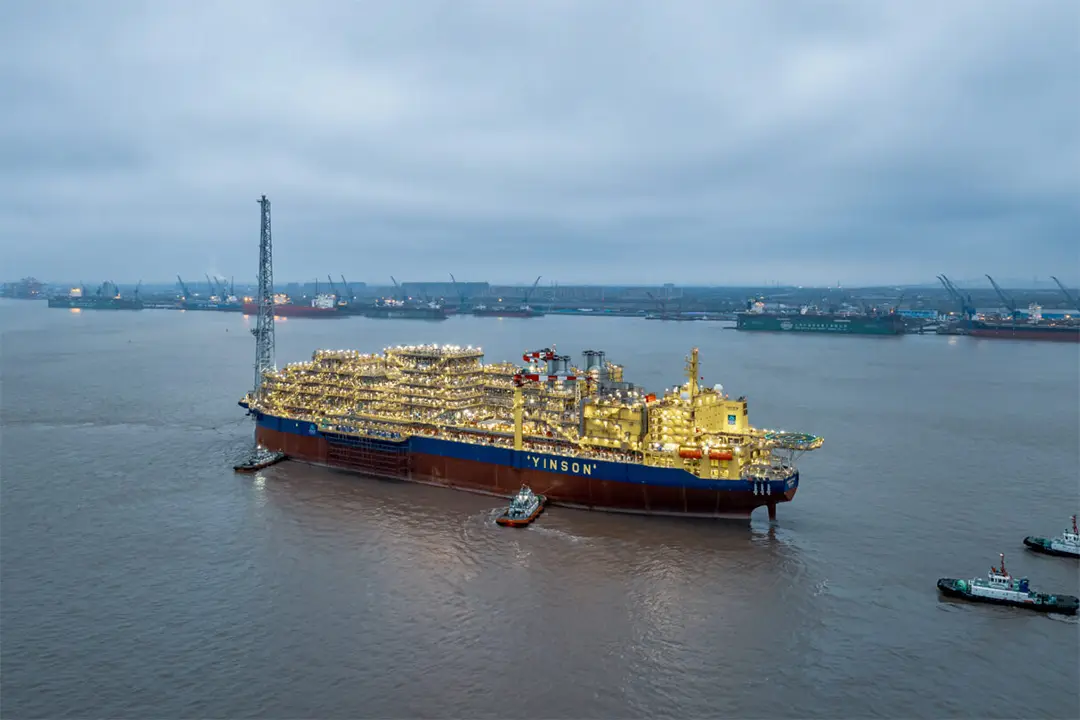
This domestic initiative coincides with another maritime milestone rooted in Chinese manufacturing. On April 2, Azule Energy announced the official operation of the world’s first offshore post-combustion carbon capture system aboard the Agogo FPSO. Converted from a traditional crude carrier at a COSCO Shipping Heavy Industry shipyard in Shanghai, the massive floating production, storage, and offloading vessel was deployed in 2025 off the coast of Angola. Designed to trap 230,000 tons of carbon dioxide annually, the vessel’s successful operation validates the feasibility of offshore carbon capture under extreme operational conditions, according to the shipbuilder.
These developments reflect a broader, more aggressive phase in China’s national push for carbon neutrality — a transition increasingly fueled by domestic policy changes and an expanding carbon trading market.
Scaling up the cap-and-trade market
While engineering projects remove carbon directly, the regulatory engine driving China’s industrial decarbonization is its newly broadened carbon market. Initially launched in 2021 covering only the power generation sector, the market underwent a massive expansion this month when regulators officially integrated the steel, cement, and aluminum smelting industries into the system. This brings the total number of regulated companies to 3,378, up from roughly 2,000 power operators. The market now covers approximately 8 billion tons of greenhouse gas emissions — representing more than 60% of the country’s total — cementing its status as the world’s largest emissions trading scheme.
The scheme operates on a cap-and-trade model. For 2025, Chinese firms in the newly added sectors were given emission quotas that matched their actual output to ensure a smooth transition. However, the market has shifted to a tighter, industry-wide break-even model for 2026. Less efficient producers will be forced to purchase additional quotas from greener competitors, placing a hard financial cost on pollution.
A smarter approach to regulation
Driving the market expansion is a crucial shift in government policy: the transition from “energy dual control” to a more targeted “carbon dual control” framework.
This represents a fundamental change in how Beijing manages economic growth and environmental protection. Under the older “energy dual control” system, the government strictly capped two things: the total amount of energy a region could consume, and its energy intensity — the amount of energy used per unit of economic output. While well-intentioned, this broad approach inadvertently penalized factories for using electricity, even if that power came from clean, renewable sources like wind or solar.
The new “carbon dual control” system fixes this flaw. Regulators now exclusively cap the total volume and intensity of carbon emissions, rather than energy usage itself, which means businesses can consume as much electricity as they need to expand, provided they source it from green energy.
This regulatory pivot resonates with Beijing’s massive, years-long investment in clean energy infrastructure. Without the country’s world-leading build-out of solar, wind, and hydropower, these stringent new emission controls would be practically impossible for heavy industries to comply with without stalling economic growth.
Financial incentives and global pressures
The financial implications for heavy industries are substantial. The carbon market’s annual quota volume translates to an estimated market size of over 500 billion yuan ($69.4 billion). The price of carbon has also fluctuated, averaging 62.36 yuan per ton in 2025, down from 97.49 yuan at the end of 2024, largely due to rules preventing power companies from hoarding excess quotas.
Consequently, carbon assets are becoming a core business consideration. China National Building Material Group, a leading state-owned cement producer, purchased 100,000 tons of quotas late last year to hedge against future shortages.
“The carbon market uses long-term carbon price expectations to guide investments into green and low-carbon industries,” Chai Qimin, an official at the National Center for Climate Change Strategy and International Cooperation, said in an interview with Net Zero Age. Chai noted that the market effectively turns low-carbon transitions into a competitive advantage by financially rewarding green efficiency.
International trade pressure is also accelerating this shift. In January, the European Union began fully enforcing its Carbon Border Adjustment Mechanism (CBAM) — essentially a border tax on the carbon emitted during the production of imported goods. This tariff directly impacts Chinese exporters of steel, aluminum, and cement, compelling them to lower their carbon footprints to remain globally competitive.
Between shifting domestic policies, a booming carbon market, and international trade pressures, China’s emission reduction efforts are maturing from conceptual targets into operational realities. As the national market prepares to welcome the chemical and aviation sectors by 2027, the cost of pollution — and the financial rewards of sustainability — will only become more pronounced.
Sources: