

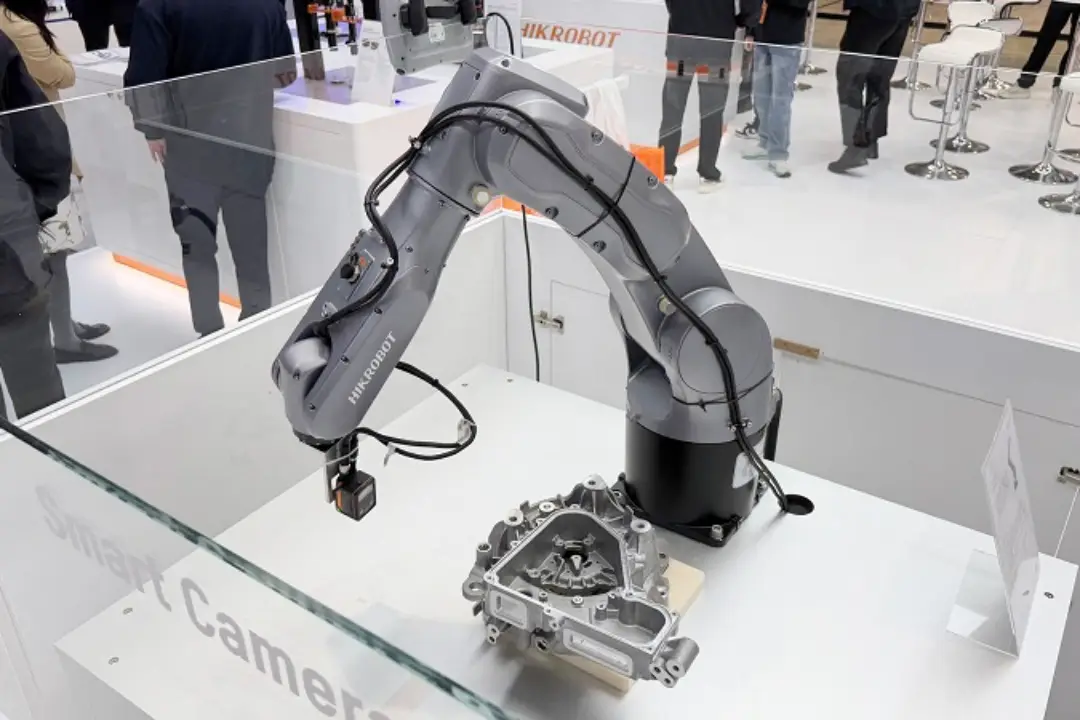
Hikrobot has completed its shareholding restructuring and begun the listing preparation process, reviving plans for a spin-off that has faced repeated regulatory delays.
By Du Chen
The robotics business of Hangzhou Hikvision Digital Technology (002415.SZ) (Hikvision) is moving closer to an independent listing after more than three years of regulatory delays, bringing a new chapter to the wealth-creation story behind the Chinese surveillance giant’s founders and early backers.
Hikrobot, one of Hikvision’s major incubated businesses, has completed its conversion into a joint-stock company and registered for IPO guidance, according to a recent disclosure by its parent on an investor interaction platform.
The development marks a fresh attempt to take the company public after its original application, filed in March 2023, to list on the Shenzhen ChiNext board was suspended seven times. The proposed IPO originally aimed to raise 6 billion yuan ($900 million).
The move also puts the spotlight back on the investors and entrepreneurs behind Hikvision, particularly early backer Gong Hongjia, whose 2.45 million yuan investment for a 49% stake in the company helped create one of China’s most extraordinary venture-capital returns.
From 28 engineers to a surveillance giant
Hikvision was founded in Hangzhou in 2001 by Chen Zongnian and Hu Yangzhong, who left the China Electronics Technology Group Corporation’s 52nd Research Institute with a team of 28 engineers.
At the time, China’s video-surveillance industry was dominated by foreign brands and low-end components. The founders had technical expertise in video-compression technology but lacked the capital and commercial experience to build a business. Gong, a university classmate, provided the crucial funding, investing 2.45 million yuan for a 49% stake.
Hikvision eventually became the world’s largest video-surveillance equipment supplier, with its market capitalization once exceeding 600 billion yuan. Its shares peaked at 69.54 yuan in July 2021 before undergoing a prolonged correction.
Despite recent changes in institutional shareholdings, its operating performance has remained strong. In the first nine months of 2026, revenue increased 12.6% year on year to 74 billion yuan, while net profit attributable to shareholders rose 38.6% to 12.9 billion yuan. Its market capitalization remains above 300 billion yuan.
That established business provided the financial and technological foundation for Hikvision’s expansion into robotics.
A new growth engine in industrial automation
In 2014, as the growth potential of conventional video surveillance began to show signs of reaching its limits, Hikvision established a machine-vision business unit. The company saw opportunities to apply its expertise in imaging technology and artificial intelligence to industrial automation, a market then dominated by Japanese and U.S. suppliers including Keyence and Cognex.
Hikrobot was formally registered as an independent operating entity in 2016, becoming one of Hikvision’s eight major innovation businesses. Rather than pursuing the more speculative humanoid-robot market, it concentrated on industrial machine vision and mobile robots for factories and warehouses.
By April 2026, the company had served more than 20,000 customers across more than 1,000 application scenarios, spanning automotive components, consumer electronics, solar power, lithium batteries, food and pharmaceuticals. In July, cumulative production of its mobile robots passed 200,000 units, following the rollout of a new forklift-style model.
The business has also reached substantial scale. In the first half of 2026, it generated revenue of 4.028 billion yuan. Yet its path to the stock market has been considerably less straightforward than its commercial expansion.
Hikvision’s board approved preparations for a domestic spin-off in December 2021, following the successful listing of another subsidiary, Ezviz (688475.SH), on Shanghai’s STAR Market.
The Shenzhen Stock Exchange accepted Hikrobot’s ChiNext application in March 2023, with the company seeking to raise 6 billion yuan. But the review process repeatedly stalled.
Its application was suspended in June 2023 and again in March and September 2024, March and September 2025, and March and September 2026. The latest suspension, in September, was triggered by the expiry of its financial reporting documents.
The repeated interruptions reflected two challenges. First, regulators were scrutinizing the independence of companies seeking to spin off from listed parents, particularly whether their operations were genuinely separate. Hikrobot transferred its drone business, whose boundaries with the parent were considered unclear, back to Hikvision for 86.7 million yuan. It also worked to reduce the proportion of related-party transactions.
Second, investors had become more demanding about the economics of the robotics industry. Rather than rewarding companies simply for entering a fashionable sector, the market was increasingly focused on margins, pricing pressure, manufacturing investment cycles and operating cash flow.
Gong Hongjia: the investor behind the empire
Gong Hongjia, who stepped down as Hikvision vice chairman but remains its second-largest shareholder with a 10.5% stake, is the figure most closely tied to the company’s capital history. China Electronics Technology Group controls Hikvision through China Electronics Hikvision and other entities and indirectly holds 60% of Hikvision Robot; employee holding platform Qinghe Investment holds the remaining 40%.
Gong’s 2.45 million yuan investment returned nearly 70 billion yuan including shares sold over more than a decade, a return of over 28,000 times. He has also invested in semiconductor, biotech and smart hardware companies including Fortune Micro, United Optics, Zhongyuan Union, VeriSilicon and Yingshi Network, and through vehicles such as Shenzhen Jiadao Capital has become a major backer of HSG (formerly known as Sequoia China), IDG Capital and Hillhouse Capital.
Hikrobot’s latest restructuring and IPO guidance registration bring it a step closer to an independent listing, but do not guarantee regulatory approval or a successful flotation. After years of delays, the company still needs to demonstrate that its business can deliver sustainable growth and profitability in an increasingly competitive robotics market.
Source:
investorscn.com
