

By Pu Fan, Cao Weiyu
The robotics industry has received another massive injection of capital. Shenzhen D-Robotics has officially closed a $120 million Series B1 funding round. Combined with its $100 million Series A round in 2025, the company has raised a total of $220 million.
This round was structured as a club deal, featuring over 15 high-profile investors divided into two camps: industrial capital including Synstellation Capital, Didi Global, Meituan’s venture capital arm Dragonball Capital, and BAIC Capital; financial invstors led by Jinqiu Capital and Xingrui Capital, with “super-pro rata” follow-on investments from existing giants like Hillhouse Venture Capital, Temasek’s Vertex Growth Fund, and 5Y Capital.
From automotive to autonomy: the Horizon spinoff
D-Robotics originated as the Artificial Intelligence of Things (AIoT) department of Horizon Robotics. The decision to spin off into an independent entity in 2024 was driven by the emergence of generative AI in 2023, which reshaped thinking about robotics intelligence and real-world deployment. By spinning off, D-Robotics could reuse Horizon’s deep technical reserves while focusing exclusively on the burgeoning embodied AI market.
The ‘shovel seller’ strategy
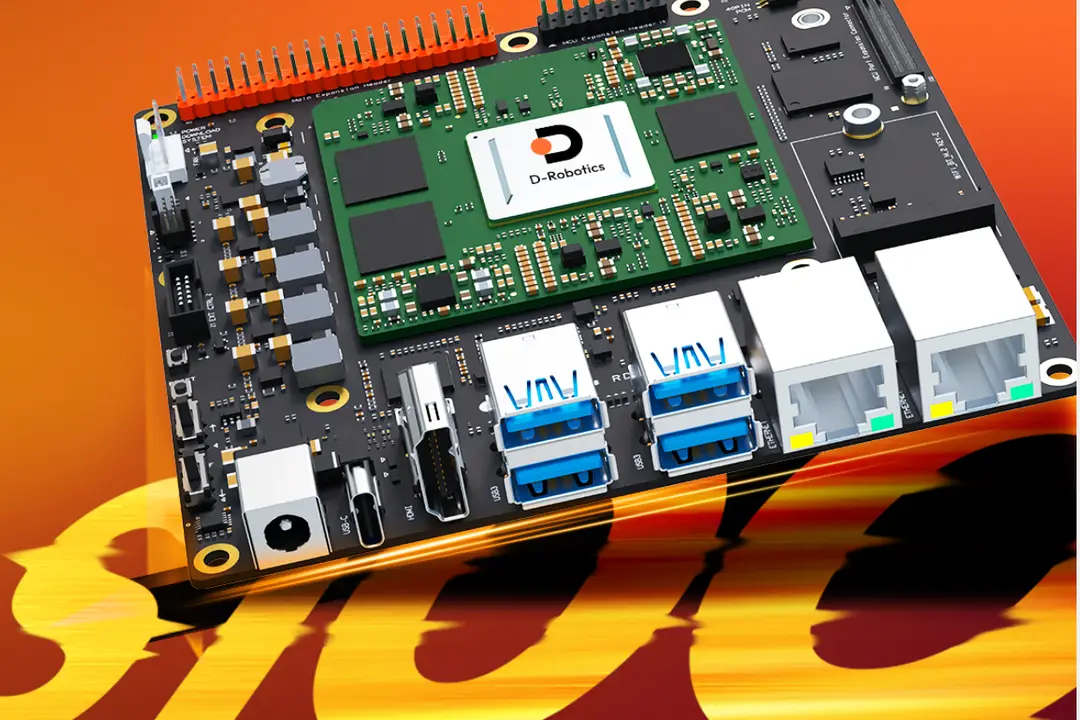
Unlike many high-profile startups building actual humanoid robots, D-Robotics positions itself as a provider of the underlying software and hardware “platform” for robotics. In simple terms, it does not primarily build robot bodies itself. Instead it supplies the tools needed for development, manufacturing and deployment, spanning chips, algorithms and software platforms.
Its technology can be used across a wide range of robot types including humanoids and quadruped robot dogs, wheeled-leg robots, service and companionship robots, and logistics autonomous mobile robots.
CEO Wang Cong describes D-Robotics’ positioning as the “greatest common denominator” for robot deployment in real-world scenarios. The strategy echoes the approach of Horizon Robotics: competing by establishing a position in an overlooked but critical layer of the ecosystem. At a time when embodied AI technologies are proliferating but industry standards have yet to converge, D-Robotics occupies a scarce and strategically important position in the robotics value chain — one reason it has attracted such strong investor interest.
Why investors are doubling down
The investment frenzy in embodied AI is not just a bubble; it is the physical extension of the LLM boom. In 2025 alone, the sector saw over 310 funding rounds, with more than 100 rounds exceeding 100 million yuan each.
However, the sector still lacks a fully developed supply chain. Many robotics companies must build basic infrastructure themselves — adapting chips, optimising operators, debugging drivers and developing system-level software — effectively reinventing the wheel and slowing industry progress. This is precisely the gap D-Robotics aims to fill and investors are drawn to the company for three core technical reasons.
First, specialized architecture: Its chips use the brain processing unit (BPU) architecture. Unlike general GPUs, BPUs are optimized specifically for edge AI inference. They offer advantages in power efficiency, latency and computing utilisation in robotics scenarios such as real-time perception and control.
Second, a complete software toolchain: Horizon spent a decade building a full-stack development platform around its chips including AI tools, simulation environments and operating system adaptation layers. D-Robotics has inherited this and is now extending these capabilities to robotics developers through its platform.
Third, mass production experience: Horizon has already shipped over 10 million chips in automotive applications, giving the technology proven reliability and supply-chain maturity — advantages that many robotics chip start-ups lack.
Outlook: the Amazon Web Services of robotics
The embodied AI era is currently bottlenecked by a fragmented supply chain. Most companies waste 80% of their R&D just getting their software to talk to their hardware.
D-Robotics’ mission is to become the Amazon Web Services of robotics. “In the future, every scenario will have different robot categories, and there will be thousands of robot companies,” Wang said in a 2025 interview. “Such an ecosystem will require a shared underlying infrastructure to grow. We don’t make the body; we serve everyone who does.”
Source:
ChinaVenture News