
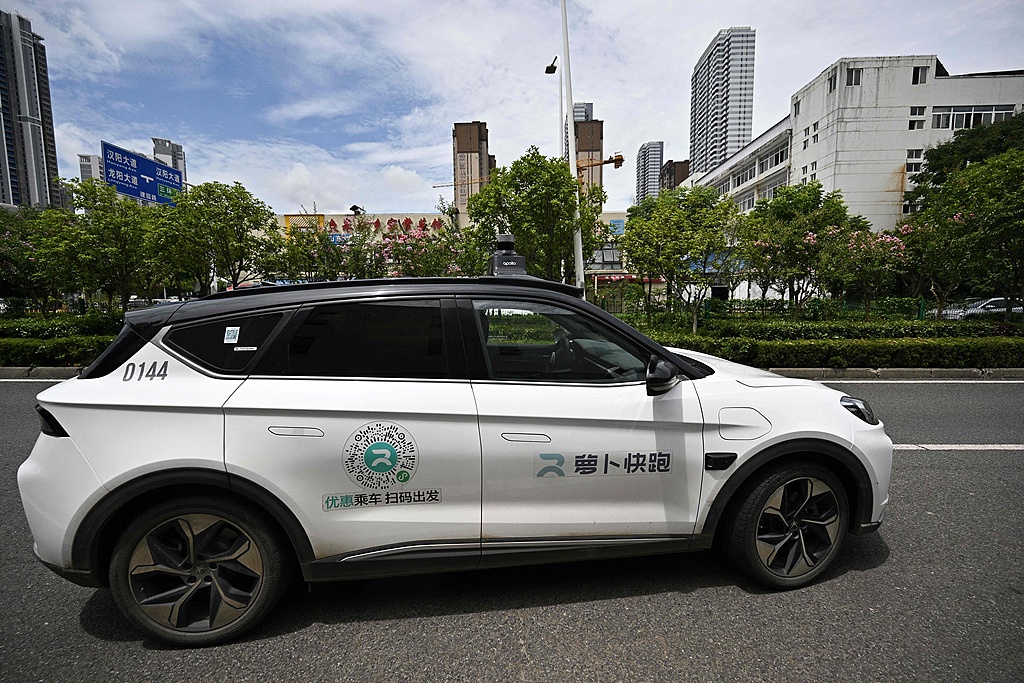
China’s robotaxi ambitions were jolted into sharp relief on the evening of March 31, when a large-scale system failure involving Baidu’s Apollo Go fleet brought parts of Wuhan to a standstill, raising fresh questions about the reliability of autonomous driving systems.
During the city’s evening rush hour, close to 100 of Baidu’s autonomous taxis simultaneously lost functionality across multiple locations. Vehicles came to an abrupt halt in live traffic lanes, hazard lights flashing as onboard screens displayed a uniform message: “Driving system abnormality.” What might have resembled a scene from a disaster film instead unfolded in real time, disrupting traffic and exposing vulnerabilities in one of China’s most high-profile autonomous driving programmes.
Traffic gridlock amid system failures
Unlike previous isolated glitches, this was a regional, synchronised failure with no prior warning. Major arteries of the city quickly descended into gridlock, with some stretches paralysed across multiple lanes. Crucially, when control was lost, the vehicles did not execute standard safety fallback procedures but instead became immediately immobile — arguably the most dangerous outcome in fast-moving traffic.
The incident highlights a structural weakness in so-called Level 4 autonomous systems, which are designed to operate without human intervention under defined conditions. In practice, however, many rely heavily on cloud-based coordination and real-time data links. When these connections fail, the system can enter a state of near-total paralysis, revealing the absence of sufficiently robust local decision-making capabilities.
For passengers, the consequences were immediate and distressing. One stranded rider reportedly waited nearly two hours before being rescued. In-car emergency call functions proved ineffective, customer service lines were repeatedly disconnected, and the company’s promise of assistance within five minutes went unmet. Ultimately, it was traffic police on the ground who untangled the mess.
From model city to nightmare
Wuhan has been central to Baidu’s autonomous driving strategy since 2022, serving as both a testing ground and a showcase for commercial viability. By late 2024, the company claimed to have achieved per-vehicle break-even, presenting the city as a model for scalable deployment and a cornerstone of what it described as China’s most advanced autonomous driving business model.
Yet this flagship market that has now exposed systemic fragilities. Beneath repeated claims of technological maturity lie unresolved challenges in data redundancy, disaster recovery and human support infrastructure. More troubling for observers has been Baidu’s limited disclosure: the company attributed the disruption to a “network failure” but has yet to publish a detailed technical analysis, a response that risks eroding confidence in its broader narrative of technological leadership.
The timing is awkward. Just a day before the incident, Baidu had announced the launch of a fully driverless commercial robotaxi service in Dubai, marking what it framed as a milestone in its international expansion. That moment, symbolised by a ceremonial first ride involving local royalty, was intended to signal the company’s transition from domestic pioneer to global contender.
A ‘safety first’ wake-up call
The mass disconnect in Wuhan could prompt a reassessment of autonomous driving. For investors, the issue extends beyond operational setbacks to the sustainability of the business model itself. A venture that claims profitability but cannot guarantee baseline stability risks having its growth narrative dismissed as premature.
The episode also underscores a broader industry lesson: Level 4 autonomy does not imply infallibility, but it does require a guaranteed minimum level of safety. Established best practice dictates that, in the event of network loss, vehicles should autonomously pull over, activate hazard signals and initiate alerts. That such a “minimum risk manoeuvre” appears to have been absent in this case is striking.
Ultimately, public trust in emerging technologies is built less on technical sophistication than on consistent, uneventful performance. A single alarming experience can outweigh years of incremental progress. Price incentives may attract users, but it is responsiveness in moments of crisis that determines whether they return.
The question now facing Baidu — and the wider autonomous driving sector — is whether it is prepared to carry the social responsibility that comes with the “driverless” label. The future of AI may not be measured by how far it can travel, but by its ability to stop safely and ensure that every passenger arrives with their dignity, and their safety, intact.
Source:
Stars of the Screen