
The Beijing-based company will use the funding to build a fleet of space robots and expand commercial in-orbit services, targeting a 16-satellite service constellation.
By Zhong Chen
Beijing space robotics company Guoyu Xingchen announced today that it has completed a Series A funding round of nearly 100 million yuan ($14 million), jointly invested by Yijing Capital, Fosun Chuangfu and Luyao Capital. The company said the proceeds will focus on building its space robot cluster and expanding commercial markets, accelerating the shift of China’s in-orbit services from technical verification to large-scale commercial delivery.
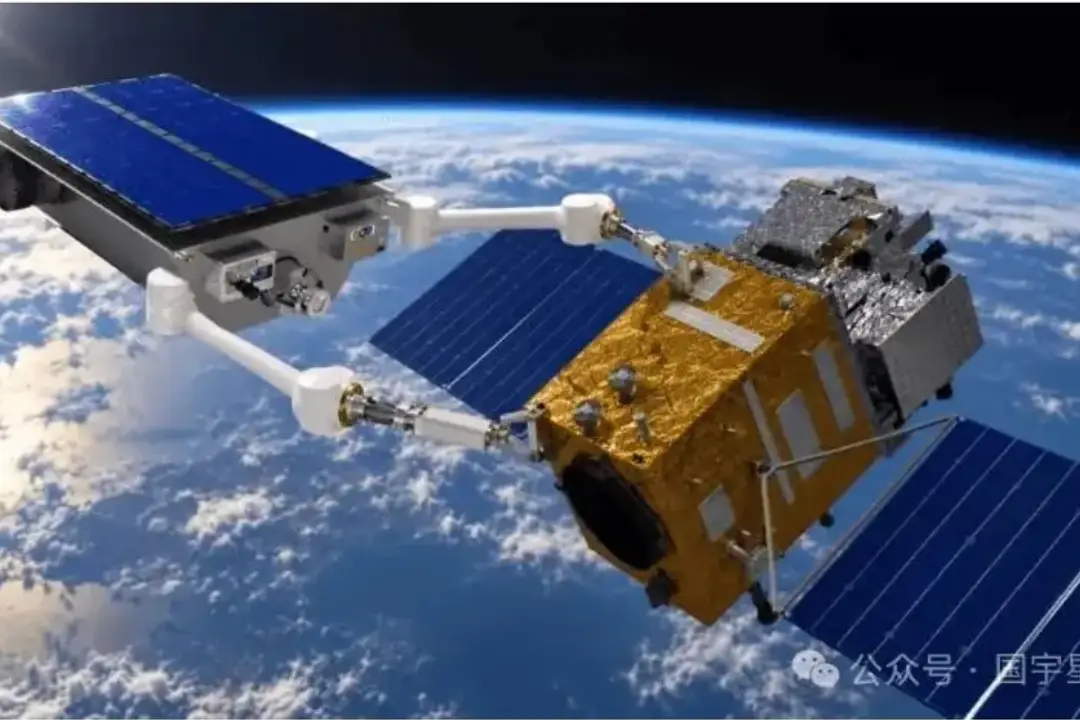
Founded in 2022, Guoyu Xingchen describes itself as China’s first in-orbit services provider with full-stack space robot development capabilities. Its goal is to build a space robot cluster — an in-orbit services constellation — that serves as orbiting operational infrastructure for the space economy.
The company’s products span four modules — “body,” “perception,” “brain” and “execution” — and it says it will progressively advance in-orbit services including assisted orbit insertion and deorbit, in-orbit refueling and maintenance, as well as in-orbit assembly, space manufacturing and deep-space development.
On May 21, 2025, the company’s self-developed Xingjiyuan-1 was successfully launched from the Jiuquan Satellite Launch Center, becoming China’s first space robot spacecraft to complete in-orbit mission verification. The robot has operated stably in orbit for more than 15 months, during which it carried out technical drills including combined-power orbital rendezvous maneuvers, non-cooperative target identification and space situational awareness.
Heritage and orders
Guoyu Xingchen says its core team is the first in China whose model experience spans both satellites and rockets. Team members have participated in multiple in-orbit service models and projects, including the Tiangong-2 accompanying satellite, the world’s first low-orbit double-star Space Da Vinci project (a Chinese in-orbit servicing and satellite maintenance initiative), a high-orbit satellite life-extension and takeover power package, and the “ICUBE-Q” satellite on the Chang’e-6 probe.
The company currently operates a research and development complex of more than 1,000 square meters, alongside a 1,500-square-meter assembly, integration and testing plant. It plans to subsequently build a service constellation of 16 space robots.
Guoyu Xingchen also disclosed that it has entered the qualified supplier lists of a national satellite internet constellation operator, China Aerospace Science and Technology Corp. (CASC) and State Grid. Contracts in hand total 100 million yuan, and the Xingjiyuan-2 space robot is expected to complete its in-orbit operation in early 2027.
Leadership
According to media reports, founder Zhang Long has more than 20 years of experience in aerospace research, engineering management and corporate management. He previously worked at CASC, participating in major national programs including crewed spaceflight, lunar exploration and Mars exploration, and served successively as a model chief designer and a group department head. From 2015 to 2021 he was president of LandSpace.
Wu Shufan is co-founder and chief scientist of Guoyu Xingchen, as well as a chair professor at Shanghai Jiao Tong University’s School of Aeronautics and Astronautics, an academician of the International Academy of Astronautics, and co-founder of LandSpace, satellite company MinoSpace and Guoyu Xingchen, and chairman of SJTU Qionglong.
Chief technology officer Rong Jiangang previously worked at the Chinese Academy of Sciences’ Innovation Academy for Microsatellites, where he took part in control system work for major programs including the Tiangong-2 accompanying satellite and the Space Da Vinci plan.
Source: Robotics Frontier