

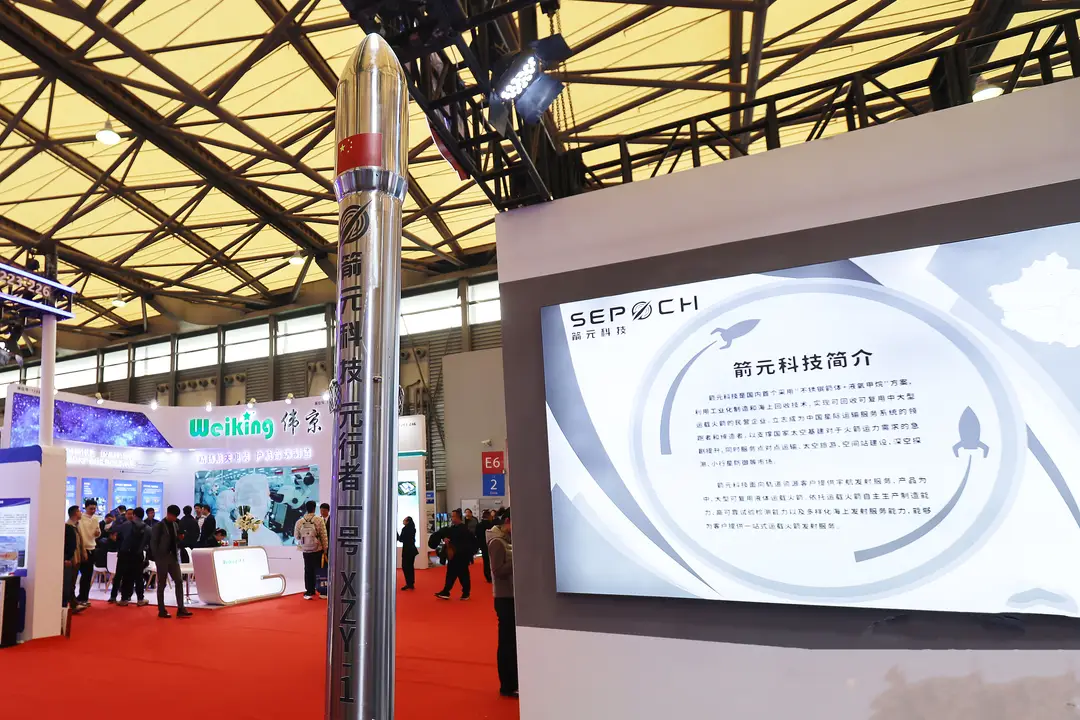
The Chinese commercial rocket maker is raising funds as it prepares its first orbital launch and recovery test.
Chinese commercial rocket maker Space Epoch has completed a B++ funding round, bringing its total fundraising over the past six months to more than 2.3 billion yuan ($340 million) as it accelerates development of reusable launch vehicles.
The company, whose Chinese name is Beijing Jianyuan Technology, claims to be the first in China to complete a sea-based flight recovery test of a stainless-steel rocket. It announced the latest funding on Sept. 16.
The B-series round was jointly led by IDG Capital, Chaos Investment, Hangzhou Capital and Songyuan Venture Capital. Other investors included Heda Investment, Linglan Capital, Huafu Capital, Yida Capital, Shangshi Capital and Renai Group, while existing shareholders including Jiuzhi Capital, Tianwen Times and Jinsha Capital also increased their investments.
The proceeds will mainly fund the first-flight preparations for the Yuanxingzhe-1 rocket, recovery and reuse testing, and the development of the company’s commercial delivery capabilities. Space Epoch will also continue research and engineering validation of its platform-based capture and recovery technology.
First launch targeted for 2026
The company says the first two Yuanxingzhe-1 rockets, designated Y1 and Y2, have now been fully assembled. They have completed more than 30 key ground tests ahead of the first flight, with all indicators meeting launch requirements.
Yuanxingzhe-1 is expected to be ready for its first flight by the end of 2026, when the company will also apply for a launch permit. The rocket will then make its first orbital launch when conditions are suitable, alongside an attempt to recover its first stage.
The first-flight vehicle uses the same structural and technical design as the rockets intended for subsequent commercial deliveries. The mission will therefore serve not only as a test of orbital launch and recovery capabilities, but also as a systems test for the commercial model.
After the first flight, Space Epoch plans to continue recovery and reuse testing before moving rapidly into serial production and commercial deliveries. It expects to begin commercial launch services during 2027.
From splashdown to ‘chopsticks’ recovery
Space Epoch has already conducted a recovery test under real flight conditions. In May 2025, it completed what it described as China’s first sea-based flight recovery test involving a stainless-steel rocket, validating key capabilities including engine relighting, return guidance and control, low-altitude deceleration and hovering, and sea recovery.
The company has since continued testing the reuse of core components including engines, building up data and engineering experience for Yuanxingzhe-1.
The rocket uses an all-stainless-steel body and liquid oxygen-methane propulsion. Rather than being fitted with landing legs, it has been designed from the outset for capture-based recovery.
Space Epoch says stainless steel can simplify manufacturing and support parallel production of multiple rockets, while methane burns relatively cleanly and is better suited to efficient engine reuse. Recovery is also critical to reducing launch costs: the first stage of a liquid-fuel rocket accounts for about 70% of the total vehicle cost, according to the company. Recovering and repeatedly reusing it therefore offers significant scope for lowering launch costs.
Capture-based recovery can further simplify the rocket’s structure and improve the efficiency of maintenance and reuse.
Globally, SpaceX’s Starship is currently the only reusable rocket system to have demonstrated the so-called “chopsticks” capture method, one of the hardest engineering feats in reusable rocketry. Space Epoch is taking a phased approach. Yuanxingzhe-1’s first flight will initially attempt sea splashdown recovery while continuing to validate precision guidance, deceleration and hovering before moving toward capture recovery.
Based on its publicly disclosed technical plans and engineering progress, Space Epoch says it could become one of the first commercial rocket companies in China to achieve chopsticks-style recovery. Among Chinese commercial rocket makers pursuing this approach, the company says it is the only one to have completed low-altitude deceleration and hovering tests under real flight conditions and to have entered the key preparations for its first orbital launch.
“Over the past four years, we have focused on tackling rocket industrial manufacturing and recovery technology,” said Wei Yi, Space Epoch’s founder and chairman. “The next challenges are recovery and reuse, and sustained commercial delivery. The next stage of the industry will be about who can continuously deliver payloads to space at low cost.”
The company ultimately aims to use reusable rockets and large-scale operations to create routine, airline-style space transportation, Wei said.
Source:
IPO Early Insights